Thursday, May 21, 2015

Bell Forest Field Trip

Acadian Forest Rich in Rare Plants

Purple Trillium Trillium erectum
Bell Forest Preserve is a 50-hectare conservation site owned by the Meduxnekeag River Authority.  It was purchased through public and private funding and preserves our best known surviving example of Acadian Forest habitat.  It contains many rare plants, some not found anywhere else in the province and some found nowhere else east of Quebec, including Maine.  It was my privilege to visit this site recently.  This posting showcases some of the plants we found.

Bloodroot Sanguinaria canadensis

Dutchman's-breeches Dicentra cucullaria
Bloodroot and Dutchman's-breeches are common in rich soils under hardwoods.  There were also many violets.  Pictured below is the Yellow Violet.  Its leaves and flowers grow from the same stem.

Smooth Yellow Violet Viola pubescens

American Dog Violet Viola conspera

Marsh Blue Violet Viola cucullata
The Marsh Blue Violet is our provincial flower and is also called the Purple Violet.  In the photo above it is spotted with water droplets. 

Wild Ginger Asarum canadense

Wild Ginger Asarum canadense
Wild Ginger is also found in Bell Forest, though only sparsely.  It has a heart-shaped leaf and its brownish-purple flower is on the ground.  It is pollenated by ants.  The root of this plant smells and tastes like ginger.  

Kidney-leaf Buttercup Ranunculus abortivus

Kidney-leaf Buttercup Ranunculus abortivus
This buttercup is fairly common in rich hardwoods where it prefers to grow under hardwood trees.  Its flower is inconspicuous.

Toothwort
There are many uncommon species of ferns growing in Bell Forest.  Christmas Fern is not rare but one of our interesting evergreen ferns.  In the photo below you can see the over-wintered fronds with new growth 'fiddleheads'.
Christmas Fern Polystichum acrostichoides
 Silvery Glade Fern is listed as 'locally common' in some rich sites.  However, it is not a fern we see very often.  It is just newly growing in the photo below.  In the adult plant the sori (fruiting bodies) are silver coloured and herringbone shaped.  They give the plant its silvery colour.

Silvery Glade Fern Deparia acrostichoides
Rich hardwood sites are a wonderful, diverse study area.  Their rich limestone soils provide nutrients for unique flora.  They are special sites which need to be treasured and preserved.


Saturday, May 16, 2015

Birds and Blooms

Field Trip Finds

Killdeer
A friend and I spent most of May 14 in the Fredericton area and in Maugerville and Sheffield looking for nature's spring abundance.  Pictured above is a welcome spring bird, the Killdeer.  It is a bird that says its own name and is a very welcome sound in spring.  It likes gravelly areas and is often seen close to roadsides.  It nests on gravelly areas and this bird was doing its broken-wing display to try to distract us from the area, probably indicating its nest was nearby.

Eastern Kingbird
This Eastern Kingbird was perched on a barren branch.  It was intent on catching an insect and paid us little attention.  Note the white band on the tip of its tail.


Greater Yellowlegs
There were about 20 yellowlegs in the roadside ponds, both Greater and Lesser.  This Greater Yellowlegs was sporting its dark breeding plumage.  It will soon move northwest to its breeding range.

Bloodroot Sanguinaria canadensis
In the rich hardwood areas around Fredericton we found some interesting plants.  The Bloodroot pictured above is reasonably common.  The specimen pictured above is shown in the morning before it had fully opened to the sun.  

Round-lobed Hepatica Anemone americana


Round-lobed Hepatica

Round-lobed Hepatica
The Round-lobed Hepatica (also called Round-leaved Hepatica) is very rare in the province and is found in dry hardwood stands often on slopes.  It has been found in the lower St. John River valley, in one site along the Bay of Chaleur and in one area alone the St. Croix River.  We were lucky to find both white and blue specimens in full bloom.  The leaf is 3-lobed like the anatomy of a liver, hence the name.  The leaf is a dark greenish purple colour.

Baltimore Oriole
When I got home, this beautiful male Baltiore Oriole was enjoying the oranges I had put out for it.
Spring is an exciting time!


Thursday, May 7, 2015

Rare Bird in Grand Manan

Yellow-crowned Night-Heron Spotted in Grand Manan

Yellow-crowned Night-Heron

A Yellow-crowned Night-Heron was found in Grand Manan on April 26 in Woodward's Cove.   It was resighted twice, once on May 4 and once on May 6 in the same general area.  We were visiting the area and were lucky to see it on May 4.  

The bird is an adult and was feeding in a very wet ditch on the roadside, under the cover of heavy bushes.  Although in a difficult position for photos, it did allow us to walk within 30 metres of it without flushing.  

The Yellow-crowned Night-Heron is a rare bird in New Brunswick.  Birds of New Brunswick: An Annotated List lists it as a very rare summer visitor; casual in spring.  There was only one record prior to 1970 and there has been an average of one per year after that.  Of the approximate 30 records for the province, 20 have been from Grand Manan.

This species normally breeds in the southern US from Texas to Virginia.  It is sometimes found as far north as Massachusetts along the coast.  It is a permanent resident of coastal Florida, Georgia and South Carolina as well as Texas and Louisiana.  It is active during the day or night and feeds on aquatic invertebrates.  It is about 24 inches tall and could be confused only with the Black-crowned Night-Heron which is a common summer resident.  The Black-crowned has a black crown and the Yellow-crowned has a yellowish-white crown and a white cheek patch.  Juveniles are difficult to differentiate from those of the Black-crowned.  (Please refer to a field guide).  

It is hoped that this bird remains on Grand Manan for the summer and that it perhaps finds a mate, although this is unlikely.


Yellow-crowned Night-Heron

Thursday, April 30, 2015

Early Spring Blooms

Harbingers of Spring


Coltsfoot
When winter finally loosens its firm grip, our earliest spring flowers begin to grow.  People, overly tired of winter, look forward to the first precious colours of spring flowers.  Coltsfoot (Tussilago farfara) is one of our first wildflower blossoms to poke its head out of frozen soil.  It is so anticipated, there is often an unofficial contest to see who can find the first blooms.  Our Coltsfoot have been in bloom for about 2 weeks now.  

Coltsfoot
Coltsfoot is a yellow, dandelion-like flower that grows on disturbed sites, mainly roadsides, stream banks and waste areas.  The flower heads are about 2.5 cm wide and the plant grows 7 to 40 cm tall.  The flowers appear before the leaves.  The leaves are vaguely heart-shaped and about 7 to 20 cm wide.  Coltsfoot can be differentiated from the Common Dandelion by its early blooming date, the scaly stems and the shape of the leaves.  In ancient times the leaves of Coltsfoot were used to make a cough syrup.  That explains the Latin name, Tussilago, which is derived from the Latin word, tussis, meaning 'cough'.

Skunk Cabbage (Photo by Nelson Poirier)

Skunk Cabbage (Symplocarpus foetidus) is another harbinger of spring.  It appears so early it is often seen poking out of the snow as in the photo above.  This is a very rare plant in New Brunswick and is found in a few sites in Charlotte County, along the lower Saint John River, and in the Cape Tormentine area.  Skunk Cabbage grows in alder thickets and swampy areas.  It is noted for its bad smell.  The flowers are in a knob-shaped cluster called the spadix inside the hood which is purplish-brown or greenish in colour.  The leaves are large and roundish and appear after the flower.  When crushed they produce a bad odour.  According to H. Hinds, the Mi'kmaq used the oil from the crushed leaves as an inhalant for headaches.  If you have ever smelled this plant you might opt for the headache ahead of using it as an inhalant!

Skunk Cabbage is often confused with another plant which is often called 'skunk cabbage'.  That plant is False Hellebore (Veratrum viride).  False Hellebore grows in alluvial soils along streams and meadows.  It also has large, broad leaves which are vein-streaked like the bellows of an accordion.  

Silver Maple

Silver Maple (Acer saccharinum) is the third early spring bloom in New Brunswick.  Silver Maple is also called Water Maple or Soft Maple.  Its flowers are among the first to appear in the spring and appear before the leaves.  The tree grows along rich bottomlands bordering rivers, swamps and lakes.  It doesn't mind getting its roots covered with water.  That makes it an ideal species for the banks of our yearly flooding streams and rivers.  The Silver Maple is a medium-sized tree growing  20 to 25 metres high and up to a metre diameter at the base.  Its leaves are 10 to 15 cm in diameter and deeply palmate and 5-lobed.  They are a pale green colour above and  silvery below.  In the fall they turn a beautiful yellow to orange colour.  When the flowers bloom in the early spring, they paint the tree line with a beautiful pink colour.  


Saturday, April 25, 2015

Birding Maugerville and Sheffield

High Water Extravaganza

Mallard
The St. John River is a migration route for many birds.  Waterfowl, shorebirds, raptors, and song birds use it as a directional aid in their quest to return 'home' to nest and spend the summer.  In high water (flood conditions) the many flooded fields in the Maugerville/Sheffield/Jemseg areas are used by waterfowl and other water birds as staging areas where they rest, feed and congregate.  Route 105 runs along the river and is often close to both the river and the flooded fields.  This makes it a wonderful birding area in high water.

Today, we birded the area and found hundreds and hundreds of ducks and geese as well as many other water-loving birds.  The most numerous were Ring-billed Gulls, Ring-necked Ducks, Black Ducks and Mallards.  There were also many Wood Ducks, Northern Shovellers, Northern Pintail, Green-winged Teal, Blue-winged Teal, Greater and Lesser Scaup, American Wigeon and Common Goldeneye.  Canada Geese were in large numbers.  That is an amazing array of species and numbers!

Ring-necked Ducks

Ring-billed Gull

There was also an unusual duck present, a Red-breasted Merganser.  This is a sea duck and it is uncommon to find it on the river.  It does happen occasionally during migration.  I expect the strong SSW winds we had on Thursday brought a number of sea ducks up river and a few of them landed to rest and feed.  

Red-breasted Merganser

Besides the numerous Ring-billed Gulls, we found 2 Lesser Black-backed Gulls, several Bonaparte's Gulls and a Black-headed Gull.  The Bonaparte's and Black-headed are rare inland, preferring salt water.  The Bonaparte's is relatively common in the Bay of Fundy.  The Black-headed is rare anywhere in New Brunswick.  The Lesser Black-backed Gull is also uncommon here.

Bonaparte's Gull

Other interesting birds seen include Wilson's Snipe, 1 Lesser Yellowlegs, 2 Greater Yellowlegs, and a Killdeer.  There were a few raptors searching for food or looking for nesting sites.  We saw 1 Merlin, 1 Northern Harrier, 3 Bald Eagles and many Osprey.  In one location a Great Horned Owl was peacefully sitting on its nest.

Wilson's Snipe

Great Horned Owl on Nest
When the water is very high our deer and moose are forced to high ground.  Unfortunately for them, that is often on or near the road.  Pictured below is a yearling cow moose which found itself with no place to go this morning.

Yearling Cow Moose


Friday, April 17, 2015

Exciting Birding Morning

Red-shouldered Hawk Intimidated by Turkey Vultures

Red-shouldered Hawk
For about 2 hours on April 13 birding was fantastic at our home in Fredericton.  A hawk appeared on the snow with a dead squirrel.  It was an unusual hawk, rare even in this area.  It was a Red-shouldered Hawk.  It soon dragged the prey over the brow of the hill nearly out of sight and began to feed.  Within about 20 minutes the action increased.  Four Turkey Vultures appeared out of nowhere and were flitting around the yard like giant butterflies.  They landed in trees near where the hawk was feeding.  Some landed on the ground and stood near the hawk.  At no time did we see any physical or vocal interaction between the hawk and the vultures.  

Turkey Vulture

Four Turkey Vultures

We realized what the vultures were doing was intimidating the hawk.  We could see the hawk get gradually more and more agitated.  It would drag the prey a few feet away and the vultures would move closer.  They made no attempt to grab it.  After about 15 minutes, the hawk became unnerved by the stares of the the vultures and gave up.  It left the prey and flew up into the trees overhead.  The vultures then moved in to feast on the prey, squabbling among themselves.  The hawk began to utter its alarm call repeatedly.  This was a new sound for me.  It would move to another overhead tree, continuing to call.  Finally it took to flight and flew out over the river only to soon return.  The vultures were still feeding and it continued to vocalize.  After another 5 minutes, the hawk appeared to give up and flew away, spirally upward into the sky and then flew up river.  

The vultures continued to feed and interact with one another.  When they were not feeding they were sunning themselves in the trees or on the ground.  The south-facing slope they were on was warm and the area was well protected with trees.  At times they spread their wings to take full advantage of the heat.  They remained in the area for about an hour.

Turkey Vulture Sunning Itself

Turkey Vulture Sunning Itself

In the early evening the hawk returned and immediately found the remains of the carcass.  It did not stay long, flying out over the island in the river.

On April 6 we also had a Red-shouldered Hawk visit our area.  Fortunately I was able to get a photo.  Comparing it with the bird of April 13, it does not appear to be the same individual.  This is unusual.  Birds of New Brunswick: An Annotated List shows the Red-shouldered Hawk as a rare summer resident, casual in winter.  It is unusual to have this species visit and most unusual to have 2 different individuals in a short period.  

Red-shouldered Hawk Seen on April 6

The vultures are early migrants and have not returned.


Friday, April 10, 2015

Sea Watch at Point Lepreau

Point Lepreau Lighthouse
On Wednesday, we participated in the Sea Watch at Point Lepreau Bird Observatory.  This is a migrating bird census done in spring and fall, monitoring mainly migrating sea ducks.  Over 10 years of data have now been collected.  Through this work we have now been able to clarify the migration routes and numbers of many of the species.  Land birds are also recorded.  

Point Lepreau Bird Observatory

Because Point Lepreau projects very far out into the bay, it is a good location for observing birds which migrate up along the shore of the Bay of Fundy. The project is sponsored by the Saint John Naturalists Club.  

Looking East from the Observatory at Sunrise
The counts are done in 15-minute intervals, with one interval on and one off.  That makes it so that the counts are done half the time.  The off periods give time to find land birds in the alders and open areas around the point.

Black and Surf Scoters

Following are what was seen that day.
Black Scoter 834
Common Eider 70
Surf Scoter 30
Long-tailed Duck 18
White-winged Scoter 6
Harlequin Duck 11
Purple Sandpiper 10
Also: Common Loon, Red-throated Loon, Horned Grebe, Red-necked Grebe, Red-breasted Merganser, Black Guillemot, Brant, Northern Pintail, Great Cormorant

Harlequin Ducks

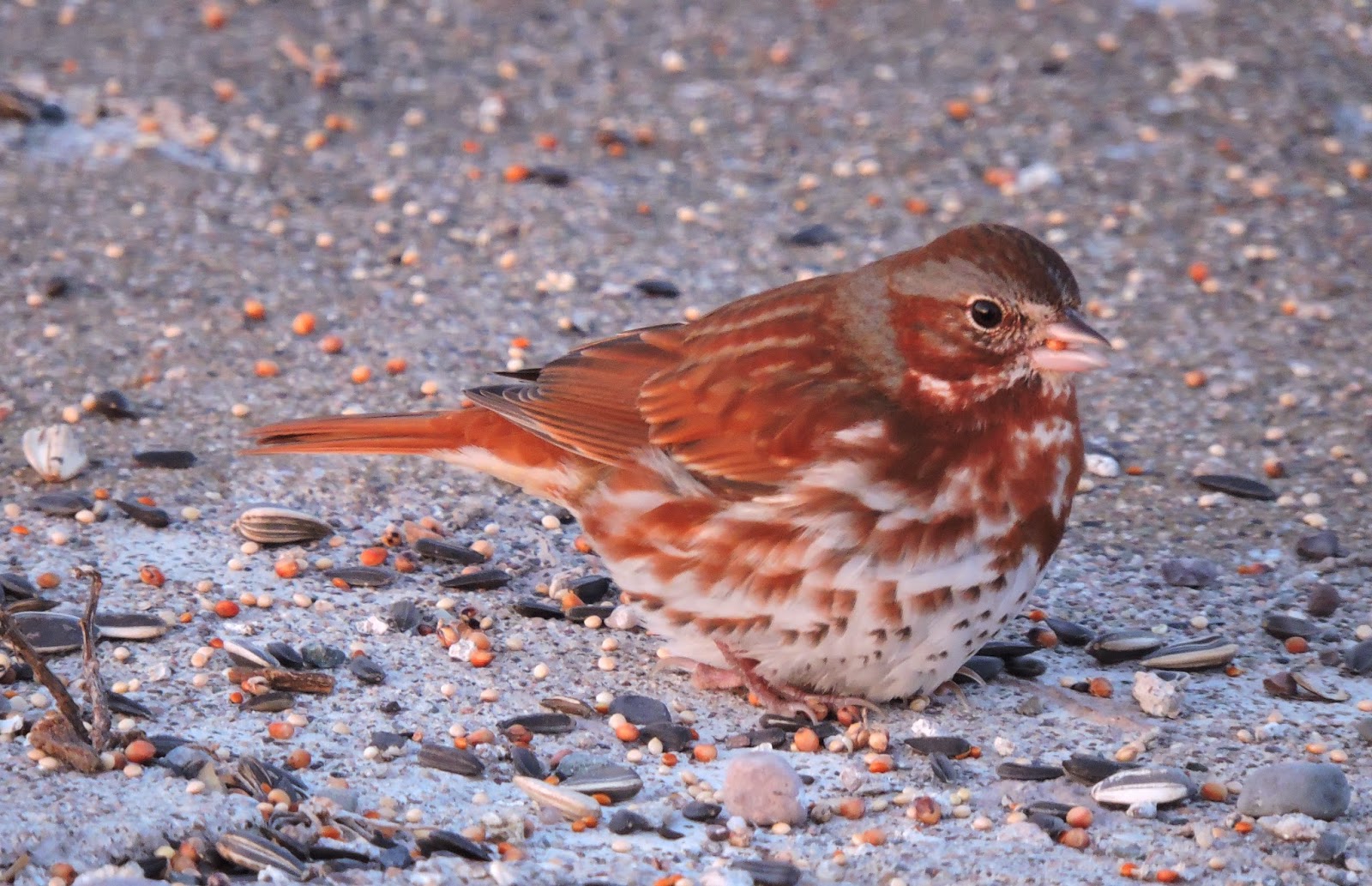
Land birds seen were large numbers of Song and Fox Sparrows, Dark-eyed Juncos, Snow Bunting, Savannah Sparrow, Woodcock, Ruffed Grouse, Downy Woodpecker.  One Northern Harrier flew over looking for food.

Purple Sandpipers

We did have one very special bird.  Richard saw a Vesper Sparrow in the bushes behind the observatory.  Shortly it appeared in front of our viewing area to feed on the seed there.  So, we had ample time to view this beautiful bird and compare it to the many Song and Fox Sparrows which were there, too.
Vesper Sparrow

Fox Sparrow