Thursday, April 13, 2017

Point Lepreau Bird Observatory

Counting Migrating Sea Birds

Migrating Sea Ducks
This week we volunteered at the Point Lepreau Bird Observatory counting migrating sea ducks.  This is a scientific project sponsored by the Saint John Naturalists Club for the last ten plus years.  They have built a small building literally on the 'point' of Lepreau in which 1-3 observers scientifically count the migrating sea birds that are flying past.  Counts are done in 4-hour segments during which birds are counted in alternate 15-minute intervals.  The count extends over about 8 weeks from late March into May.  The photo above shows what is observed as the counters determine numbers and species of the birds passing quickly by.

Black Scoters 
Most of the birds passing the point are Black Scoters as shown in the photo above.  The males have a bright orange blob on their bill.  The female is a dull brown with a beige cheek patch.  Two other species of scoters are also seen in numbers, Surf Scoters and White-winged Scoters.  See the Surf Scoter male below.

Surf Scoter Male

Common Eider Male 
Also migrating past the point in large numbers are Common Eiders.  Shown above is the black and white male.  The female is a cinnamon brown.  Their flocks look multi-coloured with the black, brown and white colours.

Brant, a smaller member of the goose family, also migrate past the point, though in smaller numbers than the scoters and eiders.  See the brant shown below.  These brant were photographed at Maces Bay where they had landed to rest and feed before moving on past Lepreau and up the Bay of Fundy.

Brant
In far fewer numbers (up to 10 or 12 per day) are the Harlequin Ducks.  These are small ducks that like to feed in the surf.  They are a beautiful dark blue and orange in the male and dark grey in the female and are about the size of teal.  See below how beautiful they are.

Harlequin Duck Male
We often see the hardy Purple Sandpipers which overwinter here along open coastal waters.  They fly by in tight small flocks and often land on the exposed rocks at the point.  They really are a dark purple colour as seen below.

Purple Sandpipers
In addition, we usually see a smattering of land birds.  Common are the sparrows which fly in and rest and feed at the point.  We put out seed for them and they usually stay a couple of days before moving inland.  Often seen are Song Sparrows, Fox Sparrows, Savannah Sparrows, and this week we had a Chipping Sparrow.  See below.

Chipping Sparrow

Song Sparrow
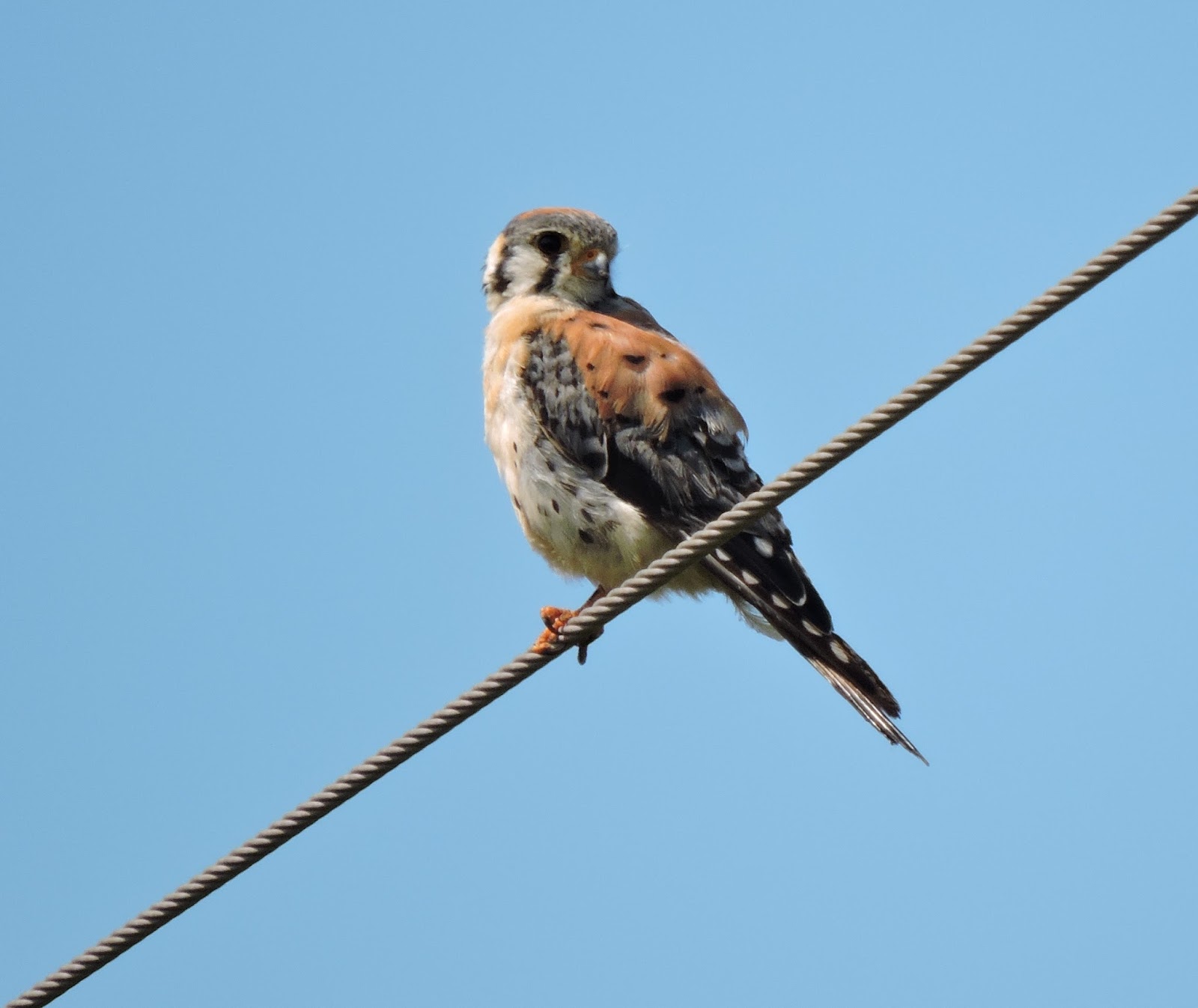
Often raptors fly in from over the ocean as they return from their wintering grounds.  Others stop by often to try to feed on the birds newly arriving at the point.  Often seen are Northern Harriers, Merlins, Kestrels and sometimes a Peregrine Falcon.  This week we saw a Merlin and an American Kestrel as seen below.

American Kestrel

Merlin
The Point Lepreau Sea Bird Counting Project is providing a large amount of useful data.  Many people are involved, both volunteer and paid staff.  On the day we were there during one 4-hour count period we tallied about 3300 birds.  That is lower than some days but more than many others.  Since we count only 50% of the time we could estimate that 6600 birds passed the point during that morning.  Our data is now being used by ornithologists and other scientists and when lumped with the data from other sea bird counting stations along the Atlantic flyway, they form a large bank of useful data.

Thursday, April 6, 2017

Lesser Black-backed Gull

Visitors from Europe

Lesser Black-backed Gull [Internet Photo]
 The Lesser Black-backed Gull (Larus fucus) is a visitor from Northern Europe which is seen in our area fairly frequently at this time of year.  A flock has moved up the Saint John River this week.

This species was first reported from Grand Manan in 1968 and 1975.  Since then it has gradually become more common, now found annually along the Bay of Fundy and up the Saint John River as far as Fredericton.  It is usually seen between March and May and then between September and November.

Lesser Black-backed Gull
The Lesser Black-backed Gull is one of the larger gulls, but smaller than the Herring or the Great Black-backed Gull.  It is 54-64 cm (21"-25") in length compared to the Herring Gull which is 56-69 cm (22"-27") and the Great Black-backed Gull which is 64-79 cm (25"-31") in length.  To identify this species you have to distinguish it from the Great Black-backed Gull.  It is smaller as the numbers above indicate.  Its back or mantle is often more grayish black than the pure black back of the Great Black-backed Gull, its head is smaller and the beak is shorter and less robust.  Its dark wings show one or two white spots on the outer primaries.  It has a clear lemon yellow iris with a reddish orbital ring.  Its legs are yellow or orange.  The Great Black-backed Gull has a very large beak, an olive to pale-yellow eye and pink legs.  

Lesser Black-backed Gull
The photo above shows a Lesser sleeping with an adult Great Black-backed Gull behind.  Note the size difference.  The photo was taken in poor light so the leg colours are not discernible.  

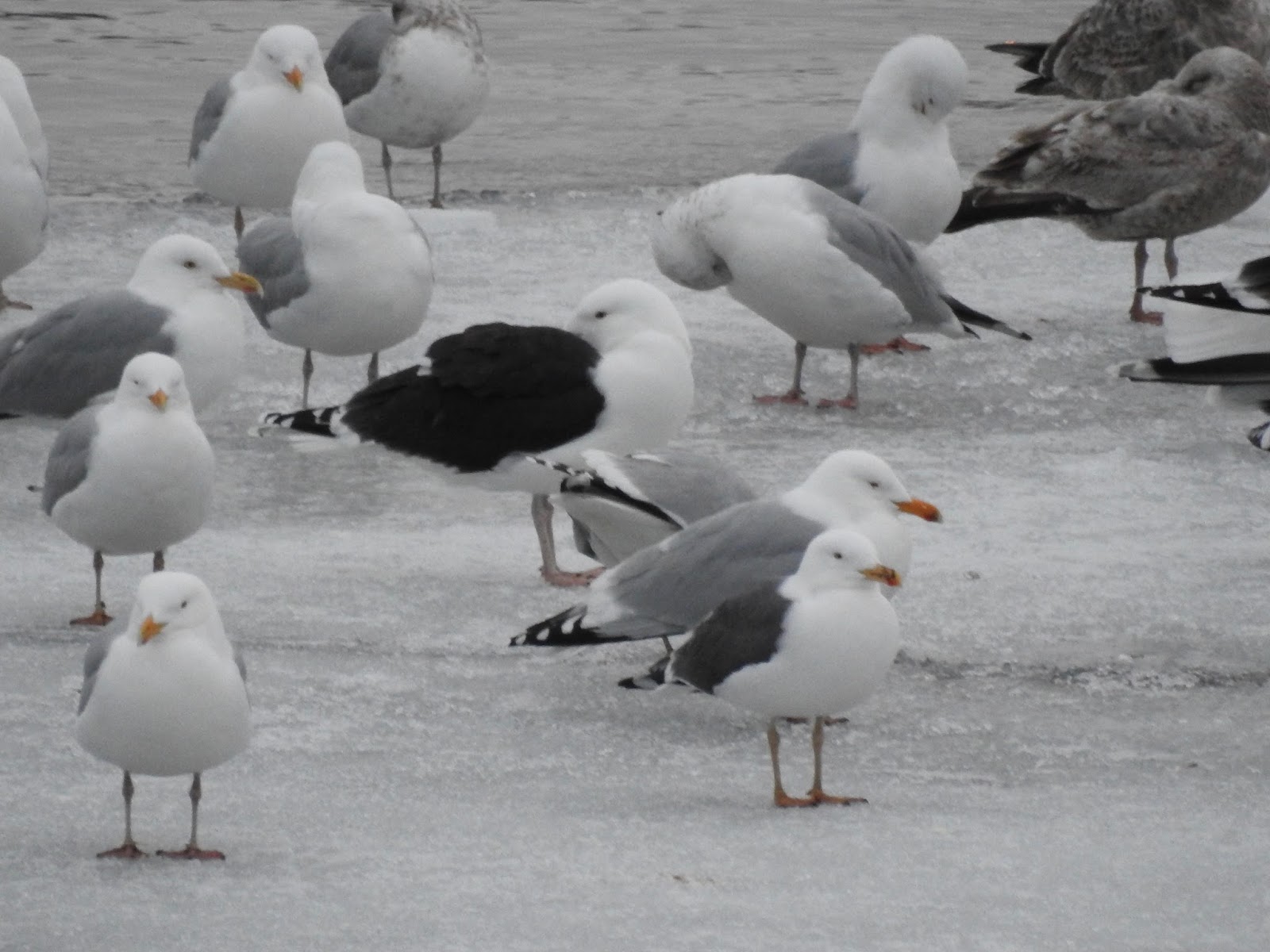
Lesser Black-backed Gull
The photo above shows the yellow legs and the size comparison with the Herring Gulls and the single Great Black-backed Gull with which it is grouped.

The Lesser Black-backed Gull breeds in western Greenland and appears to be a non-breeder in this area.  They like to associate with Herring Gulls and prefer the same feeding areas:  beaches, dumps, fishing harbours, lakes, parking lots, and intertidal waters.  It often feeds offshore over shelf areas.

Yesterday, April 5, a large group of these gulls was seen at Fredericton where they were associating with Herring and Great Black-backed Gulls.  Twenty-two were counted with the likelihood of many more out of identification range.  This is an unusually large number for this species.  Obviously it was a migrating flock.  They were mostly all adults.  It is hard to believe these birds are non-breeders.  I wonder if they were headed to a breeding area we don't know about.  An exciting find and a beautiful species to observe.

Thursday, March 30, 2017

Bittersweet Nightshade

'Deadly' Nightshade Warrants Caution

Bittersweet Nightshade [J Goltz Photo]
Bittersweet Nightshade Solanum dulcamara, also known as Creeping, Climbing, or Woody Nightshade, is a toxic plant that is common in New Brunswick.  I have heard naturalists recently trivializing the toxicity of this plant and this post is a reminder that that is an error.  This plant needs our attention.

The nightshades are a large group of plants of the Solanaceae family.  We have 3 species of Solanum here, two being rare.  Bittersweet Nightshade Solanum dulcamara, is common and the plant we are discussing in this post.  It was introduced from Europe and grows in woods and thickets throughout North America, most commonly in northern United States and southern Canada.  It has dark green leaves which are variable in shape, often with two opposite basal leaves.  It has purple, star-shaped flowers with 5  backward-pointing petals, and yellow centres.  The plant is a perennial and the stems are slender, woody and up to 1.5 m long (6 ft).  The deep medium green ovoid berries turn to bright red as they ripen.  The berries hang downward in bunches.

Bittersweet Nightshade [J Goltz Photo] 
Bittersweet Nightshade [J Goltz Photo]
Poisonings by this plant have been recorded in children, horses, cattle, sheep, and a dog.  The toxic parts include the whole plant but especially the green berries.  There are several toxic chemicals in the plant but the main toxin is solanine.

The symptoms of toxicity include mainly acute onset of weakness, staggering, and muscle tremors.  These are followed by respiratory and central nervous system depression and vomiting.  If the patient vomits plant material and it can be identified, it is somewhat easier to treat the toxicity.  Generally treatment is symptomatic.  In one reported case of Nightshade toxicity in a Labrador Retriever pup treatment was very intense for over 2 days before the pup recovered.

Bittersweet Nightshade, UNB Herbarium specimen
From the name of this plant it must not taste very good.  How, then, do animals and children get poisoned?  I am not certain about children, although I expect curiosity plays a role.  However, I can speak for animals.  In livestock the plant gets mixed in with dried forage, e.g. hay.  It is then offered to them to eat and they mistakenly eat it or they have no choice because they are hungry.  In other cases in livestock their pasture is running out and they eat whatever they can find.  In the case of the Labrador pup, there was nightshade growing around the edges  of the fenced back yard and the pup was chewing whatever it found in its environment.  I remember a case where one of my friends went picking high bush cranberries to make jelly.  They had inadvertently also picked some ripe nightshade berries and they were included in the jelly.  Fortunately in that case the jelly tasted very bitter so it was not eaten and destroyed!

In conclusion, Bittersweet Nightshade is not a plant to be ignored.  It should be eradicated from your property and wherever your pets, livestock and children spend their time.  Many years ago we diligently dug up and destroyed all nightshade from our farm for this reason.  It would be wise if you did the same.

References

Kees, Beckel, Sharp.  Successful treatment of Solanum dulcamara intoxication in a Labrador retriever puppy. CVJ Vol 56, Dec 2015.

Kingsbury, J.M. Poisonous Plants of the United States and Canada. Prentice-Hall

Hinds, H.H. Flora of New Brunswick. Biology Department, UNB

Schneider, M.F. Plants Poisonous to Children and Other People. The Health Association, Rochester, NY

Thursday, March 23, 2017

Varied Thrush Part 2

More on the Varied Thrush

Varied Thrush
The Varied Thrush returned briefly to the feeder in Fredericton last week, giving me the opportunity to get some good photographs.  It was on the ground briefly feeding on what looked like cracked corn.  It is a secretive bird which slips in quickly for a quick feeding opportunity before disappearing into the deep forest where it is more comfortable.  I will not likely stay around long and may be gone now.  Where it will go is an interesting thought.  It is so far from its home range (British Columbia northward to Alaska) that it is not likely to return there.  Will it go to Labrador?  It would be good to have a transmitter on it so we could find out.  This species likely has a lot more to tell us about its life history.

There have been about 20 records of their appearance here in New Brunswick.  An early one is described by Austin Squires (Recent Changes in the Abundance of Certain Species of Birds In New  Brunswick,  1960, p. 75).  That one appeared at Stanley in November, 1959 and stayed until March 25, 1960 when it was collected.  Collecting these rare birds was much frowned upon by birders at that time but there still were a few 'collectors' around.  Other records around that time were from Maine (December to January 1956-1957), southern New Hampshire (January 1958), and Connecticut (February to March 1960).  According to Squires, the only other sighting in eastern Canada was one in Quebec in August 1890.

Varied Thrush
The Varied Thrush is a rare feeder bird.  It much prefers feeding in the forest especially on the forest floor where it eats insects, spiders, earthworms, snails, weed seeds, acorns and berries.  It prefers shady, damp forests from western coastal areas to subalpine habitats.  It often nests at higher elevations and flies to lower elevations to feed.  Its nest is made of grasses, twigs, moss and mud and is lined with fine grasses and is placed on the limb of a shrub or tree 1.5 to 6 metres (5 to 20 feet) above the ground.  It is described as a flat, shallow structure in North American Birds Eggs by Chester A. Reed.   Three to seven pale greenish-blue eggs with a few distinct brown spots are laid.  They hatch in 14 to 16 days.  

Varied Thrush
The nest sounds much like our robin's nest except the eggs are speckled, the blue is paler, and the nest is shallower.  Wouldn't it be fun to see this nest and compare it with our robin's nest?  The sightings of rare birds have made birding this winter interesting.  Keep your eyes open.  You never know what else may show up.

Thursday, March 16, 2017

Great Horned Owl

Our Largest Resident Owl

Great Horned Owl [Internet Photo]
The Great Horned Owl is our largest resident owl.  It is common in most parts of the province.  The Snowy Owl and the Great Gray Owl are larger but they are northern visitors, usually migrating southward in some winters.  The Great Horned Owl is 56 cm (22 in) long compared to the Snowy Owl at 58 cm (23 in) and the Great Gray at 69 cm (27 in).  The Great Horned Owl has a huge wing span of 137 cm (54 in).  

Great Horned Owl [Internet Photo]
This large owl is a fierce predator.  It takes mainly mammals up to the size of snowshoe hares.  It spends its days sleeping in trees and is often seen when mobbed by crows.  

Great Horned Owl
The Great Horned Owl is an early nester.  It prefers stick nests or open tree cavities often taking over nests of Red-tailed Hawks, crows, or Osprey.  In New Brunswick it lays its eggs in early March.  The young can be seen climbing around the branches in 6 to 7 weeks and can fly at 10 weeks of age.  

Great Horned Owl on Nesting Platform in Jemseg 
Great Horned Owl [Internet Photo]
Perched adult Great Horned Owls are easy to identify by their size and their ear tufts.  Their rufous-coloured facial disk, yellow eyes and the white horizontal band under their bill help identify them.  The only similar species is the Long-eared Owl which is much smaller (38 cm - 15 in).  Its ear tufts are much closer together on top of its head and it lacks the horizontal white bar under the bill.  

Great Horned Owl - Juveniles
The Great Horned Owl is the most common owl in North America.  It is found in forested habitats in North, Central and South America ranging from Canada's Arctic to the Straits of Magellan.  It prefers coniferous, deciduous, and mixed woodlands as well areas along cliffs and rocky canyons.  When it finds a mate, it usually becomes a permanent resident.

Here along the Saint John River near Fredericton I hear the 'hoo-hoo-ho-hooo-hoo' starting in January.  Often I hear another owl answering from a distance.  That is likely the local pair hunting and keeping touch with one another.  Occasionally I will see one of the owls especially as they are disturbed from their daytime roost by a group of crows.  The owl then just sits tight or flies to another large tree in its territory.  I have occasionally seen the young as seen in the photo above.  They are curious but cautious.  The adult sometimes makes a blood-curdling scream.  I have heard that and it would certainly stop you in your tracks!

The Great Horned Owl will eat other birds ranging in size from small songbirds to Great Blue Herons and other owls.  Under cold winter conditions it will sometimes thaw frozen food before eating it by thawing it with its own body heat.  In severe winters these owls have been known to prey on small pets.  Pet owners beware!

Our local Great Horned Owls are nesting right now.  Look for their nests along waterways in hardwood tree crotches, stick nests or platforms.  You may be rewarded to see the ear tufts of Mrs. Owl as she sits on her eggs.

Thursday, March 9, 2017

Varied Thrush

Rare Thrush Found In Fredericton

Varied Thrush [Internet Photo]
 A very rare thrush has been seen feeding under feeders and on the ground under a large spruce tree in Fredericton this past week.  We were surprised to see it was a Varied Thrush (Ixoreus naevius).  The "Birds of New Brunswick:  An annotated List" cites only 20 sightings in the province until 2004.  These birds were mainly feeding on fruit-bearing trees and at feeders.  Some of them stayed in the area for most of the winter.

Varied Thrush [Carmella Melanson Photo]
The photo immediately above shows the bird seen here this week.  It is a male and about the size of our robin.  It is, in fact, a 'cousin' to the robin.  The thrush family (Turdidae) is represented here in NB by the American Robin, the Eastern Bluebird, the Hermit Thrush, the Veery, and the Swainson's Thrush and the much-rarer Bicknell's Thrush.  Other thrushes that show up here, like this bird, are vagrants (wanderers who move out of their normal range).

The Varied Thrush's normal range is in western North America west of the Rocky Mountains.  It spends the summer breeding season in British Columbia, Yukon and Alaska. It migrates south to the western US states to southern California for the winter.  Some are permanent residents along the Pacific coast from northern California to southern Alaska.  One of the subspecies (meruloides) occasionally wanders eastward through the northern US states and southern Canada and into the Maritime provinces.

The Varied Thrush is about the size of our robin and looks and moves much like it.  It is brightly marked with orange on the throat, eyeline, breast and wings.  It is a striking bird!  Unlike our robin it has a black line through the eye and a broad black breast band.  The back of the male is a gray colour which shows an interesting fine iridescent pattern.  The wings show a lot of orange markings.  The lower breast and flanks have gray scallops in the orange.  Its tail is a bit shorter than our robin's tail.  The female is similar to the male but the gray and black are replaced with brownish gray and the breast band is weak.  The young birds are similar to the females.  

Varied Thrush [Brian Cuming Photo]
The Varied Thrush is much more wary than our robin.  It prefers dense softwood forests and riparian habitats.  It feeds on fruit and insects preferring to feed on the ground or in trees and bushes.  It is not a common feeder bird.  

The song of this thrush is distinctive to our northwestern forests.  It is a high one-pitched sound repeated about every 10 seconds.  It is described as 'ethereal'.  On listening closely you can hear the vibration in the song.  While waiting for a chance view of our recent visitor I heard it call.  Interesting song indeed.  Even though the Varied Thrush is relatively common in its normal habitat,  logging in its breeding range has negatively affected its population numbers.  This species appears inconspicuous because it normally holds tight to the forest. It is a vital part of the western forest ecosystem.

Thursday, March 2, 2017

Barred Owl

Common New Brunswick Owl

Barred Owl [Internet Photo]
The Barred Owl (Strix varia) is a common New Brunswick owl species.  It is a permanent resident of most of southern Canada and the eastern United States.  It does not migrate but some individuals living in the northern-most part of the range may fly southward in winter if food is scarce.  

The Barred Owl is a medium-sized owl.  It is a member of the Strigidae family and shares the Strix genus with the Spotted Owl and the Great Gray Owl.  It is 53 cm (21 in) long and is distinctive with its dark eyes.  Most of our other owls have yellow eyes. The only owls with dark eyes are the Barred Owl, the Barn Owl (rare here) and the Spotted Owl (rare western species).  The Barred Owl is mainly brown in colour and light underneath.  It has dark brown barring on its upper breast and a distinctive dark ring around its facial disk.  The back is a rich speckled brown.  Its head appears large and it has not ear tufts.  Males and females look the same.

Barred Owl
Barred owls are primarily nocturnal.  They are a vocal species and can be easily heard at night.  Often you can hear one call and another answer from a distance.  Their call is a 'who cooks for you, who cooks for you-all' or a loud drawn out 'hoo-waah'.  

This owl lives in deep moist deciduous and boreal forests, wooded swamps and wooded areas near waterways.  We found the one shown above in a cedar thicket near St. Andrews this week.  It was being mobbed by crows but paid us little attention.  It was sleeping snuggled up to the truck of a tree. See the photo below for how well it hides itself.  It takes a trained eye sometimes to find them.

Barred Owl
Barred owls nest in tree cavities.  Occasionally they will use an abandoned stick nest.  The female lays 2 or 3 white eggs and the incubation is done by the female only.  The male brings her food while she is sitting.  They eat mainly rodents (voles, mice, rats, squirrels, young rabbits), weasels, and also some birds, reptiles, amphibians and insects.  

Barred Owl [L Doucet Photo]
The Barred Owl is almost never seen in groups.  However, during one of our owl surveys here in New Brunswick we had 6 Barred Owls at one of our stops.  That was exciting!   A group of owls is sometimes called a 'bazaar', a 'parliament', or a 'wisdom' of owls.  The English language is strange but it is interesting to experience a parliament of owls!