Thursday, May 18, 2017

Blue Grosbeak

A Blue Grosbeak?


Yes, such a bird exists!  There are 5 different grosbeaks in Canada: Pine, Evening, Rose-breasted, Black-headed and Blue Grosbeak.  They are all finches but not of the same genus.  There are other finches with large beaks but they are not called 'grosbeaks'.  Our discussion here concerns our 'grosbeaks'.  The Black-headed Grosbeak is a western species.  The Rose-breasted inhabits most of Canada.  The Blue Grosbeak is generally a southern species.  The Pine Grosbeak is generally a northern species and the Evening Grosbeak lives across the continent.  It appears the grosbeaks have spread completely across North America.

Blue Grosbeak - Immature Male
Shown above is a young male Blue Grosbeak presently visiting feeders on Grand Manan.  Being a finch it readily eats seeds.  Shown below is another immature male which visited a feeder in Gagetown a few years ago.

Blue Grosbeak - Immature Male
These young birds barely show their blue colour.  They look much like the cinnamon-coloured females.  See below for a female which also visited this province.

Blue Grosbeak - Female
This species is strongly sexually dimorphic (males and females look different).  That can really confuse us.  See below for a picture of an adult male.  There is little confusion in identifying this one!  But note the cinnamon wing bars and the deeper blue colour.

Blue Grosbeak - Adult Male [Internet Photo]
The reason I mention the deeper blue colour is that we need to distinguish this species from the Indigo Bunting which is also very blue, but a lighter blue and a smaller bird.  How lucky you would be if you had both of these species together in your yard at the same time!

The Blue Grosbeak is listed as a very rare spring and fall visitor to New Brunswick.  Most are seen along the Fundy coast and they often appear at feeders.  The normal range for this species is the southern United States where it breeds.  It usually winters in Mexico, Central America south to Panama.  The birds we see here are often young birds seeking new territory.

The Blue Grosbeak is closely related to North American buntings (Indigo Bunting, Lazuli Bunting, Painted Bunting).  It prefers overgrown fields, bushy roadsides and riparian habitats.  It likes to stay low to the ground but will sing from an exposed perch.  Its call note is a 'chink' sound and it sings with a beautiful warbling sound.  

Thursday, May 11, 2017

Herons and Egrets

Herons and Egrets Have Arrived

Great Egret
The heavy storm we had over the weekend brought us some special visitors from the south.  The strong winds from the southwest brought migrating birds to our province.  Some, like the herons and egrets described here perhaps overshot their destinations.  No matter how they got here, we are delighted to have them.

Shown above is the Great Egret.  This is a rare species for New Brunswick.  Every year a handful appear here.  They usually move along is a day or two.  We don't know whether they continue to move northward or whether they return south.  We do not have a breeding record for this province but we have enough of them coming here each year to make it possible.  This year so far we have had several reports of Great Egrets.  The one shown above was at White Head Island.

Snowy Egret
The other large white bird is the Snowy Egret, although it is a bit smaller than the Great Egret.  It can be told from the Great Egret by its black bill and its 'golden slippers' (bright yellow feet).  The Snowy Egret is rarer here than the Great Egret but we do get a report or two every year.  This year we have had a report from Saints Rest Marsh in Saint John.

Little Blue Heron
An adult Little Blue Heron appeared at Saints Rest Marsh this week.  It was still there as of yesterday.    This heron is much smaller than the egrets or the Great Blue Heron, being only 61 cm (24 inches) high.  The Great Blue Heron is 117 cm (46 inches) high, just as a reference.  The rain and muddy conditions are providing good feeding conditions for these visitors!  An immature Little Blue Heron was reported yesterday from Jolicure, NB.

The immature Little Blue Heron is more difficult to identify.  It is white and its small size makes it easy to confuse with the Snowy Egret.  The immature Little Blue, however, has a pale grayish or pink bill and pale, dull green legs.  See the photo below.

Little Blue Heron - Immature
The Tricolored Heron is listed as very rare in New Brunswick.  The first one ever recorded in Canada was collected from Nauwigewauk, NB in 1895.  There were very few records after that until the last 50 years when we get a record every year or two usually from Grand Manan or Saints Rest Marsh in Saint John.  There is a Tricolored Heron as this is being posted at Chance Harbour.  See the photo below.  This heron is about the size of a Snowy Egret, about 66 cm (26 inches) long.

Tricolored Heron
There is one more heron, a small one which is seen rarely in New Brunswick.  The Green Heron is only 46 cm (18 inches) long and is very secretive.  Rarely it has bred in the province.  A Green Heron was seen on Grand Manan this past week, on May 5.

Green Heron [Internet Photo]
The Great Blue Heron is our most common heron.  Many have returned now and can been found in marshy areas.  Yesterday I saw at least 12 at Saints Rest Marsh.

Wednesday, May 3, 2017

Killdeer

Killdeer Are Early Nesters

Killdeer
This week I have found or been made aware of two active Killdeer nests.  The one I photographed today had 4 eggs in it and the adults were beginning to incubate the eggs.  Both nests are located in active human areas, one on the side of a gravel road and one on the edge of a football field.

The Killdeer ( Charadrius vociferus) is a large plover, about 27 cm (10.5 inches) long.  It returns faithfully every year to our area to breed and raise its young.  It prefers open areas, fields, parking lots, gravel areas, and playing fields.   Although it is a shorebird, it is rarely seen near water.  It feeds on insects, worms, invertebrates, snails and occasionally seeds and small vertebrates.  

The Killdeer is easy to identify with its double breast band.  It is dark brown on its back and white underneath.  It has a rufous rump and tail.  It is very noisy, readily saying its own name.  It calls loudly when approached by humans.  It is known for its broken-wing display as shown in the photo below.  It does this to presumably lead intruders away from its nest.  Both adults were doing this today as I searched for its nest. 

Killdeer
The Killdeer builds its nest in an open site often near human activity.  The nest shown below was on the side of a gravel road.  Note the lack of nest construction, just a depression made among the small stones.  The eggs are well camouflaged in the gravel with their grey and brown spots.  This nest was very difficult to see even when standing near it!  Both adults incubate the eggs which hatch in 24-28 days.  The young chicks are very mobile and have only one breast band.  They have long legs and are able to move with the adults soon after hatching.  The young soon change plumages to the two breast bands.

Killdeer Nest
Killdeer Sitting on Nest
The adult sitting on the nest is also well camouflaged as shown above.  The bird will often remain on the eggs as activity goes on around it.  This species has adapted well to modern civilization.  It occupies a broad range, from eastern Alaska eastward to Newfoundland and south to include most of Canada.  It winters from the mid-USA to South America and the Caribbean Islands.

The only other similar species found here is the Semipalmated Plover.  It is a bit smaller and has only one breast band, so is easily differentiated from the Killdeer.  The Killdeer's noisy call is its trademark and it is a welcome sound in early spring.  In slow springs like this year it certainly is a welcome sound!

Thursday, April 27, 2017

Mew Gull

Very Rare Gull Stops in Fredericton

Mew Gull [Brennan Obermayer Photo]
In the first week of April a large mixed group of migrating sea gulls stopped at Fredericton to feed and rest.  There were hundreds of gulls in this group as they rested on the north side of the river on the ice shelf jutting out from shore into the mostly open river.  Many gulls fed and bathed on the river and others wandered around Carleton Park and the area below the walking bridge (former railway bridge).  This provided a wonderful opportunity to view and study these gulls.

Mew Gull with Ring-billed Gulls [Brennan Obermayer Photo]
Among these gulls was one very rare gull, a visitor from the west, a Mew Gull, Larus canus brachyrhynchus.  The Mew Gull is one of four subspecies of Larus canus.  The Mew Gull is the nearctic species (North America and Greenland).  The others are Common Gull (Europe), Russian Common Gull and Kamchatka Gull.

In our area the Mew Gull has to be distinguished from the Ring-billed Gull both of which are shown in the photo above.  The Ring-billed Gull is very common here and can be seen every day sometimes by the hundreds at Carleton Park.  As shown above, the Mew Gull is smaller and has a darker gray mantle (back).

Now let's look more closely at the finer details.  The Mew Gull has a smaller, finer pale yellowish bill which has no ring.  Some individuals, however, have a dusky remnant of a ring that shows as a dusky smudge.  This individual, however, is reasonably clean.  The legs are a yellowish green compared to the deeper orangish yellow legs of the Ring-billed Gull.  The head is smaller and rounder and has a steeper angle above the bill.  The head has significant 'dirty' streaking that shows here compared to the stark white heads of the Ring-bills.  Notice the eye.  The Mew Gull has a dark eye and the Ring-billed Gulls have a  yellow eye.  The Mew Gull has significantly wide white cresents at the trailing edges of the secondary and inner primary  wing feathers.  Notice the two white arcs above the tail on the back.  These are clearly visible as this gull wanders around among a group of Ring-billed Gulls.


Mew Gull [Brennan Obermayer Photo]
There are distinctive differences in wing feather patterns that ornithologists study carefully to distinguish the 4 forms of Larus canus.  Here I'll only mention the large mirrors (white spots) on the P9 and P10 wing feathers (primary feathers).  The real clincher, however, to distinguish this species from the Common Gull is the 'string of pearls' on primary wing feathers P5 to P8.  These are shown in the photo below.  Notice the white dots on the third to the sixth primary wing feather tips coming in from the tip of the wing itself.  This is getting complicated,  so suffice it to say this photo is a wonderful display of a fine distinguishing feature of the Mew Gull.  It clearly shows this individual is a Mew Gull and not a Common Gull.

Mew Gull [Brennan Obermayer Photo]
The Mew Gull lives mainly in western North America where it breeds in British Columbia, Yukon, Northwest Territories, northern Saskatchewan, and Alaska.  It winters along the coast line from northern BC southward to California.  We have very few confirmed records of Mew Gulls in New Brunswick; one from Sheffield in 1969 and just 2 or 3 since.  Most sightings of this group of gulls (Larus canus spp.) in this area are Common Gulls from Europe.

I want to thank Brennan Obermayer for his good work at identifying this bird and for agreeing to share his excellent photos with this blog.  

Thursday, April 20, 2017

Glossy Ibis

Rare Wading Bird Visits Keswick

Glossy Ibis
A tall wading bird has been visiting the Keswick area for the last 5 days.  It is 58 cm long (23 in) and is very dark in colour.  At a distance it looks black.  Yesterday it was feeding with about 20 Ring-billed Gulls and 2 Black Ducks in flooded fields off Tripp Settlement Road.  

The Glossy Ibis (Pleagadis falcinellus) is a rare 'vagrant' to this area.  In ornithological parlance that means it is a species that wanders out of its normal range.  Normally it is a permanent resident of Florida and the Gulf Coast.  It moves northward in summer to breed as far north as occasionally southern Maine.  It also is found in Eurasia, Southeast Asia, Pacific Islands, Africa, and Australia.  

Before 1900 this species was extremely rare here.  It gradually became more abundant as the twentieth century progressed.  It is thought that the original birds accidentally appeared here from Africa in the 1800s (much like the Cattle Egret).  There were a few sightings in Florida and the Caribbean Islands in the 1800s.  There is an early breeding record from Orange Lake, Florida in 1913.  We have records of a bird appearing in Pictou County, NS in 1856 and one in Montreal in 1900.  The one in NS from 1856 is most likely a bird blown off course from Europe.  The one from Montreal was likely a bird from the newly developing North American population.  The first reports for New Brunswick were in the 1950s.  The first one I ever saw was in the early 1960s at Saint Andrews.  

Glossy Ibis
The Glossy Ibis nests in trees and is pugnacious towards other birds.  It drives away other ibises and herons that might be nesting near it.  It is loving and attentive to its mate and offspring, often caressing them by bill rubbing, cooing and exercising mutual grooming.  There are usually 3 or 4 offspring.  They feed by probing the mud for crayfish, invertebrates, frogs, fish, and plants.  In the south they eat a lot of snakes and are thought to assist in snake control.  They have never bred here but there was one unsuccessful attempt on Manawagonish Island, off Saint John in 1986.  

Glossy Ibis
Like herons, ibises fly with their necks outstretched.  Their decurved bills are often visible as they fly by.  The Glossy Ibis is no songster.  It utters a guttural screeching sound as well as its soft cooing to its mate.  

As the photos show, this bird is beautiful.  Its head and breast are a deep chestnut colour.  The wings look black but actually are iridescent blue and green.  The bill and legs are grey.  The eye is black and there is a fine bluish white line around the bill base which does not extend around the eye.  Both genders look alike.  The young are mottled grayish in the head and neck.  It is a species that needs to be distinguished from the White-faced Ibis which lives in western North America.  

It is interesting that we usually get one or two individuals here every spring.  This would indicate it is expanding its range.  The bird shown in the photos above is an adult in breeding plumage.  Hopefully it will find a mate and we will be able to record a successful breeding and raising of young for this year in New Brunswick.

Thursday, April 13, 2017

Point Lepreau Bird Observatory

Counting Migrating Sea Birds

Migrating Sea Ducks
This week we volunteered at the Point Lepreau Bird Observatory counting migrating sea ducks.  This is a scientific project sponsored by the Saint John Naturalists Club for the last ten plus years.  They have built a small building literally on the 'point' of Lepreau in which 1-3 observers scientifically count the migrating sea birds that are flying past.  Counts are done in 4-hour segments during which birds are counted in alternate 15-minute intervals.  The count extends over about 8 weeks from late March into May.  The photo above shows what is observed as the counters determine numbers and species of the birds passing quickly by.

Black Scoters 
Most of the birds passing the point are Black Scoters as shown in the photo above.  The males have a bright orange blob on their bill.  The female is a dull brown with a beige cheek patch.  Two other species of scoters are also seen in numbers, Surf Scoters and White-winged Scoters.  See the Surf Scoter male below.

Surf Scoter Male

Common Eider Male 
Also migrating past the point in large numbers are Common Eiders.  Shown above is the black and white male.  The female is a cinnamon brown.  Their flocks look multi-coloured with the black, brown and white colours.

Brant, a smaller member of the goose family, also migrate past the point, though in smaller numbers than the scoters and eiders.  See the brant shown below.  These brant were photographed at Maces Bay where they had landed to rest and feed before moving on past Lepreau and up the Bay of Fundy.

Brant
In far fewer numbers (up to 10 or 12 per day) are the Harlequin Ducks.  These are small ducks that like to feed in the surf.  They are a beautiful dark blue and orange in the male and dark grey in the female and are about the size of teal.  See below how beautiful they are.

Harlequin Duck Male
We often see the hardy Purple Sandpipers which overwinter here along open coastal waters.  They fly by in tight small flocks and often land on the exposed rocks at the point.  They really are a dark purple colour as seen below.

Purple Sandpipers
In addition, we usually see a smattering of land birds.  Common are the sparrows which fly in and rest and feed at the point.  We put out seed for them and they usually stay a couple of days before moving inland.  Often seen are Song Sparrows, Fox Sparrows, Savannah Sparrows, and this week we had a Chipping Sparrow.  See below.

Chipping Sparrow

Song Sparrow
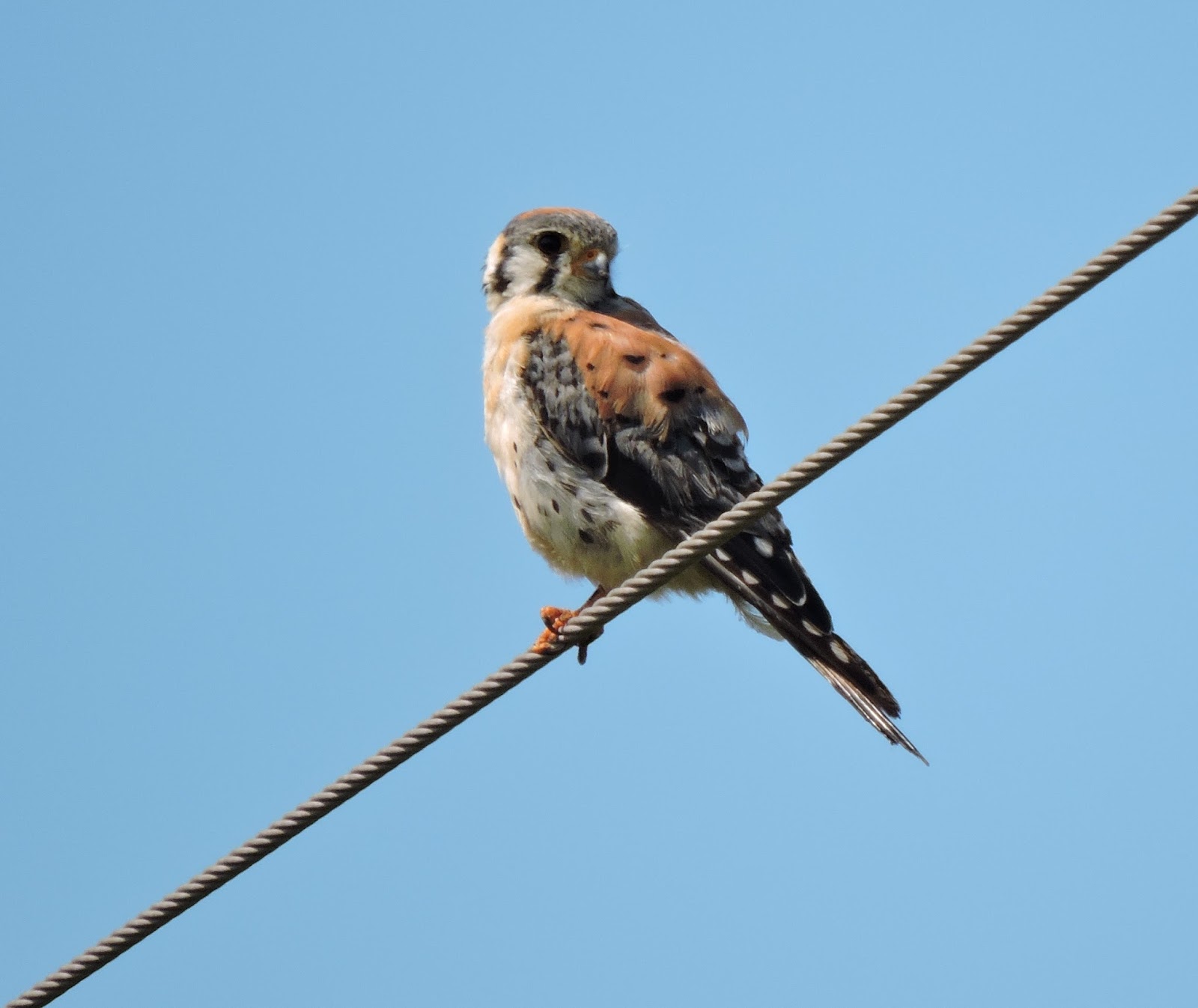
Often raptors fly in from over the ocean as they return from their wintering grounds.  Others stop by often to try to feed on the birds newly arriving at the point.  Often seen are Northern Harriers, Merlins, Kestrels and sometimes a Peregrine Falcon.  This week we saw a Merlin and an American Kestrel as seen below.

American Kestrel

Merlin
The Point Lepreau Sea Bird Counting Project is providing a large amount of useful data.  Many people are involved, both volunteer and paid staff.  On the day we were there during one 4-hour count period we tallied about 3300 birds.  That is lower than some days but more than many others.  Since we count only 50% of the time we could estimate that 6600 birds passed the point during that morning.  Our data is now being used by ornithologists and other scientists and when lumped with the data from other sea bird counting stations along the Atlantic flyway, they form a large bank of useful data.

Thursday, April 6, 2017

Lesser Black-backed Gull

Visitors from Europe

Lesser Black-backed Gull [Internet Photo]
 The Lesser Black-backed Gull (Larus fucus) is a visitor from Northern Europe which is seen in our area fairly frequently at this time of year.  A flock has moved up the Saint John River this week.

This species was first reported from Grand Manan in 1968 and 1975.  Since then it has gradually become more common, now found annually along the Bay of Fundy and up the Saint John River as far as Fredericton.  It is usually seen between March and May and then between September and November.

Lesser Black-backed Gull
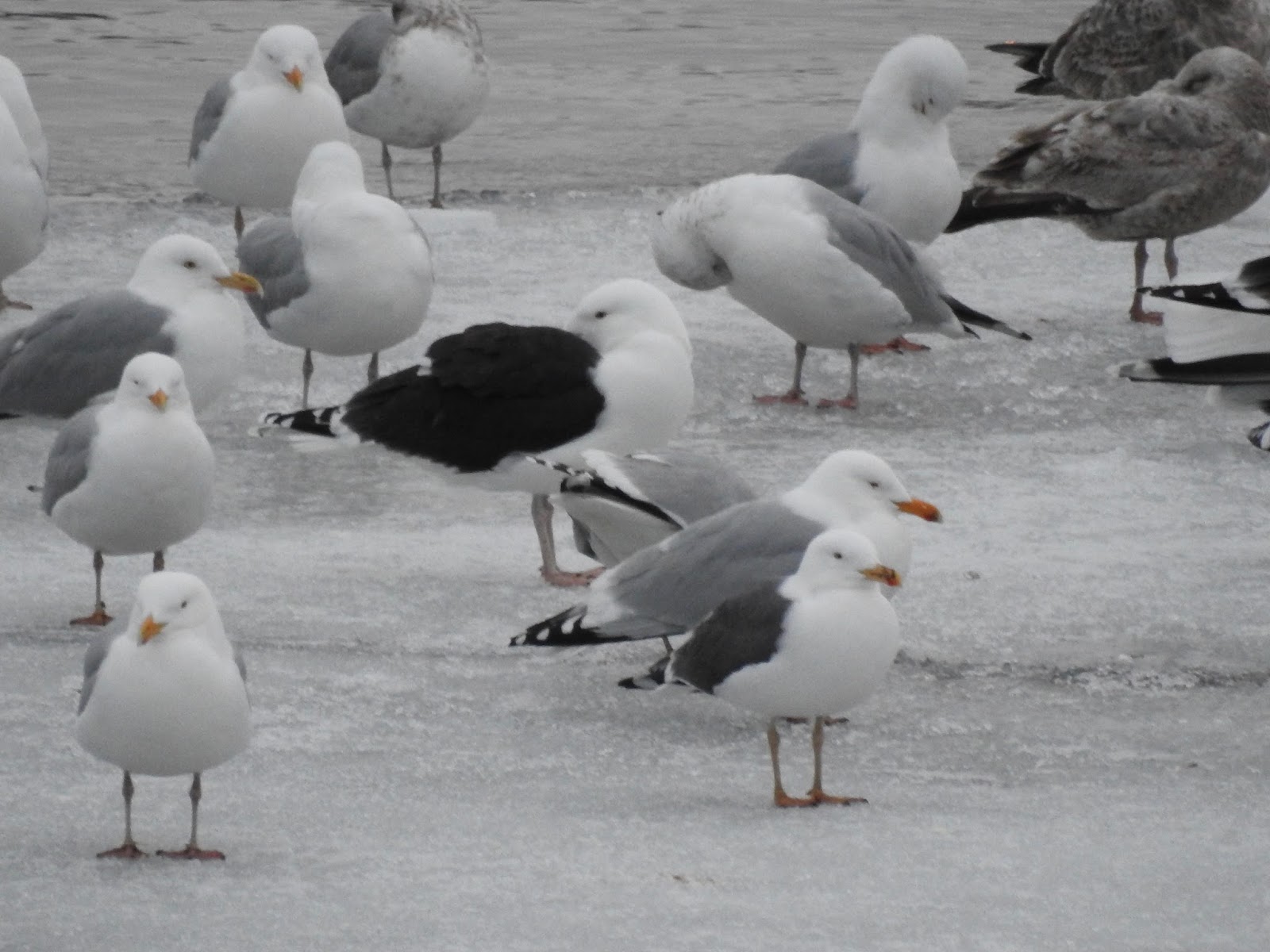
The Lesser Black-backed Gull is one of the larger gulls, but smaller than the Herring or the Great Black-backed Gull.  It is 54-64 cm (21"-25") in length compared to the Herring Gull which is 56-69 cm (22"-27") and the Great Black-backed Gull which is 64-79 cm (25"-31") in length.  To identify this species you have to distinguish it from the Great Black-backed Gull.  It is smaller as the numbers above indicate.  Its back or mantle is often more grayish black than the pure black back of the Great Black-backed Gull, its head is smaller and the beak is shorter and less robust.  Its dark wings show one or two white spots on the outer primaries.  It has a clear lemon yellow iris with a reddish orbital ring.  Its legs are yellow or orange.  The Great Black-backed Gull has a very large beak, an olive to pale-yellow eye and pink legs.  

Lesser Black-backed Gull
The photo above shows a Lesser sleeping with an adult Great Black-backed Gull behind.  Note the size difference.  The photo was taken in poor light so the leg colours are not discernible.  

Lesser Black-backed Gull
The photo above shows the yellow legs and the size comparison with the Herring Gulls and the single Great Black-backed Gull with which it is grouped.

The Lesser Black-backed Gull breeds in western Greenland and appears to be a non-breeder in this area.  They like to associate with Herring Gulls and prefer the same feeding areas:  beaches, dumps, fishing harbours, lakes, parking lots, and intertidal waters.  It often feeds offshore over shelf areas.

Yesterday, April 5, a large group of these gulls was seen at Fredericton where they were associating with Herring and Great Black-backed Gulls.  Twenty-two were counted with the likelihood of many more out of identification range.  This is an unusually large number for this species.  Obviously it was a migrating flock.  They were mostly all adults.  It is hard to believe these birds are non-breeders.  I wonder if they were headed to a breeding area we don't know about.  An exciting find and a beautiful species to observe.