Saturday, June 4, 2022

Black-necked Stilt - Nemesis Bird

                                            Black-necked Stilt  [Mark Dennis Photo]

On May 22, 2022 birders spotted 2 Black-necked Stilts at Cape Sable Island, Nova Scotia.  This is a rare species to show up anywhere in Atlantic Canada.  When they do appear, birders 'flock' from near and far to see them.  Where did they come from and where are they going?

Stilts and Avocets are members of the Recurvirostridae family.  Stilts are officially listed as 'accidental' in New Brunswick and Avocets as 'casual', according to the Birds of New Brunswick:  An Annotated List.  There have been few records over the years of Black-necked Stilts in New Brunswick.  There was one from the mouth of the St. Croix River in 1862; one from Maces Bay in 1880; three near Woodstock in 1982; and one from Jacquet River in 2000.  

The reason I call this species my 'nemesis bird' is that I have been hoping for most of my birding life to see this species.  Trips to western North America can easily produce sightings but I have not been in the right place at the right time.  The Jacquet River specimen is the closest I have come.  A group from Fredericton drove up to see the bird on 6 June, 2000 and we missed the bird by 15 minutes!  It was there 15 minutes before we arrived and was gone when we scanned the area.  We drove 4 hours each way only to miss the bird!  Such is the makings of birding stories.

I have watched many American Avocets over the years from singles to small flocks at once hoping to find a Black-necked Stilt with them, which often happens.   No luck.  I keep trying and hopefully will be lucky enough to get my binoculars trained on a beautiful Black-necked Stilt someday.

                                                            Black-necked Stilt  [Internet Photo]

The Black-necked Stilt is a unique-looking species.  It is 33 cm long with a 6.4 cm bill and the tarsus is 11.3 cm long.  It is boldly pied with black above and white below.  It has long pink or sometimes red legs and there is a white spot above and behind the eye which shows well on the black crown and face.  The bill is long, needle-like and black in colour.  The female is duller with brownish tones.  Note the black on the upper/dorsal neck which is important to note in order to distinguish the Black-necked Stilt from the much rarer Black-winged Stilt which very rarely shows up in North America from Eurasia.  The American Avocet shares the same habitat as the Black-necked Stilt but it is bulkier with an orange or gray head and much more white on it.  

The Black-necked Stilt is a graceful wader that looks very elegant.  In fact, one wonders how it manages those long legs.  It is highly social and feeds in water picking insects and other invertebrates from the surface.  It feeds by sight so you don't often see it probing the mud like some shorebirds do.  You might see large numbers of them feeding in good feeding areas on their normal range.  They will aggressively mob both aerial and terrestrial predators when threatened, even humans.  I think I would like to be mobbed by a group of Black-necked Stilts, especially if I had my camera in hand!  This species is noisy on the breeding grounds and less so during migration or in winter.  Their voice is a loud kek, kek, kek, kek.  In flight you would see the long pink legs trailing out behind and the plumage a bold black and white.  The wings are pointed and the wing beats are often halting.  

The Black-necked Stilt breeding range includes Washington State, Alberta, Oklahoma, and Virginia south throughout lowland areas to northern South America and the West Indies.  They winter in California, the Gulf coast and southern Florida south to the tropics.  Vagrants can be found in southern Canada and Bermuda.  

Black-necked Stilts breed in loose colonies in shallow, marshy lakes and coastal salt ponds.  Non-breeders move along with the breeding birds.  The nest is a shallow depression in the ground lined with grass and shell fragments.  Three to five yellow or buff eggs spotted with brown are incubated by both adults for 22 to 25 days.  The young, when they get their feathers, are grizzled-looking, paler than the adults with buff-edged feathers and greyish pink legs.  Stilts feed in both fresh and salt water on tadpoles, mollusks, aquatic insects, snails, small fish, flying insects and seeds.  

The Black-necked Stilt species was first described in 1776 by Philipp Ludwig Statius Muller, a German zoologist.  Black-necked Stilts can swim but they usually do not.  It is interesting to note that Black-necked Stilts have the second longest legs in proportion to their bodies of any avian species.  Can you guess which species has the longest? ... flamingos.

Monday, May 23, 2022

Chestnut-sided Warbler

                                                        Chestnut-sided Warbler [Internet Photo]

The Chestnut-sided Warbler is one of the many wood warbler species that migrate into New Brunswick each spring to breed, raise their young and spend their summers.  Wood warblers make up the family, Parulidae, which contains 56 species of 15 genera.  We have approximately 38 of these species here 
with 13 of them being rare or very rare.  We have so many warblers migrating into NB in the spring that they can be seen as a huge patch on radar screens as they wing their way here.  New Brunswick (and eastern Canada) are unique in the world with the diversity and beauty of wood warblers present in spring, summer and fall.  European birders, for example, envy us.

The Chestnut-sided Warbler (Setophaga pensylvanica) is a typically sized warbler; 13 cm long.  They are common here and can be seen flitting around bushes and low shrubbery gleaning insects from under the leaves.  They are fast-moving but so worth getting a good look at or a photo.  They often droop their wings and cock their tail.  

                                                                 Chestnut-sided Warbler

The male and female adults look much alike, the female being duller with less black and chestnut markings.  The adult male is beautiful with his bright yellow crown (deep gold or green gold (in artist speak)), black lores, eyeline and malar stripe.  Note the big chestnut stripe on the sides of his breast and flanks, the white throat and breast and the white cheek.  He has 2 pale yellow wing bars, some yellow in his wings and striping on the back.  

The fall plumage is very different, as it often is in warblers.  In the fall both male and female have bright lime green (green gold) upper parts including crown and a pale gray cheek, throat and upper breast.  Of note is the white complete eyering.  In my experience, when you see a fall-plumaged Chestnut-sided Warbler the greenish upper parts jump out at you.  All you need to know is that this is a Chestnut-sided Warbler!

What similar species do you need to know?  The breeding plumage is distinctive so no problems in identification there.  In the fall,  you need to distinguish them from fall-plumaged Bay-breasted Warblers and Blackpoll Warblers.  But the green upper parts and eyering identify it as the Chestnut-sided Warbler. 

                                                               Chestnut-sided Warbler

Learning bird calls is very helpful in warbler identification.  Warblers are hard to see because they move around quickly in the foliage and are mostly hidden.  There are many computer programs available now to help with this task.  I can't stress enough how helpful it is to learn the warbler songs.  For example, this morning I was outside (doing chores) and heard beautiful bird song from our apple tree which was in full bloom.  One species was the male Baltimore Oriole who appeared to be telling me how much he loved the apple blossoms.  The other was a warbler which I could identify as a Nashville Warbler without even seeing the bird.  As the leaves quickly expand fully, that skill will be even more useful. 

The Chestnut-sided Warbler song is described as rich and musical and can be learned by interpreting it as 'please please pleased to meetcha'.  This makes learning this song easy.  There can be two different Chestnut-sided Warbler songs.  The one described above is used by the male to attract a female.  It decreases in frequency as the female sits on the eggs.  This song is known as the 'accented song'.  Males also sing an 'unaccented song'.  That is a song with the 'meetcha' removed from the end.  This song is used in territory defence and in warding off other males.  Research has shown that some males sing only the 'unaccented song' and that those males are less successful in finding mates.  The females must like the accent on the end of the song!

The range of the Chestnut-sided Warbler is most of eastern Canada from the central prairies to Nova Scotia, around the Great Lakes and down into the eastern US.  They winter in southern Mexico and Central America.  It is hard to believe this beautiful little bird can travel that far!  The preferred habitat of this species is second growth forest and scrubland.  Because so much of our forests were cut in the late 19th and 20th centuries, the second growth accelerated the population numbers of this species.  Unfortunately they have been declining some in recent years.

Chestnut-sided Warblers feed mainly on insects but also on some fruits.  They build their nests a few feet above the ground in a small tree or bush.  The nest is made of grass and bark and lined with hair and rootlets.  Three to five white to pale green eggs blotched with purple or brown are laid and incubated 11 to 13 days by the female.  

Chestnut-sided Warblers are neat warblers to learn and appreciate.  Ornithologists tell us that even though they have had a decline in numbers their population is still listed as 'least concern'.  If you haven't seen this species, go outside into the bushes and low trees and listen for 'please please pleased to meetcha'.  You will be happy to meet his beautiful warbler.  

Tuesday, May 3, 2022

Blue-gray Gnatcatchers Arrive

                                               Blue-gray Gnatcatcher  [Jennifer Pierce Photo]

There have been several reports of Blue-gray Gnatcatchers (Polioptila caerulea) seen in the province since early April.  These are exciting to see since we are out of their normal range.  Their normal summer range is the central US with some occurring into New England.  They winter from southern California to the Gulf coast and the Carolinas, southward to Mexico and the Caribbean islands.  For a full discussion of this species, please search this blog (November 16, 2017).

Gnatchatchers are tiny, active insectivores.  They raise and flick their tails (constantly!) supposedly to raise insects which they then devour.  One time I watched a flock of these birds and they were very active, flicking their tails and making short flights in every direction to catch insects around a salt water wharf.  They would quickly move from bushes and low shrubs to seaweed covered rocks.  They certainly were having a good feed! 

Gnatcatchers resemble hummingbirds in their nest sites and nest structure.  They build a tiny cup nest which they place on top of a horizontal branch and then decorate with lichens.  We have seen many hummingbird nests so would probably overlook a gnatcatcher nest for a hummingbird nest.  The Gnatcatcher nest would be a bit larger, the gnatcatcher being 10.8 cm long (a lot of that being tail) compared to the 8-cm Ruby-throated Hummingbird.  And, the Blue-gray Gnatcatcher weighs 6 grams compared to the 3 gram weight of the Ruby-throated Hummingbird.  

                                            Blue-gray Gnatcatcher  [Jennifer Pierce Photo]

The Blue-gray Gnatcatcher is a member of the Polioptilidae family (gnatcatchers and gnatwrens).   It was first described by Linnaeus in 1766.  There are 4 species of gnatcatchers in North America; California Gnatcatcher, Black-tailed Gnatcatcher, Blue-gray Gnatcatcher, and Black-capped Gnatcatcher.  The other 3 species are birds of the far west and south.  

The Blue-gray Gnatcatcher is the only truly migratory member of the family and has the northernmost range.  Fortunately for us, this species is expanding its range northward.  So watch out for them with chickadees and kinglets or with warblers.  They are a beautiful sight.

Sightings this year have occurred on Grand Manan where the photos above were taken and in the southeastern part of the province.  Since they could occur anywhere in the province, keep this species in mind.  They prefer to nest in swampy woods, so look for their nests when out birding or botanizing.  They nest as close as Southern Maine.  There was one report of a nest at Sackville in 1989.  Given this, we are likely to have a nest or two here this summer.

Saturday, April 23, 2022

Double-crested Cormorant


                                            Double-crested Cormorants in Breeding Plumage

The Double-crested Cormorants have been returning to the province for the last week or so.  I saw a flock of 125 floating as a raft down the St. John River at Crock's Point last weekend (April 16) and there was a report of about 400 roosting on the piers of the former Fredericton bridge that same weekend.  They were  migrating up the St. John River in large numbers.

The Double-crested Cormorant (Nannopterum auritum) was classified as the Phalacrocorax genus until 2021 when the genus was changed to  Nannopterum by the IOC.  The genus name, Nannopterum, means small winged which came from a flightless member of the family.  The auritum means 'eared' which comes from the nuptial crests.

Cormorants are long-necked diving birds of which there are 6 species in North America.  In New Brunswick we have 2 species, the Double-crested Cormorant and the Great Cormorant.  For more information on the Great Cormorant, search this blog.  Cormorants in general have long necks, long, heavy bodies, stiff tails and long, hooked bills.  The Double-crested Cormorants are large birds, 70-90 cm long (28-35 inches).   They feed mainly on fish but also amphibians and crustaceans which the catch underwater by swimming  swiftly with the strong propulsion of their feet.  They get their feathers wet while swimming in order to reduce their buoyancy.  After a feeding session they perch and dry their wings by perching and spreading them out.  That is a characteristic cormorant sight.  See the photo below. 

                                    Double-crested Cormorant Juvenile Drying its Wings

The Double-crested Cormorant in breeding plumage is all black with greenish or greyish patterning on its upperparts.  Its bill is yellow or orange and its gular (throat) patch is orange.  It has bare supraloral skin (in front of the eyes) which is orange.  In breeding plumage the bill is blackish above and pale below.  Males and females look the same and juveniles are a duller gray-brown.  The alternate plumage (non-breeding) is similar to the breeding plumage but duller.  

So what about the crests?  In breeding plumage they sometimes show a pair of tiny crests/plumes on the top of the head which can be black, white or peppered.  The white crests/plumes are more often seen in the north and west of their range.  

The Double-crested Cormorant likes both salt and fresh water unlike the Great Cormorant which also occurs here.  In order to tell the two species apart you have to take a close look to check for the larger size of the Great Cormorant and its white chin patch and white flank patch.

The range of the Double-crested Cormorant covers most of North America except the far north.  They breed in most of southern Canada and the US including all of the Atlantic provinces.  A few are beginning to remain here for most of the winter along our coasts.  They winter on the west coast from Alaska to the Baja Peninsula and in the east from southern Maine to the Yucatan Peninsula.

                                                    Double-crested Cormorant Juvenile 

During the breeding season the male has an elaborate courtship dance in which he presents the female with nesting materials and points out a suitable nesting site.  The nest is built of twigs and seaweed and in it the female lays two pale blue eggs.  Both adults incubate the eggs for 28 to 30 days.  

The vocals of this species are not spectacular to humans.  Their deep guttural grunts are part of the aquatic landscape.  Because they are gregarious birds and often found in colonies, they can be loud.

Today the population size of the Double-crested Cormorant is healthy and increasing.  In the 1960s their numbers decreased due to DDT poisoning.  Because they are perceived as being detrimental to the fish stocks, there has been some loss by humans destroying them.  In recent years their population has increased probably due to less contaminants in the water and the rise of the aquaculture industry.  They have increased in the Great Lakes region due to the rise in the non-native species of fish, the alewife.  In some places culling operations have taken place to control the Double-crested Cormorant population.  

In the wild the Double-crested Cormorant life expectancy is 6 years.  The oldest documented wild Double-crested Cormorant lived to be at least 17 years 9 months.

                             Double-crested Cormorant  Showing The Turquoise Eyes  [Internet Photo] 

Monday, April 11, 2022

Black Guillemot - A Local Marine Bird

                                                Black Guillemot in Breeding Plumage

The Black Guillemot (Cepphus grylle) is a small marine bird species which is a resident of New Brunswick.  It is a member of the Alcidae family.  It is found commonly at the mouth of the Bay of Fundy and breeds on many islands there.  It is also common along the shores of the Acadian Peninsula in fall and winter and it breeds at Heron Island, Belldune, and Pokeshaw in Chaleur Bay.  Like all alcids, Black Guillemots are rarely seen on fresh water and come to land only when nesting.  

The Black Guillemot range is widespread in Canada.  It is found along ocean shorelines from Maine (USA) northward along the coast year round all the way to Ungava and Baffin Island.  It is also found in summer on the high Arctic islands.  It is also found on the northern coasts of Yukon and Alaska.  This species' range is not restricted to North America.  It is also found in Europe along shorelines of Greenland, Iceland, the United Kingdom, Scandinavia and Siberia.  It is, however, more abundant on the American side of the Atlantic and Arctic Oceans.

                                                Black Guillemot in Winter    [Denise Albert Photo]

The Black Guillemot is a small alcid, measuring 30-32 cm long (13").  In breeding plumage it is all black with large white dorsal wing patches.  It has bright red feet, a dark, pointed bill and bright red mouth linings.  It flies in a rapid straight line with whirring wingbeats and the conspicuous white wing patches flashing. That makes it easy to identify.  In the alternate plumage it becomes mostly white with black mottling mainly on the back.  The white dorsal wing coverts (patches) are still visible in this plumage.  Both genders are similar.  The young are similar to winter adults but are speckled all over.  

There is another guillemot which the North American birder needs to be aware of, the Pigeon Guillemot (Cepphus columba).  The two guillemot species are very similar but can be distinguished by the wing linings and the wing patches.  The Black Guillemot has clean white wing linings and a completely white wing patch.  The Pigeon Guillemot has dark wing linings and the white wing patch has a black bar extending into its base.  The Pigeon Guillemot's range is along the west coast of North America from Alaska to California so we are not likely to see it here.

Black Guillemots are very vocal especially around their breeding sites.  Their voice is a high-pitched scream or whistle.  It is described as a persistent 'peeeeeeech'.   After hatching the young utter cheeping and whistling calls.  They are noisy birds!  The red mouth linings and persistent cries must be used as signals between mated pairs.

Guillemots breed on rocky shores and build their nests under or behind large rocks.  The nest is made of debris and small stones.  One to two white boldly blotched eggs (sometimes tinted blue-green) are laid and incubated from 23 to 39 days by both parents.  The species is not colonial but a few pairs can be found nesting closely in suitable habitat.  They often nest in single pairs.  Black Guillemots are the only auk that lays more than one egg.  Guillemots feed by diving to the bottom using their wings in a flying motion under water.  Their feet are used only for steering.  They are known to dive at least 50 metres.  They feed on polychaetes, mollusks, jellyfish, crustaceans, barnacles and fish.  That is a large variety!  Each pair sticks to their own special area of water.

                                            Black Guillemot in Alternate Plumage

Black Guillemots are sometimes called 'Sea Pigeons'.  Looking at the bird you can easily tell why.  They remind one of pigeons in shape and movement.  They are also sometimes called 'Tysties'.  The genus name, Cepphus, is derived from the ancient Greek word, kepphos, which was a pale waterbird mentioned by ancient Greek authors including Aristotle.    The species name, grylle, was a local name for this species in Gotland in the 1700s.  Our English word, guillemot, is from the French word, guillemot, which was probably derived from 'Guillaume', their word for 'William'.  However it was named, this alcid is a common, enjoyable oceanic bird of Canada and New Brunswick and a delight for birders to see.  Its population numbers are doing well for now.  We hope that remains so.

Monday, March 28, 2022

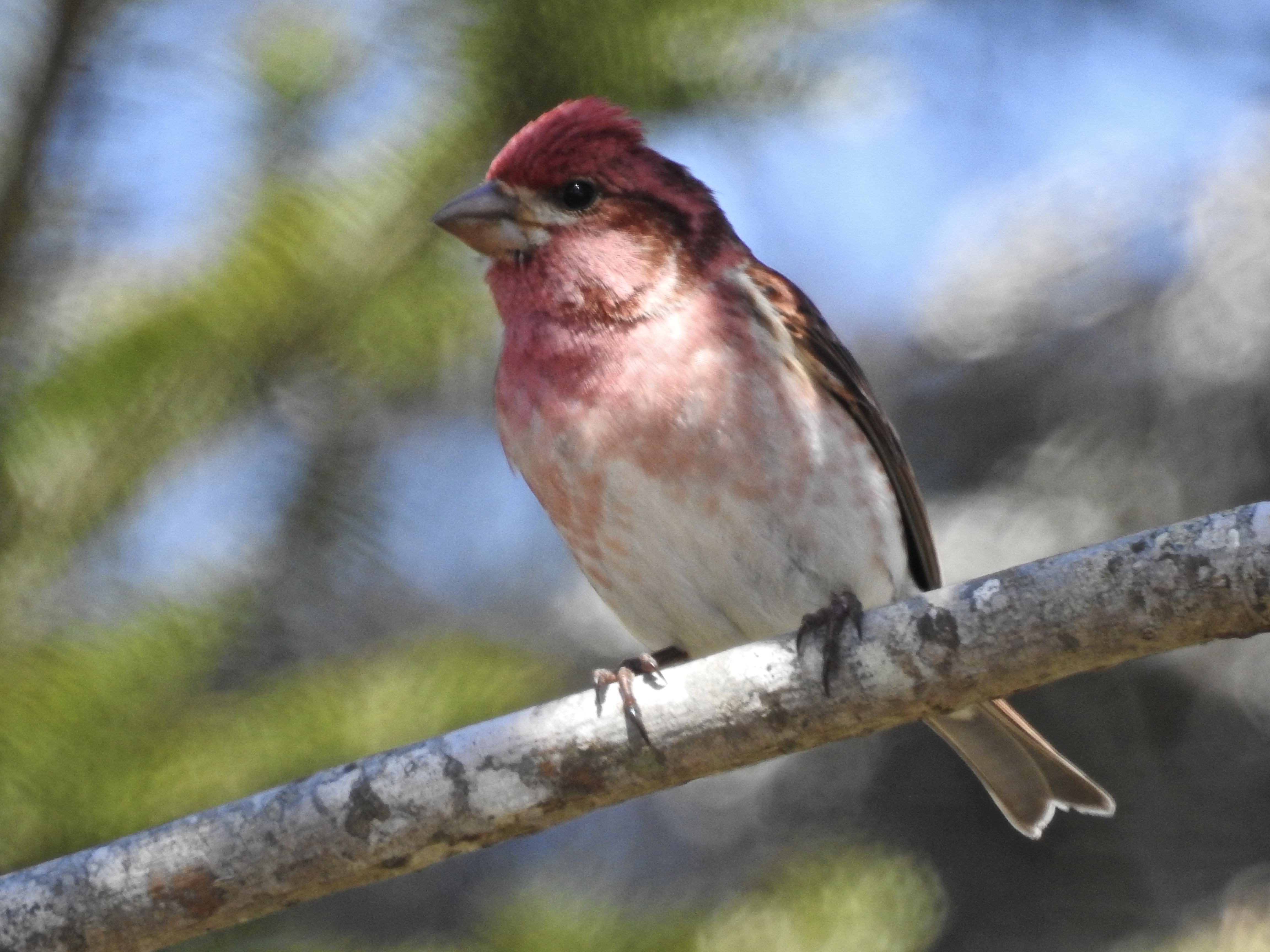
Purple Finch


                                                                    Purple Finch Male

The Purple Finch (Haemorhous purpureus) is listed in the Birds of New Brunswick:  An Annotated List  as a common summer resident and migrant and rare-to-fairly common in winter.  This winter must have been one of those 'fairly common in winter' winters.  We have had Purple Finches in the Fredericton area and also in other parts of the province for most of the winter; more numbers as the winter progressed.  They have been singing their beautiful warbling song in my area for 10 days or so now.  

The Purple Finch is a beautiful finch, the reddish purple of the male brightening up the stark trees of winter.  It is a friendly species which spends considerable time around cities and towns.  It readily comes to feeders so livens up our yards and can give us something to look forward to on bleak winter days.

                                                                    Purple Finch Male

The range of the Purple Finch covers a large part of North America.  It is listed as a permanent resident of the Maritime Provinces, southern Quebec and southern Ontario, New England and the areas just south of the Great Lakes; also in the extreme western parts of the US.  It is a summer resident in the rest of Canada south of a line from southern Yukon to Newfoundland.  It is a winter resident in the eastern half of the US (and in the areas of Canada where it is a permanent resident).  This species normally inhabits coniferous forests and mixed woods in the East.  In the West it prefers mountain coniferous forests and oak canyons.  This species can be erratic and is often found in our province in the upper St. John River valley and the northwest.  It is more likely to be present in winter when there is a good cone crop in our forests.  It regularly visits bird feeders where it readily eats peanuts, millet, suet, fruit, sunflower seeds and mixed seed.  In the wild it eats seeds, blossoms, buds, and fruits taken mainly from the outer edges of trees but sometimes from the ground.

The male Purple Finch is listed as both dark red and purple in colour.  It depends on the light but I have seem many males that show a beautiful magenta colour.  The male's rosy colour is brightest on the head and rump.  The back is brownish with pink stripes.  The bright rosy head shows a distinct paler pink eyebrow and a darker cheek patch.  There are two indistinct wing bars and the lower belly is whitish with varying indistinct streaking.  The undertail coverts are white.  The bill is large, conical and a light gray colour.  See the photos above.


                                                                Purple Finch Female

The female Purple Finch does not sport the beautiful red/purple colour of the male.  She is a subdued brown, streaky finch.  Her back and head are boldly streaked with a whitish eyebrow and submoustachial stripe that contrasts well with the dark brown cheek and malar stripe (below the cheek).  Her underparts are white with heavy dark brown streaking that does not extend to the white undertail coverts.  See photo above.   

The Purple Finch nests in conifers where it makes a cup nest of grasses and twigs, lined with fur.  Three to five light green eggs with black or brown blotches are laid.  The female incubates the eggs for 13 days.  

In our area the only species the Purple Finch has to be differentiated from is the House Finch.  The Purple Finch is stockier than the House Finch.  Its tail is shorter and deeply notched.  Its wings are longer and more pointed.  The House Finch has less red on the head and has a squared tail-tip.  In the west the Purple Finch also needs to be differentiated from the Cassin's Finch.   There are presently two named subspecies of the Purple Finch.  

The Purple Finch belongs to the Fringillidae family.   It was originally named in 1789 by Johann Friedrich Gmelin.  Purple Finches measure 12-16 cm long and weigh 18-32 g.  The Purple Finch is the state bird of New Hampshire.  In 1763 a female Purple Finch in Mexico was described by Richard Brookes who called it the Chia Seed Bird ('Chiantotot').  The Purple Finch and its two close relatives (House Finch and Cassin's Finch) were originally classed with the rose finches of Eurasia in the genus Carpodacus.  They have since been removed to their own species, Haemorhous,  because it was found that they are not closely related to the Eurasian finches.  

Tuesday, March 15, 2022

Red Fox Encounter

                                                                            Red Fox

As mentioned in a previous post (April 15, 2021) we have 1 or 2 active fox dens near our house.  These are dug into gravel banks near the river or in a gully.  Since we have good fox habitat on our property we often see and hear them.  In January and February we often heard their barks and 'howls'.  They often vocalize in breeding season which is now past.  

The foxes have become accustomed to our presence and will usually come near our house at night.  This they sometimes also do during the day.  One day last week when there were only small patches of exposed grass and weeds the fox came right up to the house in the day time.  Next to the foundation there was a 3-metre strip of grass where the snow had melted away.  The fox usually checks that area for mice on its way to better habitat further down the field.  On that day we saw her/him coming and watched from a glass door as she moved immediately along the house.  She stopped at the front door step and came right up on the porch!  A few seconds later I had my camera in hand and the attached photos are from that photo shoot.  As she got to the end of the building she made a huge leap and pounced on a clump of long grass and played catch with a fat vole that was hiding therein.  The vole got away and the fox carried on for further hunting.  At no time did she know we were within as little as 3 metres of her!

                                                                Red Fox in Mid-air Pounce

In the photo below notice how healthy and well filled out the fox is.  Also note there is no evidence of mange dermatitis.

                                                        Red Fox After Missing the Vole

The photo below shows the fox moving on to more hunting down the field.  What a fine specimen he/she is.

                                Red Fox Moving on for More Hunting Down the Field