Monday, August 1, 2022

Local Church Protects Cliff Swallows

                                                               Cliff Swallow Nests on Church


 For some reason the Cliff Swallows (Petrochelidon pyrrhonota) like to build their nests on the Scotch Settlement Church, York County.  And what is even worse for the parishioners is that they much prefer to build them over the main entrance!  Every year that creates a problem for people entering and leaving the building.  This year there are about 12 nests, all built over the entrance.  Some nests are singles, some doubles and some triples.  That makes a lot of activity, birds coming and going to feed hungry chicks.  

The nest-building this year is very robust.  There is a constant chorus of chirps and warbles as adults are coming and going and young are fed or letting it known that they are hungry.  The birds do not seem to be inhibited by the people of the church.  

                                             Cliff Swallow Adult About to Leave Nest

                                                Cliff Swallow Dropping Fecal Matter From Nest

The people of the church, however, do have a problem with the birds, or rather, their droppings.  As the nests became occupied in the spring the problem soon became evident.  Bird droppings began to appear on the carpeted steps to the church and the people had to quickly duck as they entered or left the building. An earlier attempt to dissuade the birds from building in that location, the hanging of CDs in the preferred areas, had failed.  The birds just built right among the CDS, even incorporating some of them into the mud of the nests.  

So, what to do?  The church people used a simple solution.  They turned the top step on its side in order to prevent the buildup of fecal matter on the carpet.  Then they roped off the front steps and asked the church goers to enter and leave by another door!  Bravo to the Scotch Settlement Church for putting the well-being of the birds ahead of their convenience!  After all, the birds are God's creatures too.  See below for how they altered their front door.

                                 Front Door of Scotch Settlement Church - Temporary Arrangement

 The bird enthusiasts and environmentalists in the area are happy.  Many thanks to the people of the Scotch Settlement Church for putting their concerns for the birds into action.  They have set a good example of care for the environment and its creatures.  

                                                    Scotch Settlement Church, York County

Saturday, July 16, 2022

Purple Gallinule - A Rare Visitor to NB


Purple Gallinule  [Jim Carroll Photo]

In early July, 2022, a Purple Gallinule appeared at a small pond in the Dipper Harbour area, along the coast of the Bay of Fundy.  Because it was happily living there the owners of the property chose to keep its appearance from the public in order to protect the bird and themselves from the normal parade of avid birders which follows the report of a rare bird.  Some of the photos in this blog were taken by a close friend/relative of the property owners.  This blog intends to provide information on this species which is a very rare visitor to NB.  For more information please search this blog for 'Purple Gallinule Killed by Cat' which describes a Purple Gallinule which appeared in Nova Scotia in the past. 

Of the 20 or more known records of Purple Gallinules to New Brunswick, most have been in the fall and were immature birds.  Spring visitors are much more rare and those are mostly adults, which is the case with our recent visitor.  The vagrant Purple Gallinules that arrive here are mainly due to severe storms which blow them way out of their normal range.  However, with global warming and the movement of the normal ranges of avian species northward, we might some day see Purple Gallinules breeding here in small numbers.  The normal range for this species is Florida, southern Alabama, Mississippi, Texas, Mexico and the Caribbean islands.  Vagrants can occur throughout the eastern half of the US and the Maritime Provinces.  

The preferred habitat for this species is lakes, pools, marshes and waterways.  Their diet consists of invertebrates, frogs, aquatic vegetation, seeds and berries.  They forage while walking slowly along shorelines, by wading and even by swimming.  They are most notable as they walk over lily pads in marshy ponds.  Their very large feet make them well suited for that!

                                                        Purple Gallinule  [Jim Carroll Photo]

The Purple Gallinule is about the size of a small chicken, 33 cm long.  On first view it looks like a blue bird with brilliant yellow legs and feet.  The upperparts are purplish blue which irridesce green.  The underparts are a deep blue with white undertail coverts.  The eye is red and the bill is red with a yellow tip.  There is a light blue shied on the forehead which sometimes looks white.  The feet are huge and are obviously a big help in manoeuvring  over marsh vegetation.  The juveniles have olive brown upperparts, pale brown underparts and a dark bill.  This species pumps its head when it swims. 

                                            Purple Gallinule  Showing Very Long Toes  [Internet Photo]

Purple Gallinules nest in marshes where they build their nests low over the water among dense sedges and rushes.  The nest is built from dried stems and leaves which are interwoven and well concealed.  In it are laid 5 to 10 pink or buff eggs marked with brown (6 to 8 being the average number).  Incubation lasts 22 to 25 days.  The young at first are covered with black fuzzy down.  

                                        Purple Gallinule With  Young [Internet Photo]

Purple Gallinules (Porphyrio martinica) are a member of the Rallidae family along with coots and rails.  Here in NB we need to differentiate the species from the Common Gallinule which is becoming a bit more numerous here and has even been known to breed.  The Common Gallinule is larger and is a dark gray colour.  It has obvious white stripes on its flanks.  Some might also confuse the Purple Gallinule with the American Coot but it is all black with a white bill.  There is another similar species which is an import from Europe, the Purple Swamphen.  It occurs only in southern Florida and is much larger, 50 cm vs. 33 cm.  Of interest, the Purple Gallinule has also been introduced to Europe!  We need to stop meddling with bird ranges.

The Purple Gallinule is an amazing species in many ways.  How does it arrive here when it appears to be such an awkward flyer?  It flies with those big legs and feet dangling.  It has even shown up as far away as Europe and South Africa!  It is also very versatile.  It can swim on the water surface like a duck but it can also walk on floating plants with ease.  And speaking of feet, it often uses them to hold food in order to feed.  See the photo below.

                                                            Purple Gallinule  [Internet Photo]

Purple Gallinules cackle almost constantly while flying, a kek kek kek.  The call note is described as a peculiar guttural sound.  This species can run fast and also dive under water and swim away from harm.  When not disturbed their movement over the water is graceful and elegant.  We have a lot of marshes in NB.  I would be delighted if we had many more Purple Gallinules!

Thursday, June 30, 2022

Mourning Warbler - A Late Starter

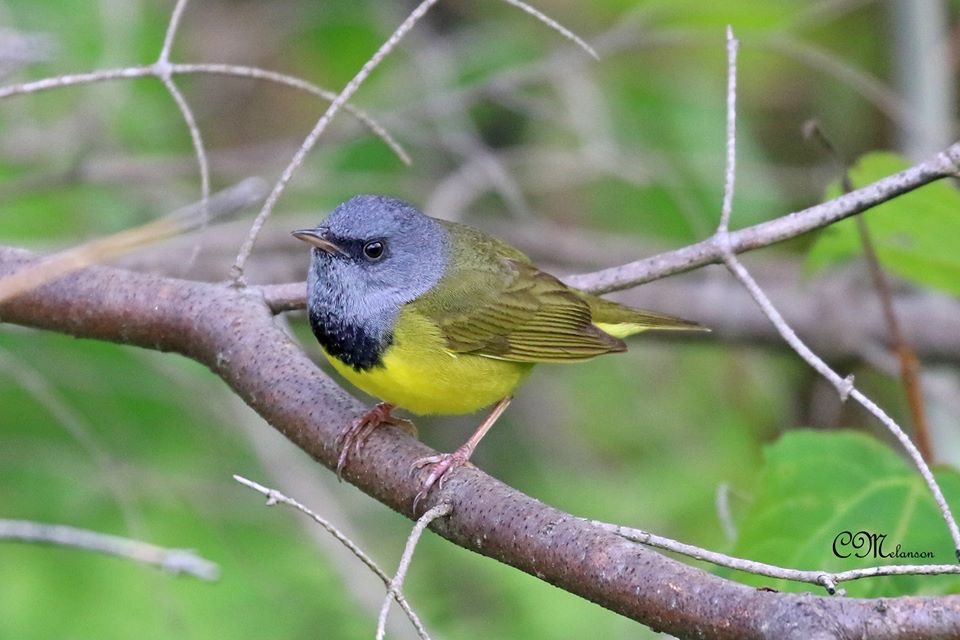
                                        Mourning Warbler Male   [Jim Carroll Photo]

The Mourning Warbler (Geothlypis philadelphia) is one of our latest warbler species to arrive in the spring.  They are an uncommon summer resident which breeds across the province.  They are more numerous everywhere than in the south-central lowland around Grand Lake and on the east coast.  They can be found from late May to late September.  Mourning Warblers prefer heavy tangled vegetation in forest openings and along forest edges.  They like ferns, raspberries and broadleaf shrub tangles.

                                             Mourning Warbler Male   [Jim Carroll Photo]

The Mourning Warbler, a member of the Parulidae family, is an intermediately sized warbler (13 cm long).  In breeding plumage the male has a bluish-gray hood and a variable dark patch on the breast.  The olive upperparts and yellow underparts make it outstanding in appearance.  There may be dark lores (patch in front of the eye) and the legs are pinkish.  Rarely there may be a thin white eyering.  The bill is pinkish with a dusky upper mandible.

The female in breeding plumage is similar to the male except she has a light gray hood and no or little black on the breast.  Her throat may be buffy or whitish and she may have a thin broken white eyering.  Like all warblers the plumage changes in the fall.  The males look similar to spring females except their heads and upperparts are all olive or brownish with a yellow or whitish throat.

                                     Mourning Warbler Female   [Marbeth Wilson Photo]

Other warbler species that one would need to differentiate this species from are MacGillivray's Warbler,  Connecticut Warbler and the Common Yellowthroat.  For us here in New Brunswick the Common Yellowthroat would be the most likely species one would have to watch out for.  But they have a longer tail, a smaller dark bill and they don't have the gray crown.  MacGillivray's are not seen here and Connecticut Warblers are very rare.  Connecticut Warblers have a distinctive complete white eyering and a shorter tail projection.   Connecticuts also walk and the Mourning Warbler hops to move itself along, a neat distinguishing feature.  

                       Mourning Warbler Male Showing Black Lores  [Carmella Melanson Photo]

The summer range of the Mourning Warbler includes Atlantic Canada, across the southern half of Quebec and Ontario and into the prairies north to touch a bit on northern British Columbia and the Northwest Territories.  It also is found south of the Great Lakes to about southern Ohio and Michigan and New England.  Their winter range is the southern part of Central America and the northwestern part of South America.  No wonder it takes them a long time to get here in the spring!

The song of the Mourning Warbler is not a mournful song as the name would suggest.  It is a happy, 'cheery' melody.  Their cheery cheery cheery chorry chorry is what led me to find my first ever member of this species.  It is an easy song to remember and describes this beautiful warbler.  So, why the name?  Well, the Mourning Warbler was named by Alexander Wilson, a famous American ornithologist, in 1810  because of the gray hood and the black markings on the male's breast.  He must have thought it looked like it was in mourning.  The 'philidelphia' part of the name came from the place where he first saw it.  Another ornithologist, Forbush, in 1929 took exception to the name given by Wilson and stated that the bird is active and happy and its song is a 'paean of joy'.  I agree with Forbush but unfortunately the name given by Wilson has stuck.  

The Mourning Warbler nests in dense undergrowth in forest clearings, usually near wet areas.  This is a vegetation type we don't often wander in so no wonder we don't often find their nests.  The nest, a well concealed open cup,  is on or near the ground and is made of fibres and leaves and lined with grass and hair.  Three to five creamy white eggs spotted with brown are laid and incubated by the female for 12 days.  Both adults will use the broken wing display to try to detract intruders from the nest.  After the young birds hatch, the female eats the egg shells.  Mourning Warblers feed on insects and spiders which they glean from tree and bush foliage. 

The Mourning Warbler population numbers are listed as stable.  This is one species that has benefitted from humankind's disruption of the forest.  It likes the bushy tangles that often are found where the trees have been cleared.  It also benefits from the broken continuity of the forest that often follows forest operations.  We have so much of that I am surprised we don't see more of this species in New Brunswick.

Monday, June 13, 2022

Yellow-bellied Flycatcher

                                        Yellow-bellied Flycatcher  [Jim Carroll Photo]

The Yellow-bellied Flycatcher (Empidonax flaviventris) is a common New Brunswick summer resident.  It migrates here in May and leaves in the fall.  It is a bird of the northern boreal forest and can be found throughout the province.  It likes dense spruce woods and dense understory with brushy vegetation.  

First let's review flycatcher classification from a New Brunswick perspective.  Knowing where the species fits and what are its close relatives helps with identification.  More broadly speaking, there are 3 major categories of flycatchers: Tyrant Flycatchers, Old World Flycatchers and Silky Flycatchers.  The Old World Flycatchers act like the New World Flycatchers but they are not closely related.  The Silky Flycatchers are flycatchers of Middle America and are different from the Tyrant Flycatchers, which is the group that this post deals with.  

The Tyrant Flycatchers, family Tyrannidae, include the Empidonax and Myiarchus flycatchers as well as the Phoebes and the Kingbirds.  The Empidonax and the Myiarchus flycatchers present some of the most difficult identification challenges in birding.  For identification one must pay attention to the overall shape, head shape, bill structure, primary projection, and wing feather formula.  This group eats insects with a few eating small fruits during migration or on the wintering grounds.  Most sit on a perch and fly out to grab an insect.  Some return to the perch to eat the insect; some to another perch; some hover before grabbing the prey; some fly out from the perch to grab the insect on the ground.  Differences in foraging methods can be used to help identify the species.  

The plumage of males and females is usually the same in Tyrant Flycatchers.  This family is very large and is exclusively found in the New World.  Although found in most of the New World, there are by far the most member species in the tropics.  Of 425 member species altogether, 45 species are found in North America; 35 of these breed here and 10 are vagrants.  Flycatchers are threatened species caused by loss of habitat, fragmentation of habitat and habitat degradation.  

                                            Yellow-bellied Flycatcher  [Jim Carroll Photo]

So what flycatchers do we have in New Brunswick and how does the Yellow-bellied Flycatcher fit in?  The Tyrant Flycatchers we have are grouped as follows:
Peeweees - Olive-sided Flycatcher - Contopus cooperi
                    Eastern Wood-Pewee - Contopus virens
Empids - Yellow-bellied Flycatcher - Empidonax flaviventris
                Alder Flycatcher - Empidonax alnorum
                Willow Flycatcher - Empidonax traillii
                Least Flycatcher - Empidonax minimus
Phoebes - Eastern Phoebe - Sayornis phoebe
                Say's Phoebe - Sayornis saya
Myiarchus Flycatchers - Ash-throated Flycatcher - Myiarchus cinerascens
                                        Great Crested Flycatcher - Myiarchus crinitus
Kingbirds - Eastern Kingbird - Tyrannus tyrannus
                   Western Kingbird - Tyrannus verticalis
                    Scissor-tailed Flycatcher - Tyrannus forficatus
                    Fork-tailed Flycatcher - Tyrannus savana 

There are many more members of these groups in North America.  I have included most of the species we find here in summer with a few vagrants that often show up here.  

The Yellow-bellied Flycatcher is a small bird, 14 cm long.  It is mostly yellow all over. It appears short-tailed and big headed.  The head has a round crown (some species have a flat crown).  It has a moderate primary projection (in the folded wing, the distance from the end of the primary feathers to the tip of the tertial feathers).  The bill is broad-based with a pale yellow-orange to pink lower mandible.  The adult bird is mostly olive above and yellow below.  There is an olive green wash over the sides of the breast.  The bold eyering is even all around and yellowish in colour.  It can be slightly thicker behind the eye.  The wings are black with bright white wing bars.  Similar species include the Acadian Flycatcher and the Least Flycatcher.  The Acadian Flycatcher does not occur here but the Yellow-bellied Flycatcher is smaller with a shorter primary projection and smaller bill.  The olive wash on the breast also helps identify it as a Yellow-bellied Flycatcher.  In the fall when the birds' feathers are more worn, the Yellow-bellied Flycatcher can be mistaken for the Least Flycatcher but the throat of the Yellow-bellied Flycatcher is a more blended colour and the mandible is uniformly pale.  

Flycatchers are not noted for their song.  This is due to the anatomy of the syrinx.  The call of the Yellow-bellied Flycatcher is a sharp, whistled chiu.  The song is a che-bunk like the Least Flycatcher but softer and lower in tone.  It is not as 'snappy' as the Least's song, according to David Sibley.  

Yellow-bellied Flycatchers occur in summer on their breeding grounds all across Canada from Newfoundland and the Maritimes to Yukon, but not including most of British Columbia and southern Alberta and Saskatchewan.  In the fall they migrate back to their wintering grounds in eastern Mexico and Panama using the overland route.  They do not fly over the Gulf of Mexico.  

Yellow-bellied Flycatcher nest in the boreal forest close to the ground.  The nest is usually built within 2 feet of the ground usually on top of a hillock or stump or among rootlets or fallen trees.  The nest is made of twigs, rootlets, weeds, and moss and lined with thin rootlets, grass and fresh leaves.  Three to five white eggs spotted with brown are laid and incubated by the female.  

The Yellow-bellied Flycatcher species was first described by an American, Spencer Fullerton Baird, in 1843.  By some sources the Yellow-bellied Flycatcher is described as the easiest of the Empidonax flycatchers to identify.  I would add that this group is very difficult!  One very interesting fact about this species is that it winters in semi-open habitats including coffee plantations and that shade-grown coffee plantations have higher densities of this species than do sun-grown coffee plantations.  This also is true for other avian species.  Do your research on where coffee is grown and support shade-grown coffee products in order to save our avian species.    

Saturday, June 4, 2022

Black-necked Stilt - Nemesis Bird

                                            Black-necked Stilt  [Mark Dennis Photo]

On May 22, 2022 birders spotted 2 Black-necked Stilts at Cape Sable Island, Nova Scotia.  This is a rare species to show up anywhere in Atlantic Canada.  When they do appear, birders 'flock' from near and far to see them.  Where did they come from and where are they going?

Stilts and Avocets are members of the Recurvirostridae family.  Stilts are officially listed as 'accidental' in New Brunswick and Avocets as 'casual', according to the Birds of New Brunswick:  An Annotated List.  There have been few records over the years of Black-necked Stilts in New Brunswick.  There was one from the mouth of the St. Croix River in 1862; one from Maces Bay in 1880; three near Woodstock in 1982; and one from Jacquet River in 2000.  

The reason I call this species my 'nemesis bird' is that I have been hoping for most of my birding life to see this species.  Trips to western North America can easily produce sightings but I have not been in the right place at the right time.  The Jacquet River specimen is the closest I have come.  A group from Fredericton drove up to see the bird on 6 June, 2000 and we missed the bird by 15 minutes!  It was there 15 minutes before we arrived and was gone when we scanned the area.  We drove 4 hours each way only to miss the bird!  Such is the makings of birding stories.

I have watched many American Avocets over the years from singles to small flocks at once hoping to find a Black-necked Stilt with them, which often happens.   No luck.  I keep trying and hopefully will be lucky enough to get my binoculars trained on a beautiful Black-necked Stilt someday.

                                                            Black-necked Stilt  [Internet Photo]

The Black-necked Stilt is a unique-looking species.  It is 33 cm long with a 6.4 cm bill and the tarsus is 11.3 cm long.  It is boldly pied with black above and white below.  It has long pink or sometimes red legs and there is a white spot above and behind the eye which shows well on the black crown and face.  The bill is long, needle-like and black in colour.  The female is duller with brownish tones.  Note the black on the upper/dorsal neck which is important to note in order to distinguish the Black-necked Stilt from the much rarer Black-winged Stilt which very rarely shows up in North America from Eurasia.  The American Avocet shares the same habitat as the Black-necked Stilt but it is bulkier with an orange or gray head and much more white on it.  

The Black-necked Stilt is a graceful wader that looks very elegant.  In fact, one wonders how it manages those long legs.  It is highly social and feeds in water picking insects and other invertebrates from the surface.  It feeds by sight so you don't often see it probing the mud like some shorebirds do.  You might see large numbers of them feeding in good feeding areas on their normal range.  They will aggressively mob both aerial and terrestrial predators when threatened, even humans.  I think I would like to be mobbed by a group of Black-necked Stilts, especially if I had my camera in hand!  This species is noisy on the breeding grounds and less so during migration or in winter.  Their voice is a loud kek, kek, kek, kek.  In flight you would see the long pink legs trailing out behind and the plumage a bold black and white.  The wings are pointed and the wing beats are often halting.  

The Black-necked Stilt breeding range includes Washington State, Alberta, Oklahoma, and Virginia south throughout lowland areas to northern South America and the West Indies.  They winter in California, the Gulf coast and southern Florida south to the tropics.  Vagrants can be found in southern Canada and Bermuda.  

Black-necked Stilts breed in loose colonies in shallow, marshy lakes and coastal salt ponds.  Non-breeders move along with the breeding birds.  The nest is a shallow depression in the ground lined with grass and shell fragments.  Three to five yellow or buff eggs spotted with brown are incubated by both adults for 22 to 25 days.  The young, when they get their feathers, are grizzled-looking, paler than the adults with buff-edged feathers and greyish pink legs.  Stilts feed in both fresh and salt water on tadpoles, mollusks, aquatic insects, snails, small fish, flying insects and seeds.  

The Black-necked Stilt species was first described in 1776 by Philipp Ludwig Statius Muller, a German zoologist.  Black-necked Stilts can swim but they usually do not.  It is interesting to note that Black-necked Stilts have the second longest legs in proportion to their bodies of any avian species.  Can you guess which species has the longest? ... flamingos.

Monday, May 23, 2022

Chestnut-sided Warbler

                                                        Chestnut-sided Warbler [Internet Photo]

The Chestnut-sided Warbler is one of the many wood warbler species that migrate into New Brunswick each spring to breed, raise their young and spend their summers.  Wood warblers make up the family, Parulidae, which contains 56 species of 15 genera.  We have approximately 38 of these species here 
with 13 of them being rare or very rare.  We have so many warblers migrating into NB in the spring that they can be seen as a huge patch on radar screens as they wing their way here.  New Brunswick (and eastern Canada) are unique in the world with the diversity and beauty of wood warblers present in spring, summer and fall.  European birders, for example, envy us.

The Chestnut-sided Warbler (Setophaga pensylvanica) is a typically sized warbler; 13 cm long.  They are common here and can be seen flitting around bushes and low shrubbery gleaning insects from under the leaves.  They are fast-moving but so worth getting a good look at or a photo.  They often droop their wings and cock their tail.  

                                                                 Chestnut-sided Warbler

The male and female adults look much alike, the female being duller with less black and chestnut markings.  The adult male is beautiful with his bright yellow crown (deep gold or green gold (in artist speak)), black lores, eyeline and malar stripe.  Note the big chestnut stripe on the sides of his breast and flanks, the white throat and breast and the white cheek.  He has 2 pale yellow wing bars, some yellow in his wings and striping on the back.  

The fall plumage is very different, as it often is in warblers.  In the fall both male and female have bright lime green (green gold) upper parts including crown and a pale gray cheek, throat and upper breast.  Of note is the white complete eyering.  In my experience, when you see a fall-plumaged Chestnut-sided Warbler the greenish upper parts jump out at you.  All you need to know is that this is a Chestnut-sided Warbler!

What similar species do you need to know?  The breeding plumage is distinctive so no problems in identification there.  In the fall,  you need to distinguish them from fall-plumaged Bay-breasted Warblers and Blackpoll Warblers.  But the green upper parts and eyering identify it as the Chestnut-sided Warbler. 

                                                               Chestnut-sided Warbler

Learning bird calls is very helpful in warbler identification.  Warblers are hard to see because they move around quickly in the foliage and are mostly hidden.  There are many computer programs available now to help with this task.  I can't stress enough how helpful it is to learn the warbler songs.  For example, this morning I was outside (doing chores) and heard beautiful bird song from our apple tree which was in full bloom.  One species was the male Baltimore Oriole who appeared to be telling me how much he loved the apple blossoms.  The other was a warbler which I could identify as a Nashville Warbler without even seeing the bird.  As the leaves quickly expand fully, that skill will be even more useful. 

The Chestnut-sided Warbler song is described as rich and musical and can be learned by interpreting it as 'please please pleased to meetcha'.  This makes learning this song easy.  There can be two different Chestnut-sided Warbler songs.  The one described above is used by the male to attract a female.  It decreases in frequency as the female sits on the eggs.  This song is known as the 'accented song'.  Males also sing an 'unaccented song'.  That is a song with the 'meetcha' removed from the end.  This song is used in territory defence and in warding off other males.  Research has shown that some males sing only the 'unaccented song' and that those males are less successful in finding mates.  The females must like the accent on the end of the song!

The range of the Chestnut-sided Warbler is most of eastern Canada from the central prairies to Nova Scotia, around the Great Lakes and down into the eastern US.  They winter in southern Mexico and Central America.  It is hard to believe this beautiful little bird can travel that far!  The preferred habitat of this species is second growth forest and scrubland.  Because so much of our forests were cut in the late 19th and 20th centuries, the second growth accelerated the population numbers of this species.  Unfortunately they have been declining some in recent years.

Chestnut-sided Warblers feed mainly on insects but also on some fruits.  They build their nests a few feet above the ground in a small tree or bush.  The nest is made of grass and bark and lined with hair and rootlets.  Three to five white to pale green eggs blotched with purple or brown are laid and incubated 11 to 13 days by the female.  

Chestnut-sided Warblers are neat warblers to learn and appreciate.  Ornithologists tell us that even though they have had a decline in numbers their population is still listed as 'least concern'.  If you haven't seen this species, go outside into the bushes and low trees and listen for 'please please pleased to meetcha'.  You will be happy to meet his beautiful warbler.  

Tuesday, May 3, 2022

Blue-gray Gnatcatchers Arrive

                                               Blue-gray Gnatcatcher  [Jennifer Pierce Photo]

There have been several reports of Blue-gray Gnatcatchers (Polioptila caerulea) seen in the province since early April.  These are exciting to see since we are out of their normal range.  Their normal summer range is the central US with some occurring into New England.  They winter from southern California to the Gulf coast and the Carolinas, southward to Mexico and the Caribbean islands.  For a full discussion of this species, please search this blog (November 16, 2017).

Gnatchatchers are tiny, active insectivores.  They raise and flick their tails (constantly!) supposedly to raise insects which they then devour.  One time I watched a flock of these birds and they were very active, flicking their tails and making short flights in every direction to catch insects around a salt water wharf.  They would quickly move from bushes and low shrubs to seaweed covered rocks.  They certainly were having a good feed! 

Gnatcatchers resemble hummingbirds in their nest sites and nest structure.  They build a tiny cup nest which they place on top of a horizontal branch and then decorate with lichens.  We have seen many hummingbird nests so would probably overlook a gnatcatcher nest for a hummingbird nest.  The Gnatcatcher nest would be a bit larger, the gnatcatcher being 10.8 cm long (a lot of that being tail) compared to the 8-cm Ruby-throated Hummingbird.  And, the Blue-gray Gnatcatcher weighs 6 grams compared to the 3 gram weight of the Ruby-throated Hummingbird.  

                                            Blue-gray Gnatcatcher  [Jennifer Pierce Photo]

The Blue-gray Gnatcatcher is a member of the Polioptilidae family (gnatcatchers and gnatwrens).   It was first described by Linnaeus in 1766.  There are 4 species of gnatcatchers in North America; California Gnatcatcher, Black-tailed Gnatcatcher, Blue-gray Gnatcatcher, and Black-capped Gnatcatcher.  The other 3 species are birds of the far west and south.  

The Blue-gray Gnatcatcher is the only truly migratory member of the family and has the northernmost range.  Fortunately for us, this species is expanding its range northward.  So watch out for them with chickadees and kinglets or with warblers.  They are a beautiful sight.

Sightings this year have occurred on Grand Manan where the photos above were taken and in the southeastern part of the province.  Since they could occur anywhere in the province, keep this species in mind.  They prefer to nest in swampy woods, so look for their nests when out birding or botanizing.  They nest as close as Southern Maine.  There was one report of a nest at Sackville in 1989.  Given this, we are likely to have a nest or two here this summer.