Friday, February 24, 2017

Gyrfalcon

North America's Rarest Falcon Seen in Nova Scotia


Gyrfalcon - Dark Morph - Juvenile  [Jason Dain Photo]
The Gyrfalcon is a very rare winter resident and migrant to Atlantic Canada.  For the last few days there has been one reported from the River Hebert area, near Joggins, NS.  This bird was seen and photographed by several birders on Tuesday, Feb. 21, 2017.  A big 'thank you' goes out to both Jason Dain and Carmella Melanson for the use of their photos.  These are prized images which provide a great educational opportunity for birders, environmentalists, and general nature lovers.

The Gyrfalcon is the world's largest falcon.  It is 51-64 cm long (20-25 in).  For comparison, the Peregrine Falcon is 41-51 cm long (16-20 in).  The Gyrfalcon sits upright often on manmade structures or cliff edges, presumably watching for prey.  It is a super hunter, capable of taking down flying geese or cranes.  Here it would probably be feeding on waterfowl or pigeons.  Its colour is variable.  It occurs in three colour morphs; white, gray and dark; sometimes listed as white, intermediate and dark.  Genders are similar but juveniles are a bit different.  As in most raptors, females are larger.  

The Gyrfalcon is a large, bulky falcon.  It is not as sleek looking as our other falcons (kestrel, merlin, peregrine falcon).  Its wings are wide at the base and pointed.  In flight the tail base looks wide and the tail is longer than that of the peregrine falcon.  When perched the wings extend about 2/3 of the way down the tail length.  In flight its wing beat appears slow but don't be fooled.  This bird is a very fast killing machine.  

The dark morph is dark gray to gray-brown on the back and wings with heavy striping on the breast and underneath.  The gray morph is similar to the dark morph but much lighter overall.  The white morph is all white with dark wing tips and streaks mainly on the upper body parts.  Underneath all morphs show lighter trailing edges of the wings and darker wing coverts.  See photo below.

Gyrfalcon - Dark Morph - Juvenile [Jason Dain Photo]
The adult Gyrfalcon shows yellow on the cere (base of bill), feet and around the eye.  In the juvenile, these features are gray.  

Adult Gyrfalcon [Icelandic Bird Guide, Hilmarsson, JO, p. 106]
The Gyrfalcon has been a famous hawk since medieval times when it was the most desired species for falconry.  Only kings were allowed to use this species.  Unfortunately, falconry is still going on today and these birds are being captured and kept in captivity for this purpose.  

The Gyrfalcon is a holarctic species. In North America it is a year-round resident of Alaska, northern Yukon, Nunavit and Northwest Territories, Ungava, north to our northernmost islands.  It is rare south of these areas, usually coming south in winter.  We have records for New Brunswick for 1989, 1991, 1994, 2000.  I have been lucky enough to have seen 2 gray morphs in Iceland and a white morph here in New Brunswick.

Gyrfalcon [Carmella Melanson Photo]
Gyrfalcons nest on cliffs or in abandoned raven nests.  Breeding occurs only in the far north.

All the photos shown (except the light gray morph taken from the Icelandic Bird Guide) are of the same bird now present somewhere in Nova Scotia.  It is possible this bird will stay around for a few days yet.  We were unable to locate it yesterday.  We wish it well as it soon journeys to the far north to breed.

Thursday, February 16, 2017

House Sparrow

Old World Species Gets Scarcer

House Sparrow - Male
 The House Sparrow (Passer domesticus) was once a common resident of New Brunswick.  Its numbers have been declining since about 1970.  It was very common in the first half of the 1900s probably because it embraced agricultural communities and city environments in which horses were common.  It is an introduced Eurasian species and was first reported in New Brunswick in 1884.  It all started when eight pairs were released in Brooklyn, New York in 1851.  Several more releases occurred after that, some in the 1870s.  Other groups were captured and released in various places throughout the United States.  One reason this was done was to provide familiar wildlife for local residents who had come from Europe.

House Sparrows are a unique species and have several behavioural traits which set them up for success as an introduced species.  They prefer to live near human habitation.  This provides food and nesting sites and some protection from predators.  They are an active, aggressive species and can successfully compete for food and nesting sites with native species.  They nest before our native species arrive back in the spring so have their preference of nesting sites.  They have 2 or 3 batches per year of up to 5 offspring each.  These traits lead to rapid population increases.

House Sparrow - Female
The House Sparrow is a gray/brown short-legged sparrow.  It represents a different family from our native sparrows.  The male has a black bib, gray crown and brown band from the eye backwards across the neck.  The female is gray/buff with a buffy line over the eye.  In the non-breeding season the male's plumage becomes more brown-buff in colour with a buffy colour infringing on the bib and brown eye line.  Many of us remember the discordant 'cheep cheep' sound these birds make.  They definitely are not musical.

The range of this species covers all of North America and Mexico and extending northward into Labrador and Northwest Territories.  I was surprised recently to see pictures of them thriving in Churchill, MB.  Having Eurasian distribution, they are native to Britain, Scandinavia, Siberia, northern Africa, Arabia, India and Burma.  Because of introductions by humans they have become established worldwide almost everywhere except Antarctica.  Because of this their population is extremely large.  In Europe alone their population is estimated to be 270 million.

House Sparrow - Male, Non-breeding Plumage
House Sparrow - Female, Non-breeding Plumage
Why has our population been declining since 1970?  That is a question pondered by many birders.  This year is the first year we did not find any on the Mactaquac Christmas Bird Count.  Every year since its inception we have found this species around cattle barns.  Very few House Sparrows live in Fredericton now.  The decline is a worldwide phenomenon.  Scientists do not know exactly why this is happening,  It certainly would be multi-factorial.  The huge decrease in the number of farms, removal of horses from the streets, improvement in grain-harvesting efficiency, and use of insecticides would be some of the reasons.  It will be interesting to see what will be the final results of scientific investigations.  As much as many people dislike these spunky little sparrows, it is sad to see them decline so severely.

Thursday, February 9, 2017

Townsend's Solitaire

Rare Western Thrush Visits NB

Townsend's Solitaire
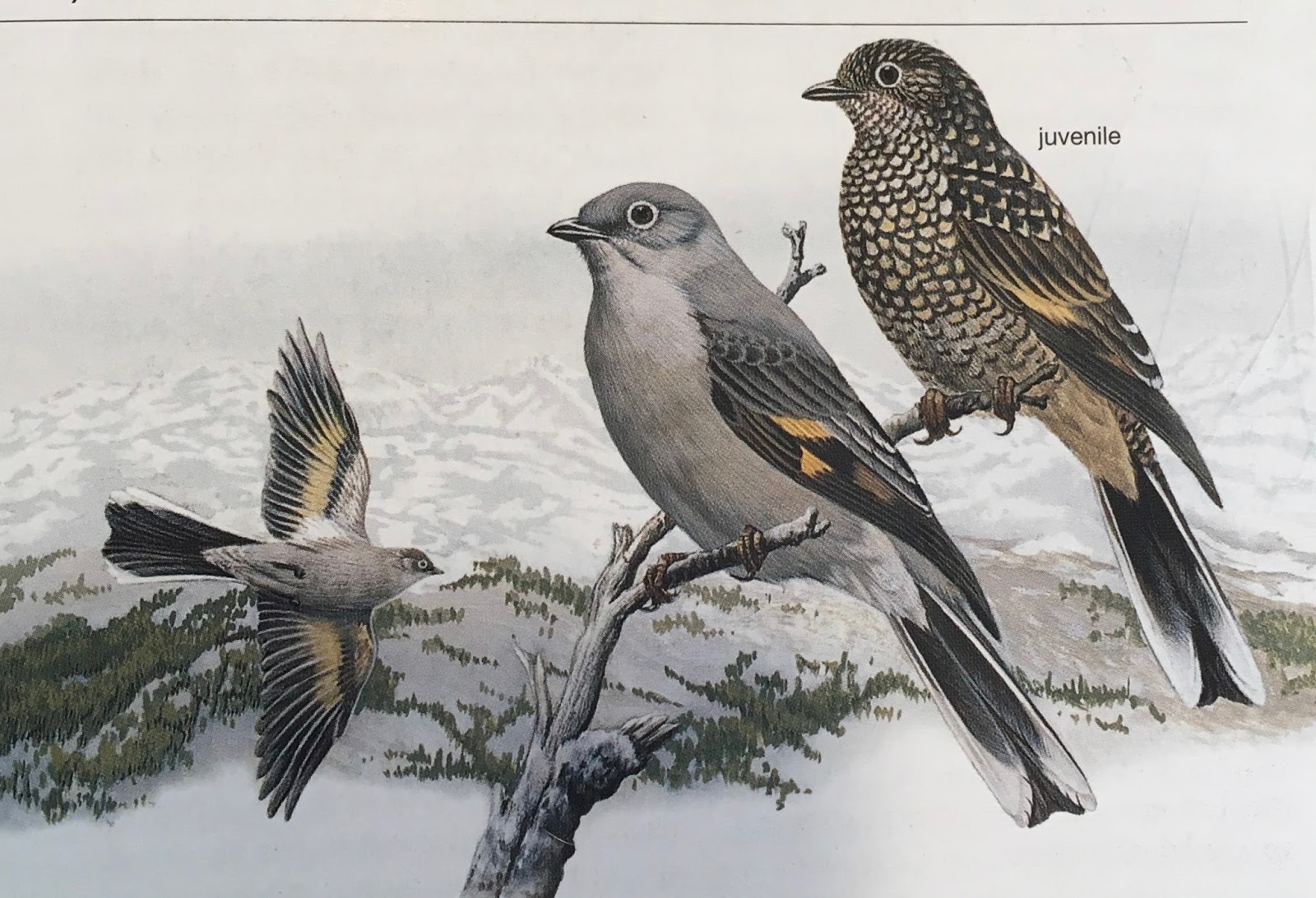
For the past 3 weeks there has been a Townsend's Solitaire (Myadestes townsendi) visiting a feeder area in Riverview.  As shown above, this is a long, slender very gray bird.  It is a member of the Thrush Family (Turdidae) but is a little different from other thrush members that normally live here, e.g., robins, hermit thrushes, bluebirds.  

The Townsend's Solitaire is dark gray above and light gray below.  It has a small dark bill, distinctive white eyering and splashes of beige on its wings.  It has white outer tail feathers and shows a buffy-orange colour under its wings in flight.  It is 21.5 cm long (8.5").  In the photo above note the eyering.  This bird is just beginning to show a bit of beige on the wings.  It is probably a juvenile just getting its adult plumage.

Townsend's Solitaire [National Geographic Complete Birds of North America, p. 483]
The illustration above shows the adult, young and a bird in flight.  Note the buffy/beige patch on the wings of the perched adult and the white outer tail feathers.  The bird in flight shows the distinctive buffy-orange under the wings.  Most young thrushes are spotted as shown above.  Note the long tail.  It would be very unusual to see a young bird here because the bird does not breed in this part of North America.

Townsend's Solitaire
It is rare for this species to show up in NB.  It normally breeds in British Columbia, Yukon and Alaska and winters in the western US south to Mexico.  It is a permanent resident in the mountains of the western US.  Townsend's Solitaires breed in the mountains and come to the lowlands for the winter.  They feed on insects, worms and berries.  Normally they feed on juniper berries in winter.

According to Birds of New Brunswick An Annotated List there have been about 15 records of visits of this species to NB.  They come in fall and winter and often do not come to feeders.  Clearly their arrival is a result of disturbed migration patterns.

Thrushes are noted for their songs.  This species sings a very long warbling sound much like a purple finch or certain warblers.  There is no common species here that one would mistake this species for.  However, it could be mistaken for a Northern Mockingbird which shows up here in small numbers every year now.  The mockingbird is larger and does not have the white eyering, has two white wing-bars and a longer bill.

Winter is an unique time for those interested in birds.  The cold weather and scarcity of food tend to bring birds to feeders.  That makes it easier to notice a rare visitor.  We have had many this year in New Brunswick.


Thursday, February 2, 2017

Pine Grosbeak

Colourful Winter Finches

Pine Grosbeak - Male
A gentle melodic twitter coming from a group of apple trees is a clue to look among the branches and on the ground under the trees for Pine Grosbeaks.  Their full song is a beautiful melodious warble.  

Pine Grosbeaks are a large plump finch (23 cm/9 in) which visits us only in winter, some winters more than others.  This year is a poor finch year so we have only a few Pine Grosbeaks.  They love fruit and berries so would be found in apple and crab trees and in bushes bearing fruit at this time of year.  

The male Pine Grosbeak shows a beautiful pink-to-reddish-pink colour on the head, breast, back and rump.  He is gray on the sides and belly.  His wings are black with two fine white wing bars.  The tail is long, black and notched.  The bill is black, large but stubby.  There is significant regional variation in the intensity of the pink/red colour.

Pine Grosbeak - Female
The female shows a lot of light gray colour with deep yellow to rust on the head, back, and rump.  The wings are gray with two fine white wing bars.  Juveniles resemble the females.

The only species here one would mistake for a Pine Grosbeak is the White-winged Crossbill.  It has similar coloration but is only 2/3 the size and has a very distinctive crossed bill.  Both species feed on spruce cones so partly share the same habitat.

Pine Grosbeak - Male
In the photos above the grosbeaks were feeding on crab apples.  They are a tame species and do not pay humans much attention.  One can get reasonably close for photos.  It is important to give these birds respect and not get so close they are forced to fly away.  They are in these feeding areas because they need food and safety.

Pine Grosbeak - Female [N Poirier Photo]
The photo above shows a different female than the previous one.  Notice the yellow colour is much darker and she is eating high-bush cranberries.  

The Pine Grosbeak is a holarctic species.  It lives in the northern hemisphere around the world.  Here in North America it breeds in the far north.  It winters in the Maritime provinces, the southern parts of the rest of Canada (except British Columbia) and the northern states east of the Rockies.  It is a permanent resident in the area in between these areas.  It prefers coniferous woods as its name implies but feeds on fruit mainly in winter.  

When we have winters with a large population of Pine Grosbeaks present, it is called an 'irruption'.  What makes years when we have many and years when we have few or none?  The abundance or lack of fruit determines its movement in flocks.  That is what drives irruptive years and years of scarcity of this species.  We have lots of fruit this year but they must also be finding plenty further north, hence the low population here so far this winter.  We may have more flocks move in as the winter progresses.

Thursday, January 26, 2017

Labrador Duck

Labrador Duck (Camptorhynchus labradorius


Labrador Duck [John Gerrard Keulemans Illustration]
The Labrador Duck is a little known extinct duck from our part of North America.  It was an uncommon duck when the first settlers came to northeastern North America.  It became rare in the 1850s to 1870s and was extinct by 1878.  It was also known as the Pied Duck or the Sand Shoal Duck.  Some locals called it the Skunk Duck but that term also included the Surf Scoters and Common Goldeneyes.

Labrador Duck [Painting by Louis Agassiz Fuertes]
The life history of the Labrador Duck is not well known.  Much of our information is assumed by extrapolation from other duck life histories.  That is unfortunate because our population was 'young' as a nation and uninformed and facts were not gathered and we were not aware that this species needed protection.

Labrador Duck [John James Audubon Painting]
From what we know or have assumed, the Labrador Duck lived in northeastern North America only.  It bred along the coast of Labrador and along the Gulf of St. Lawrence.  It wintered along the coast of the Maritime Provinces and down the eastern seaboard of the US as far south as  New Jersey and Chesapeake Bay.

Although the breeding biology of this species is unknown it probably nested on rocky cliffs or on islands.  It fed on molluscs, shellfish and seaweeds.  It preferred sandy shoals where it used its long, wide bill to glean food.  I picture its feeding behaviour as similar to our Harlequin Ducks.  Its common name tells us it preferred shallow water.

Labrador Duck - Male
The Labrador Duck was beautiful.  As seen above, the male was pied, black and white.  Its head was long and the bill was almost as long as the head.  Its eyes were small (this may be a taxidermy specimen error).  It was certainly adept at life in the surf.  Its bill was unique, long and wide and 'soft' with lamellae for sifting out food.

Labrador Duck - Female
The female was very gray overall.  We don't know a lot about the juveniles.  The Fuertes painting shown above shows a young male which is quite gray with white starting to show on the head.  The wings of the males were unique with an all-white wing except for the primaries.  They must have been beautiful in flight!

There are 54 (or 55 according to Chilton 2009) specimens existing, scattered throughout the world from museums, private collections and even in the possession of Sheik Saud of Qatar.  They have been sold, traded, looted, fraudulently copied, and narrowly escaped destruction in world wars.  Fortunately some good specimens still exist.  We have one specimen in Canada at the Redpath Museum in Montreal.  The US has specimens at Harvard and the Smithsonian.  They can also be found in the UK, Germany, the Netherlands and other places.

Audubon was in Labrador in July, 1833 and could not find the Labrador Duck.  He lists a breeding site, his son having found possible nests.  This was circumstantial evidence only and is generally not accepted.  One would assume that if the duck were there Audubon would have found it.  In 1840 Audubon wrote that the flight of the duck was swift and its wings emitted a whistling sound.  In 1891 S.F. Cheney of Grand Manan wrote that the Labrador Duck he had shot sometime in the past had small shells in its crop and it was accompanied by long-tailed ducks.

The Labrador Duck is our most mysterious duck.  Why did it go extinct, especially since it was scarce when the white man first came here?  No one really knows.  It doesn't seem to be because of environmental causes. Some think it was not from market hunting because it apparently was not a good-tasting duck and was not popular in the markets.  It was not often seen in the markets probably because it was rare.  I think it went extinct  because of a combination of factors.  I think market hunting did have an affect.  Any amount on a rare species would have an impact.  I think the other reason was the same reason the Great Auk went extinct - nest destruction.  I think the native people, seafarers, and other predators extensively robbed nests of eggs and the birds were constantly on the decline.  I expect this species could not readapt to new breeding sites where they were safe from predation.

The first depiction of a Labrador Duck was a drawing done in 1792.  Once its presence became known, collectors were on its trail.  It took less than 100 years for it to meet its demise.  A sad testament to a beautiful species and a regrettable step for humankind.

Reference

Bent, A.C. 1925. Life Histories of North American Wild Fowl Part Two.  Dover Publications.
Chilton, Glen 2009. The Curse of the Labrador Duck.  HarperCollins.

Thursday, January 19, 2017

Mactaquac Christmas Bird Count

Local Birders Conduct Citizen Science

Hairy Woodpecker
January 1st brings a group of birders to the Mactaquac area to do an annual bird census, the Christmas Bird Count.  Over 50 counts are done in New Brunswick between the dates of December 14 and January 5.  Counts are done in the same 24 km circle every year.  This provides useful data on bird populations and all the factors that might influence them.  The Mactaquac circle goes from Keswick to Granite Hill and Kingsclear to Upper Prince William.  This year 14 people took part.

Bald Eagle
The count yielded 36 species and 1965 individuals.  The group drove almost 400 km and worked about 24 hours altogether, a commendable effort.

Pine Grosbeak [N Poirier Photo]
Below are the results.  They show a rather low count for finches.  That was expected because the cone crop was low in the area.  There was an excessive number of Blue Jays in some sectors.  This was the first year we did not record any House Sparrows.  Their numbers have been dwindling for many years and normally a close look around active barns would produce some.  This year we found none.  

Surprise findings were a Brown Thrasher coming to a feeder in Upper Queensbury.  This was the first time we have had Wild Turkeys.  There was a Belted Kingfisher and a Horned Grebe at the Fish Hatchery.  A kingfisher was found only once before on a count.  We have never had a grebe before, an exciting find.  There was a lot of open water there so it must have been finding food.  Undoubtedly the cold weather will drive it to the coast.

Canada Goose


0
Am Black Duck
120


20
140
Mallard
5


5
Common Goldeneye


0
Hooded Merganser


1
1
Common Merganser
16


8
24
Wild Turkey


6


6
Horned Grebe
1


1
Bald Eagle


1
1
3
3
8
Sharp-shinned Hawk


1


1
Red-tailed Hawk


0
Rough-legged Hawk


0
Ruffed Grouse


0
Herring Gull
1


4
5
Great Black-backed Gull
2


22
24
Rock Pigeon

24
3
260

2
289
Mourning Dove
8
1
7
37

15
68
Belted Kingfisher
1


1
Downy Woodpecker
1

5
11
1

18
Hairy Woodpecker
2
1
10
11
2

26
Pileated Woodpecker


1
1
Blue Jay
5
6
45
128
37
4
225
American Crow
19
27
5
35
4
13
103
Common Raven
2
6
11
8
4

31
Black-capped Chickadee
25
18
65
179
14
12
313
Red-breasted Nuthatch

2
3
6


11
White-breasted Nuthatch
1

5
11

1
18
Brown Creeper


1
2


3
Golden-crowned Kinglet


0
American Robin


1


1
2
Brown Thrasher


1


1
European Starling
17


77
200
12
306
Bohemian Waxwing


15


15
Snow Bunting


0
American Tree Sparrow
2

6
26
2

36
White-throated Sparrow


2


2
Dark-eyed Junco
2

3
13
2

20
Northern Cardinal


1
3


4
Pine Grosbeak


30
2


32
Purple Finch


2


2
White-winged Crossbill


0
Common Redpoll


0
Pine Siskin
15


15
American Goldfinch
48
11
48
48

20
175
Evening Grosbeak
12

2
15

4
33
House Sparrow


0


Total birds

1965


No. species

36
  
With ever decreasing funds available for biological and environmental research, citizen science is becoming more and more important.  Christmas bird counts have been done in New Brunswick since they first began in the early 1900s.  We have accumulated a large body of data for New Brunswick, more than some other provinces.  Many thanks to birders all over the province and especially to those who helped with this count. 

American Robin