Thursday, March 25, 2021

Bird Hearing - How Are Birds Special

                                     Great Gray Owl Showing Pronounced Facial Disc  [Internet Photo]

Birds have incredible sight and hearing abilities.  Being around them, it does not take long to realize they are much more visually and auditorily acute than we humans.  This post will discuss hearing in birds and try to explain some of the reasons birds are so 'blessed'.

Birds depend on sight and hearing to locate food, to navigate, to protect themselves and their offspring from harm and predators, and to locate mates and other members of their species.  The Trichomonas victims (House Finches) we are seeing this winter around some feeders are a good example of how handicapped a bird is without good sight or hearing.  

                               Barn Owl Showing Edge of Facial Disc  [Internet Photo]

Hearing is the second most important sense possessed by a bird, second to sight.  Birds can hear sounds located at a much greater distance and much lower in frequency than we can hear.  We have had a flock of Wild Turkeys visiting our yard lately and the slightest sound in the house causes them to raise their heads and look at the house.  The same is true of the many migrants arriving daily to feed.

Let's begin by describing how bird anatomy assists their hearing.  Not all birds are the same but many species have developed anatomical features that enhance their hearing abilities.  These features involve the head mainly.  Owls, for example, need acute hearing since they hunt mainly at night.  They often feed on rodents and they need to be able to hear a vole, for example, as it tunnels through heavy grass.  Owls have developed flat faces and facial discs which collect sound like a parabola.  Note the facial discs in the Great Gray Owl and the Barn Owl shown above.  The sound is collected by these discs and is funnelled to the ear openings.  Also note that the beaks of owls are positioned flat against the face (pointing downward) so that they do not distort the sound.  Head shape is also significant.  Studies have shown that the oval head shape of most birds helps with the processing of sound waves similar to the external ears of humans.  The feather ruffs on the face and around the facial discs work similarly.  Also do you know that they can change the shape of the facial disc as they wish in order to focus sound better?  

                                                    Great Horned Owl Showing Ear Tufts

Great Horned Owls and some other species (Long-eared Owl, Short-eared Owl, Eastern Screech-Owl) show ear tufts on their heads.  Let's make it clear.  These have nothing to do with hearing but are for display.  They are made of tufts of feathers and have no connection to the auditory system.  They do, however, sometimes help birders with finding and identifying the species.  I recently found a female Great Horned Owl hunkered down deeply in her nest and those ear tufts helped in finding her.

Birds do not have external ears (pinnae) like humans do.  They are descended from reptiles and external ears are not a reptilian trait.  They have, however, adapted wonderfully!  Their external ear canal openings (apertures) are on the sides of their heads.  If they have facial discs they are placed on the edges of the discs so that the sound is funnelled to them.  Some apertures are just covered with feathers for protection and to stop the muffled sound of air rushing past.  Some species have a cover over the aperture.  In some owls this covering (operculum) is round and acts like a valve.  In other species it is just a fold of skin.  

Many (most?) bird species have their apertures (ear openings) symmetrically placed on the sides of their heads.  Each side of the head matches the other.  Some species of owls, however, have asymmetrically set apertures.  The opening is set higher on one side of the head than on the other.  This is an amazing anatomical adaptation to enhance owl hearing.  Some other species of owls (Ural, Great Gray, Boreal, Saw-whet Owls) have another amazing adaptation.  They have asymmetry but it is in the temporal area.  There is an enlarged area on one side of the head in the area of the eye and where the jaw moves under the eye.  This slightly lop-sided anatomy is used to help improve sound acuity for these species.  

                    Northern Cardinal Showing Aperture (Auditory Opening) With Feathers Pulled Back

So how do birds locate the sound source accurately?  When a bird hears a sound it is able to pinpoint the direction it is coming from because the sound hits each ear at a different time.  This is a minute difference but an owl can detect a difference of 30 millionths of a second!  As the owl hears the sound it can tell which ear heard it first and it turns its head toward that direction. When the sound hits both ears simultaneously, it knows it is directly facing the source of the sound.   In owls with auditory openings unevenly placed on the head, they can tell better if the sound is coming from higher or lower areas.  So these owls can locate a sound in 4 ways; left, right, up or down.  These stimuli are computed instantaneously in the brain and the owl then knows exactly where the prey is located spatially.  

Owls have another adaptation to make them even more adept at prey location.  The area of the brain where sound is processed is called the medulla.  Studies have shown that owls have more complex medullae than other bird species.  A Barn Owl medulla is estimated to have 95,000 neurons which is 3 times more than crows! (Campbell, Wayne. 1994. Know Your Owls. Axia Wildlife).  Once the owl has located the prey it flies directly to it, keeping its head zeroed in on it.  If the prey moves, the owl does another quick calculation and adjusts its flight path.  

                                                Turkey Vulture Showing Auditory Opening


                           Black Vulture Showing Fold of Skin Over Aperture [Internet Photo]

                                     
                                       Wood Stork at Nest Showing Aperture  [Internet Photo]

Note the apertures (auditory openings) shown in the above photos.  I have selected featherless heads to make them more visible except for the cardinal.  Some birds have round apertures and some have slits.  Some have developed muscles which pull folds of skin over the aperture for protection.

The story of bird hearing is not complete without a word about what happens once the sound waves enter the ear canal.  Birds have a smaller hearing range to humans but they have a more acute sound recognition.  They are very perceptive to pitch, tone, and rhythm.  This translates into different sounds, calls and songs which they use for territory defence, sourcing food, protection against predators, etc. Some birds are capable of using echolocation (like bats).  These are cave-dwelling species and they use rapid chirps and clicks to navigate in dark caves.  Swifts are one species that uses echolocation.  

As in humans, as the sound enters the auditory canal it meets the tympanic membrane.  Here the similarity ends.  The tympanic membrane in birds is double.  The outer membrane protects the inner, more sensitive membrane.  The sound causes the tympanic membrane to vibrate and this vibration is transferred to the ossicular chain which transmits the vibration to the cochlea.  The ossicular chain is in 3 parts in humans but in only one part in birds.  This is called the columella.  The cochlea in birds is not spiral-shaped as in humans but is straight or banana-shaped.  The cochlea contains vibration-sensitive hair-like structures which transmit the sound stimuli to the medulla in the brain where it is interpreted for the bird.  

Birds hear over a wide frequency range.  They usually have a high degree of sensitivity in the low and middle range and it decreases rapidly as the frequency gets higher.  One study shows Bullfinches hear in the 100 to 12,800 Hertz range.  Pigeons can hear up to the 10,000 to 11,500 Hertz range.  The hearing range of most birds is from 1000 to 4000 Hz but it differs some among species (e.g. Long-eared Owl, 100 to 18,000 Hz).  Birds have another amazing hearing trait.  As we know, human hearing gets worse with age and with exposure to loud noises because of damage to the sensitive hair cells in the cochlea.  Not so with birds!   Avian hearing maintains itself over the life of the bird.  They do that by regenerating the sensitive hair cells in the cochlea as they wear out.  

And that is not all!  Bird hearing has even another amazing trait.  Birds living in temperate zones have hearing ability that fluctuates throughout the year.  When do they need better hearing?  During breeding season, of course.  They need to locate their mates, find their offspring, protect them, etc.  They need good hearing to do this.  Studies have shown that the auditory regions of their brains enlarge during breeding season.  Later in the season when song is not so important, that part of their brains then shrink.  

All this information puts 'birding by ear' in a new light.  We use bird sound to identify birds often in our study of birds.  It is good to think about how much more important hearing is to them.  It also makes us wonder about what noise pollution is doing to them.  How much damage is it causing to them physically and how does it disrupt their breeding and navigation behaviours?  And, what about airports where they are using noise to remove birds?  What is that doing to their hearing?  And, considering birds' ability to regenerate hair cells in the cochlea, would further study provide information which could help with neurodegenerative diseases in humans?  Without a doubt, birds are fascinating!!


Sunday, March 14, 2021

Starlings Go To Roost

                                                        European Starling in Winter

The European Starling (Sturnus vulgaris) has become a very common resident of New Brunswick even though it is an introduced species.   Its former range was Europe.  It breeds throughout all of Europe.  It is a permanent resident in most of central and southern Europe.  It also winters in Spain and North Africa.  

How did it get here and become so common?  Well, it was brought to New York City in the 1890s by a group who were trying to bring to North America all the birds mentioned by Shakespeare.  They brought 100 European Starlings to Central Park and they were able to get a foothold from there.  The species found favourable habitat over most of North America and we now have a huge population.  It is estimated over 200 million European Starlings live from Alaska to Mexico.  

According to Squires in The Birds of New Brunswick, our first record was recorded by Moses in 1924.  Specimens were later taken or found in 1926 and 1928.  A nest was found in Salisbury in 1928.  The first record from Fredericton (Squires) was in 1929.  The population grew dramatically and they began to compete with our native Eastern Bluebirds for nesting sites which led to the decline in that species.  Starlings gather in huge flocks after the breeding season.  And that leads us to the topic of this post.

                                View From Shore Showing Piers From Former Fredericton City Bridge


                                            Close-up of Bridge Piers, Fredericton

Shown above are the piers for the former bridge crossing the St. John River at Fredericton.  One pier has a structure built on top which covers the top of the pier.  This was placed there in earlier times for an unknown purpose.  The interesting thing about this covering is that the Starlings have discovered that the area under it provides an excellent roosting site.  It is accessed from the side shown in the photo and provides a large covered area where the birds can roost in close proximity providing warmth and protection from predators.  I am surprised the birds are smart enough to discover this.  Maybe I shouldn't be!

                                                        European Starlings Entering Roost

It has been observed by local birders that large numbers of Starlings enter this roosting site at dusk.  Twice this last week I have watched this interesting spectacle.  Starlings appear in the sky in both small and large flocks.  The small flocks join the large flocks and they perform impressive aerial manoeuvres while getting organized in small groups to enter the roost.  In some ways it is similar to Chimney Swifts swirling over a chimney prior to going to roost.  What is different about the Starlings is that they 'murmur'.  We were able to watch this as they flew upward and around seemingly waiting for their chance to enter the roost. 

When Starlings murmur, the flock acts as one entity.  It swells and shrinks in one flowing unit.  It becomes a large ball which narrows in at the 'waist' and then falls out into a long rolling line.  It pulses, swirls and twists in a dance that looks choreographed.  While I watched I saw flocks of 50 to 100, flocks of 200 and one of 400 individuals.  I estimated there were about 1000 starlings going to roost that night.  It was reported by another birder that 1400 went to roost while he was watching.  All these birds entered the roost by flying into the face of the pier and slipping under the overhang of the top. This was done in groups of up to about 30 birds.  

I wondered where all the Starlings had come from.  Our Fredericton Christmas Count recorded 578 this year.  It appears that Starlings come in from outside the city to take advantage of this roost.  

This week the Starlings have another obstacle to getting into their roost, a Peregrine Falcon.  All the time we watched the Starling spectacle a Peregrine Falcon perched on one of the piers watching the Starlings.  It tried unsuccessfully a few times to catch one but the Starlings appeared to be faster and more agile than the falcon.  The falcon appeared to be a juvenile because it showed a bit of brown in its plumage.  That would explain its inexperience.  It is unusual to see a Peregrine Falcon in Fredericton so I was delighted to watch it.  Shown below is the Peregrine Falcon.

                                                    Peregrine Falcon Perched on Pier

I think it won't take long for the falcon to learn how to catch Starlings.  The flock seemed to perform without a lot of fear.  It is interesting that this spectacle was going on within a few hundred feet of the very core of downtown Fredericton.  The walkers and cyclists in the area were not even aware of it.  It is wonderful that some of our species have learned so well to adapt to our urban environments.

Saturday, March 6, 2021

Wild Turkey - Life History

                                                                        Wild Turkey

The Wild Turkey (Meleagris gallopavo) is one of our largest birds.  It is a gallinaceous bird of the family, Phasianidae, order Galliformes.  It is the largest game bird in North America.  Originally the Wild Turkey was found in good numbers throughout most of continental US and in parts of  Mexico.  It occasionally spread into the extreme southern parts of Canada especially Manitoba, Ontario and New Brunswick.  Heavy hunting and habitat loss in the 1800s and 1900s extirpated it from most of its range.  Due to reintroduction programs and cessation of hunting it has now increased its population numbers over most of its original range.  Reintroduction programs in upper New York State and Maine have led to its range expansion into Ontario and New Brunswick.  

                                                            Wild Turkeys Feeding on Mixed Seed

Wild Turkeys provided a stable source of food for native Americans for countless years before the colonists arrived.  At that time the colonists could easily bag a turkey close to their homes.  They provided a good food source and so arose their popularity as a favourite food in North America.  They provided an abundant food supply for both the colonists and the First Nations peoples who also used the feathers for adornment.

Turkeys were sold in markets in the east for many years.  In 1711 you could buy one in Hartford, Connecticut for one shilling, four pence.  In 1730 in Northampton, Mass the price was one and one-half pennies per pound.  The last turkey was killed in Massachusetts in 1851 and in Connecticut the last one was seen 1813.  There were very few birds in Kentucky in 1930.  It is estimated the total population got as low as 30,000.  The current population now is estimated to be 7 million.

The Wild Turkey is not mentioned in the 'Birds of New Brunswick:  An Annotated List' (2004).  It has become gradually more populous over the years since it began spreading into New Brunswick from Maine.  The first ones I ever saw in the wild was a flock of about 40 individuals feeding in a field in a hilly area of upper New York State in the winter of 1971.  They had been reintroduced into that state and were expanding at that time.  Although New Brunswick was not normally part of the Wild Turkey range, it has become so with global warming.  We have plenty of good turkey habitat and they are taking advantage of it.  Turkeys prefer hardwood forest especially with nut-bearing fruits (oak) with open areas near water.  They usually roost over or near water.  


                                                         Wild Turkeys Feeding in Our Yard

 Wild Turkeys are large, males are 117 cm (46 inches) long; females, 94 cm (37 inches).  They weigh up to 11 kg (24 lbs).  Some gobblers can get larger that that.  Males have a dark, very iridescent plumage showing beautiful greens and cinnamon browns.  The flight feathers are barred with white and the tail shows barred cinnamon with terminal bands of dark brown and then white.  The head lacks feathers and is red and blue.  He has red wattles and a black tuft of feathers extending from the middle of his breast.  This is about 25 cm (10 in) long but can be up to 45 cm (18 in) long or as short as 8 cm (3 in).  This anatomical feature is known as the 'beard' and is often used to identify males.  It sometimes looks like it is made of hair but it is really modified feathers.  Males also have spurs on their legs.  Females are smaller and duller.  They lack the wattles and usually the beard and spurs.  About 10% of females have beards and sometimes a single small spur but these individuals are normal reproductive females.  Turkey poults have a light cinnamon head, breast and flanks.  The back is heavily spotted with dark browns.  

Male turkeys during breeding season grow a 'breast sponge'.  This is spongiform tissue which swells in the upper breast area near the crop.  It fills with sweet, rich fat which sustains the tom during the breeding season when he is so busy he does not have time to feed.  

The breeding season takes place in the spring.  Turkeys are polygamous and the tom 'services' his harem.  This can be exhausting for him because the hens need to be bred every day when they are laying in order for the eggs to be fertilized.  He has an elaborate courtship display.  He raises and expands his body plumage, spreads his beautiful large tail and his naked head ornaments swell up.  He shakes his adorned head and rattles his wing quills while he drags his wings on the ground while gobbling and strutting around.  Many of us have seen this display and it is remarkable.  

The hen makes her nest on the ground near a tree or log or in some secluded place.  She scratches out a hollow about 30 cm (12 in) wide and 8 cm (3 in) deep and lines it with leaves and dry grasses.  She is careful to keep her nest hidden from the tom.  When all of her 8 to 15 eggs are laid, she incubates them for 28 days.  The precocious young are ready to leave the nest as soon as the last chick is hatched.  The female might bring them back to the nest for a couple of nights after that but they wander thereafter.  The hen is very careful to keep the poults safe and dry.  Predation is common at that time and cold, wet weather causes high mortality.  When the young are about 14 days old they are able to fly into trees to roost in the branches where adult turkeys normally spend their nights.  

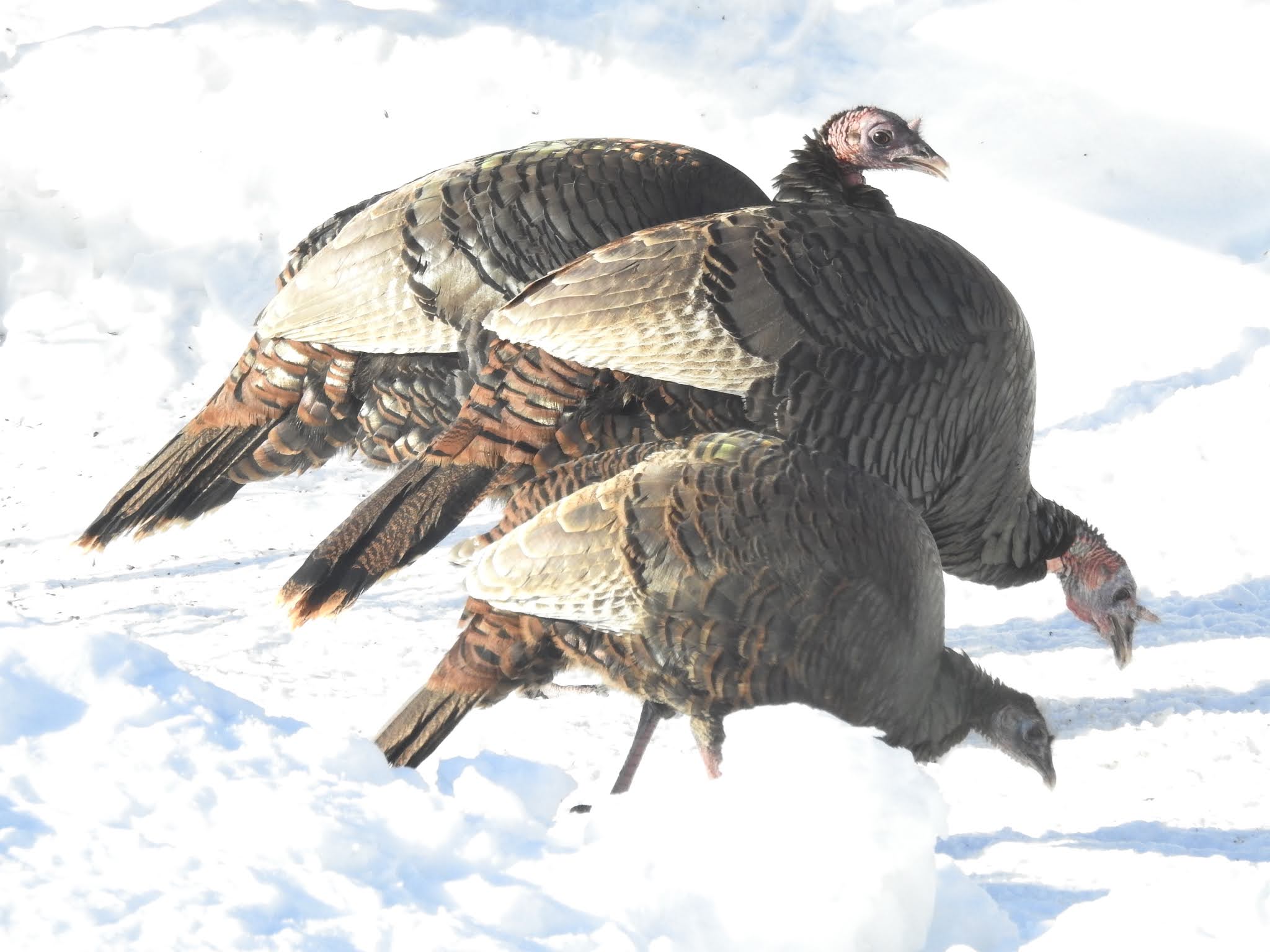
It takes 4 years for turkeys to reach full size and colouring.  During the late fall and winter the genders usually flock separately.  Young males often flock separately from the adults toms.  The flock that is currently coming to our yard is mainly females.  Turkeys are non-migratory.  They wander around suitable feeding areas usually near water.  In winter if the snow is very deep and too soft for them to walk easily they will spend considerable time in the trees waiting until conditions improve.  

                                                     Wild Turkeys Feeding in Snow

Domestic turkeys descended from Wild Turkeys.  Turkeys originated in North and Central America.  They were domesticated by the Aztecs about 500 BCE.  The Spanish Conquistadors took them to Europe in the 1500s where they became popular and eventually arrived in England.  The colonists brought the domesticated turkey back to North America.  And, as they say, 'the rest is history'.

New Brunswick has never had a turkey hunting season.  Since the numbers have been increasing hunters have requested from our Department of Natural Resources to instigate a turkey hunting season.  As a result, it has been proposed that open season on turkeys will begin in April, 2021.  From what I understand, hunters will have to apply and have their name drawn.  Hunting will be strictly regulated in specified zones.  It will cost $6 to apply, $20 for the licence and a $5 conservation fee will be added on.  The season will be for 2 weeks beginning on the second Monday in May.  There will be other restrictions as well, e.g., the use of recordings for calling the birds will be prohibited and bearded turkeys only will be 'bagged'.  I expect this new season will cause a lot of opposition.  I wonder if we have a large enough population to begin 'harvesting' (slaughter).  

The Wild Turkey is one of two avian species originating in North America which have been domesticated.  The other is the Muscovy Duck.  Another interesting turkey fact is that it was once considered to be the national bird of the United States, being suggested by Benjamin Franklin.  Maybe they would not have been so slaughtered if they had been the national bird.

Sunday, February 28, 2021

Big Birds At Our Feeder - Wild Turkeys

                                                                        Wild Turkey

 The following story is written by guest writer, Marc Schneider, about our experience recently (Feb. 20-25, 2021) with Wild Turkeys.


One day recently a neighbour called to say he had seen 12 turkeys in our north fields. We live on a farm that is split by a busy highway. It has fields and mixed forest on the north of the highway and a field on the south, between the highway and the St. John River with hardwood trees lining the river. Turkeys had been seen within 5 km for the past few months but not here.


Given our habitat and location I did not expect to see turkeys here on the south side where we live. But the turkeys fooled me.  We had never known the turkeys to cross the highway and so have never been seen on the south side before.   I thought the habitat was inhospitable for them and the area too small to support them.


One morning a few days after the neighbour’s report, I went out to fill the bird feeders and noticed large bird tracks in the snow near the feeder. They were much too large for crows or ravens, normal regular visitors. And they certainly weren’t Great Blue Heron tracks which they looked like.  So what was I looking at? When I told my birder wife about it, she asked if I had thought of turkeys.


Early the next morning, I looked out the window and there was a flock of turkeys under the feeder, pecking away! We counted 13 birds. We were amazed and pleased. The turkeys were eating mixed grain I had spread on the ground and sunflower seeds that had fallen from the hanging feeders.  I put more seeds out, morning and evening in subsequent days, and the turkeys showed up twice each day. We enjoyed watching them peck the ground, scratch, make runs at one another, flap their wings and mill around. The original 13 became 15, and not because we counted wrongly. A couple more had joined the flock. Some of the birds have small beards, indicating they are young toms.


                                                            Wild Turkeys Feeding Under Trellis


One time I watched the flock for a bit, and then went to do something else. When I came back, there was a flock of redpolls on the ground where the turkeys had been. The turkeys had really shrunk! The largest birds we have ever had at our feeders were replaced by one of the smallest.


                            Wild Turkeys Feeding on Scattered Seed - Note the Spur on the Leg


At various times over the next five days, we would see the turkeys walking along near the edge of the river, going up and down and feeding on fruit still on the wild grape vines. Then one day, they appeared as usual in the late afternoon to feed.  Afterwards, they loitered around, preening, snoozing and gradually walking towards the oak and ash trees on the riverbank. Soon one turkey flew into one of these hardwood trees. As we watched over the next 20 minutes, all the turkeys flew up into the trees and looked like they were trying to get as comfortable as they could.   As the turkeys settled, they did lots of wriggling, flopping and preening. Eventually, they were quiet, each bird roosting a few metres from its nearest neighbour. 


                                            Wild Turkeys Roosting in Ash and Oak Trees


The night had good moonlight, so I checked with binoculars a few times during the night and could see the turkeys were in the trees. At breakfast time, with the sun up, they were still there.   Around 8 AM, the turkeys began to fly down from their roosts. Very shortly, they were at the feeders, eating the seeds I had put out the night before. They had spent a full day with us and answered a question we had about what turkeys do at night or in a storm. I’ve been in a crow roost in the softwoods and have seen ruffed grouse roosting but the whereabouts of turkey roosts remained a mystery.  These turkeys gave us a rare insight into what they do when roosting for the night. We feel privileged to have had the experience.


If this flock spends too much time with us, there might be a problem.  Their droppings are much like goose droppings and they produce a lot of them!  After a 5-day visit, the turkeys appear to have moved on.  We do not know where they have gone  but are pretty sure they will be back.

Monday, February 22, 2021

Great Backyard Bird Count 2021

                                                    Barrow's Goldeneye Female and Male

The Great Backyard Bird Count ( GBBC) for 2021 took place on February 12-15.  During each of those 4 days people were encouraged to stay in one place, for example their home, and record the species and numbers of birds seen in a period of 15 minutes or more.  The results are then sent into a central tallying location and compiled.  This takes place all over the world and is sponsored by the Cornell Laboratory of Ornithology.  Please see a previous post, 'Great Backyard Bird Count' from February 19, 2016 for more information.  One change should be noted; in that post it says to send your results to gbbc.birdcount.org.  That has now been changed to ebird.org.  

One of the counts we did this year was at the Mactaquac Dam Site.  We checked the fields above the dam where we found no birds and then the dam area proper as well as the area below the dam where access was possible.  That being one of the few areas here where there is open water at this time of year, we found that a lot of waterfowl had gathered there to feed.

                                                    Common Goldeneye Male and Female

Following is the list of the birds counted in a 1-hour period beginning at 10:30am.  

Black Duck 4, Common Goldeneye 32, Barrow's Goldeneye 7, Hooded Merganser 1, Common Merganser 24, Bald Eagle 5, Rock Pigeon 5, American Crow 5.

                                            Common Mergansers - 2 Males, 1 Female

The conditions were cold and snowy, with about 15 cm of snow cover.  In many years we see Snow Buntings along the road leading to the dam but there were none this year.  The numbers of goldeneyes and mergansers was about normal but the number of Barrow's Goldeneyes was the most I have ever seen at that site.  Usually there might be 1 or 2 and often none.  Seven was exciting.  It was nice to have both female Common and Barrow's Goldeneyes present for comparison studies.  They are very similar in appearance.  I was also surprised that there were no gulls present and very few pigeons.  I believe there are more pigeons in the area and they were just not there at that time.  The gulls have remained absent since that date so it is valid.  It was nice to see 5 Bald Eagles and that is about normal for that area.  

                                                                       Bald Eagle

                                                                     
                                                                               Black Duck

The GBBC is a wonderful example of citizen science.  Anyone can participate.  It does not take a lot of time or expertise.  Normally you are tallying familiar birds.  The compiled results are huge and represent a great resource for research and management.  Please consider participating next year and get your children and grandchildren involved.  

Although the entry of results is far from finished at this point, so far there have been 314,400 checklists submitted representing 6351 species from around the world.  There are 253 sub-regions from Columbia to India and beyond.  These data are very exciting and represent a wonderful tool for further work with our avian species and the environment.  This is one of the wonderful applications of our modern technology and environmentally-conscious world citizens.  Bravo!

Saturday, February 13, 2021

Merlin - Killer of Feeder Birds


                                                                                   Merlin

The Merlin (Falco columbarius) is a fierce predator of birds coming to feeders in winter.  Feeders tend to be places where birds congregate.  This makes easy feeding grounds for hawks that kill and feed on small birds.

At a feeder in my area this winter the owner has been enjoying the presence of three Northern Cardinals, one male and two females.  Cardinals are relatively new to this area and the recent invasion has brought them to many feeders.  This feeder area was particularly good for cardinals because there are several well-stocked feeders and heavy cover nearby.  Many birds of various species are enjoying this as a wintering ground.  Unfortunately a Merlin has discovered the bird concentration there.

                                                                Northern Cardinal Male

I am sad to report that the Merlin has remained in the area for about a month and has been brutal to this feeder yard.  It has killed all three of the Northern Cardinals!  The first casualty was the male which it was chasing, causing the male to hit the door and break its neck.  See photo below.  I apologize if this photo offends anyone.  Over the next three weeks the Merlin has killed both of the remaining females.

                                                Northern Cardinal Male Killed by Merlin

Why does this happen?  The Merlin species usually migrates from this area in winter.  For some reason a few have remained this year.  It is probably because the early part of this winter has been reasonably mild.  It may be because of global warming.  It may be that the Merlin population is high.  For whatever reason the Merlin has staked this area out as a good food source in winter, a season when food is not normally readily available.  

                                    Northern Cardinal Female   [Julie Sproul Photo]

How can the Merlin be so successful at catching these birds?  These cardinals had learned to come and feed just before dark and the Merlin learned that and was watching for them.  There was cover very close and they would feed only near the cover.  Even that did not outsmart the Merlin. 

The Merlin is a swift predator that can outfly and outmanoeuvre most birds it pursues.  It is built with a trim body and long, pointed wings for extreme speed.  Besides that, it is skillful at dodging obstacles and it uses flight tricks to confuse its prey.  One trick it uses is to fly close to the ground and when the prey thinks it is safe the Merlin bounds straight up.  This and other tricks make it relatively easy for them to catch prey.  They are also notoriously bold and fearless.  They would come into a feeder area and take a bird with a human standing in the midst.  They can easily use various situations to their advantage.  Merlins are so fearless that they will attack a much larger bird, a gull, for example.  

What can one do when a Merlin has staked out your feeders?  It is inevitable that the Merlin will take a bird somewhere.  It needs to feed and is an integral part of the ecosystem.  If the Merlin stays in your area, you can stop putting feed in your feeders until the Merlin leaves.  Or, you can move the feeders in under foliage or in tight areas with heavy cover, places the Merlin would have trouble flying into.  You could put your feeders inside a heavy wire enclosure which would prevent the Merlin from entering.  This should be inside or immediately beside thick cover so that the birds can be hidden as they leave the wire enclosure.  

Why did the Merlin take the Northern Cardinals?  Simply, they are a good target.  The cardinals are larger birds and would be a more valuable prey for the Merlin than a chickadee, for example.  A chickadee would be harder to catch and would provide less of a meal.  The cardinals are not well camouflaged and would be easier to target.  Why did the Merlin not take a Blue Jay which are numerous around those feeders?  It could just be chance but the Blue Jays are probably more experienced with the Merlin and have a good warning system.  Now that the cardinals are gone the Merlin may take a Blue Jay.  The Northern Cardinals that were there were probably young birds and less experienced.  

The loss of 3 beautiful new birds to your feeders to such a violent means is disheartening.  It is difficult to accept.  However, we need to learn from the experience and try to find ways to prevent it in the future.

Sunday, February 7, 2021

Orange-crowned Warbler - Over-wintering


                                                             Orange-crowned Warbler - Female

This winter, like many winters, has brought some rare and uncommon winter birds to our feeders and popular feeding areas.  That is true of the Orange-crowned Warbler (Oreothlypis celata).  Every winter we have a few reports of over-wintering Orange-crowned Warblers, this year being no exception.  For detailed information on this species please see a previous post dated November 23, 2017 and titled, 'Orange-crowned Warbler'.

As stated in the above-mentioned post, 'The Orange-crowned Warbler is a small warbler, 12 cm (4.75-5 in) long.  It is yellowish/grayish with a small sharp bill.  It has faint streaks on its underparts, a broken white eyering, a line through its eye, and yellow under tail coverts.  It is named for its least conspicuous field mark, the orange crown which is rarely seen.  Females and juveniles are grayer than the more yellowish males.  The yellow under tail coverts are an important field mark.  That helps distinguish it from the very similar Tennessee Warbler which has white under tail coverts.'

A feeder at a home near here has had wonderful birds due to its location, lots of cover nearby, and the diligent care of the feeders by the home owner.  This winter she has had two different warblers which did not migrate (at least at the normal time).  In the late fall she had a Pine Warbler coming regularly to feed.  Around Christmas Bird Count time she had an Orange-crowned Warbler coming regularly.  This bird we saw and photographed on Bird Count day.  The bird's size, sharp fine bill, colouration, lack of wing bars and yellow vent (area under the tail) made the identification.  The photo above shows the bird and because it shows a lot of gray I would guess it is a female.  

                                        Orange-crowned Warbler on Ground Near Feeders

The photo above shows the same bird but it looks more yellow because of the lighting.  Note the broken eyering and lack of wing bars.  You can see the yellow vent on this photo but  the photo below shows it more clearly.

                                            Orange-crowned Warbler Showing Yellow Vent

During summer the Orange-crowned Warbler eats mainly insects but also berries, invertebrates, sap and nectar.  It will pierce the side of a flower in order to get the nectar.  Here in winter they feed on suet, peanut butter, and whatever spiders they can find.  They prefer low thick bushes so that is where this individual is spending its time when not at the feeders.  There are many thick evergreens around this house.

Orange-crowned Warblers are late fall migrants.  They leave their breeding grounds in Quebec and Labrador late so arrive here normally in late fall.  This individual has chosen to stay on and will likely spend the winter here.  Normally it would have left now for its wintering area in the southern US and the tropics.  Hopefully it will find enough protection from winter storms to make it through to spring.  There is good opportunity where it is to soak up the southern-exposure sunshine.  Good luck, Little One!