Thursday, September 22, 2022

Tricolored Heron


 The Tricolored Heron (Egretta tricolor) is a small-to-medium sized heron of the Americas.  It lives in coastal habitats in the Atlantic region from northeastern US south through the Gulf of Mexico and the Caribbean to northern South America as far south as Brazil.  In the west it ranges from Peru to California. As a vagrant it strays in the west as far north as Oregon and in southern Canada from Manitoba to Newfoundland.  Its population is reasonably stable, having been less affected by the millinery trade in the nineteenth and early twentieth centuries.  The Florida population, however, shows recent declines probably due to habitat loss.

                                                                        Tricolored Heron

The Tricolored Heron has a long slender neck and the bill is noticeably long and thin.  The genders are similar and one wonders which 3 colours gave it its name.  It has a slate gray head, neck, back, wings and tail.  The back is often covered with purplish maroon long scapular feathers.  The rump is white as is the throat and underparts with the white extending in a thin strip from the throat to the belly.  The eyes are brown, the lores yellow and the bill is yellow.  The legs and feet are yellowish gray.  So, what 3 colours give it its name - the slate gray, the purplish maroon scapular feathers and the white?  In some birds with the yellow bill and lores, the yellow extends down the neck a bit.  So, it might be the slate gray, the white and the yellow.  

In breeding plumage the eyes turn red, long white occipital plumes appear as do purplish plumes on the neck.  The chin, scapulars, and throat turn rufous and a turquoise colour appears on the lores and bill base.  The feet and legs can also turn pinkish.  Given that rainbow of colours, now what is the origin of the name?  We may never know!

                                     Tricolored Heron Showing Purplish Plumes  [Jim Carroll Photo]

The Tricolored Heron is about 66 cm in length with a wing span of 91 cm.  For contrast, the Great Blue Heron is 117 cm in length with a wing span of 183 cm.  The photo below shows the difference but it is somewhat misleading because of the Great Blue Heron is closer to the camera and the Tricolored Heron is crouched down while the Great Blue is fully upright.  Notice the length of the bill in the Tricolored.

                            Tricolored Heron with Great Blue Heron    [Jim Carroll Photo]

We often have vagrant herons and egrets visit us here in New Brunswick in spring and summer.  This year we had many Great Egrets.  At one time there were 6 at Saints Rest Marsh in Saint John.  That is where the Tricolored Heron was found this summer.  It probably came north on the same weather system that brought the egrets.  It was at the marsh for at least 3 weeks and may still be there.  We saw it on September 17.  

The Tricolored Heron is quite unique and not easily mistaken for another species.  It is the only dark coloured heron with a white belly.  A new birder would have to consider whether it might be a Green Heron but a Green Heron is much smaller and does not have that long thin neck and white belly.  A dark morph Little Blue Heron might also have to be considered but it does not have the white on it.  The Reddish Egret dark morph which has never been seen here (as far as I know) might also be considered but it has no white on it either.  

                                                                    Tricolored Heron

The Tricolored Heron spends most of its time feeding in water and it is not afraid to wade deeply.  It feeds mainly on fish but will also take amphibians, reptiles and invertebrates.  It is very active as it feeds, often running after fish with its wings raised.  I have actually enjoyed watching them feed in South Carolina.  This species is a colonial breeder often on islands usually with other herons and egrets.  A platform nest is built of stems and twigs and lined with grass.  Three or four light blue green eggs are laid and incubated by both adults for 21 days.  

Although the voice of this species can be a croak or squawk like other herons it often is a soft, nasal moan.  Being relatively abundant in the Deep South, it is an easy bird to observe.  It was formerly called the 'Louisiana Heron'.  When I first started birding I often wondered what bird a Louisiana Heron was because it was renamed in all my bird books.  With the many I have seen, I have never seen more than one or two together.  They are much more solitary than egrets or Great Blue Herons.  Their feeding antics of chasing fish and flapping around are sometimes described by some as 'ballet dancing'.  Tricolored Herons are obviously smart birds.  They often follow Double-crested Cormorants or Pied-billed Grebes and scoop up the fish that they stir up.  

Thursday, September 1, 2022

Can You Identify This Hawk?

On August 24 and 25, around 9:00 AM a hawk was seen perched on a dead tree near the river behind our house in Fredericton. It remained there for a considerable time, up to 40 minutes. The unusual thing was that it was wet, preening and continuously fluffed its feathers or sat with its wings and tail spread out, presumably to dry. It must have bathed in the nearby river and was using that perch to self-care. The only time it sat in normal position with normal contour was a few seconds on the second day before it flew. That made it difficult to identify. Let's see what you can do with identifying this hawk. Here are the identifying features: its shape was rounded (or it appeared so, the size was that of a small buteo, crow-sized or slightly larger). Its breast showed vertical stripes. The tail was boldly striped showing white at the tip and alternate white and dark even stripes. The head, upper breast and upper back were a rufous brown colour. The back was dark brown or gray with many large white spots. The tail appeared (at first) to be average length. The photos above show the notable features. At first I thought it must be a Red-shouldered Hawk. The size and shape were right. The tail looked right. The spots on the back were right (in my experience). I tentatively decided it might be a juvenile Red-shouldered Hawk. It gave me plenty of time to take many photos (at a distance of 60 metres) using my super-zoom camera. Studying the photos with friends gave me a different perspective. We went over the individual features carefully. The size was right for a Red-shouldered Hawk or a Cooper's Hawk. The vertical stripes on the breast were bold and tear-drop shaped. That would indicate a Cooper's Hawk. The feet and legs were yellow which did not give any clues. The rufous colour on the head, upper breast and upper back made me think of Red-shouldered although we didn't see any red on the shoulder. The tail showed white stripes on the ventral aspect and gray stripes on the dorsal aspect. That would indicate Cooper's. The white spots on the back definitely pointed to Red-shouldered to me because I had seen them on Red-shouldered before but never on an Accipiter. It was difficult to tell what hawk we were looking at with it fluffed up and in abnormal position.
Hawk Showing Tear-drop Striping on Breast
Hawk Showing White Patches on Back In one poor picture from the first day the tail appeared long. See below.
It was time for an expert to examine the photos. We sent a batch off and later it was determined that the hawk was a Cooper's Hawk. That confirmed most of the field marks. But what about the shape and the white spots on the back? The second day's visit gave the opportunity for many more photos. That confirmed many white patches on the back and wings. Only at the last few seconds before the bird took off did it sit in a normal position and shape. See below for two views of the tail, dorsal and ventral.
That short view of the bird, as it finished its preening and took off, confirmed that identification. Its shape and size were definitely that of a Cooper's Hawk. The tail was long and rounded on the tip characteristic of a Cooper's. The breast striping confirmed it as a juvenile Cooper's Hawk. That was a difficult identification but an enjoyable puzzle. The whole problem was that the bird never until the last few seconds on two separate visits, sat in a normal postion. The long sleek appearance of a Cooper's Hawk was not evident. What about the white patches on the back and wings? That really fooled me. I have never seen that beforre on an Accipiter. According to the expert, some Accipiters have spots on their backs. I checked 100s of images and Sharp-shinneds, Cooper's and Northern Goshawks and all three species can have white spots on their backs, although that feature appears to be uncommon. Also, what is a juvenile Cooper's Hawk doing here in August? According to the literature, Cooper's Hawks breeding range extends into Maine (Sibley's) or southern New Brunswick (National Geographic). In 'Birds of New Brunswick: An Annotated List' it says the species is a rare summer resident and that there have been a few nesting records. Peterson Field Guide, 'Hawks of North America' shows a breeding range in southern and south-western NB. So, what I learned is that nesting Cooper's Hawks are unusual breeders in NB but they do exist. What we were looking at was a juvenile probably from one of those rare nesting pairs here. What a privilege to have enjoyed this hawk! Note: the absence of formatting in this post is due to problems with the blog software.

Wednesday, August 17, 2022

Swallows Soon to Migrate South


                                                 Swallows Lining Up On Utility Wires

On August 1,  I was surprised and excited to see swallows lining up on the utility wires in the Scotch Settlement, York County, area.  I haven't seen this behaviour in many years and I was very happy to witness it this year.  There were about 100 birds of 3 species (Cliff Swallows, Tree Swallows, Barn Swallows) cavorting around and vying for what appeared to be preferred positions along the wires.  They were actively flying to and from the wires and going afield only to return quickly.  

                                            Swallows on the Wires in Pre-Migration Gathering

There was obviously much excitement among the birds.  It did not seem to matter which species lined up closely to which.  They appeared to all be getting ready for something exciting.  At one point an American Bittern flew across the road and a few swallows took after it and either chased or accompanied it across the field and out of their gathering place.  That looked like a squadron of jet fighters escorting an enemy plane out of protected air space.

Late July through September is the preferred time of departure of 'our' swallows.  Cliff Swallows depart after the nestlings fledge which has happened in that area.  Their departure is listed as early August through early September.  Barn Swallows depart from late July onwards with the migration departure peaking from late August to early September.  Tree Swallows depart a bit later with most leaving in September.  Cliff Swallows migrate to southern Brazil and south-central Argentina.  Barn Swallows go mostly to South America as far south as central Chile and northern Argentina.  Tree Swallows migrate to the southern US, Central America and the Caribbean.  Looking at their destinations, you can see why the Cliff and Barn Swallows leave earlier than the Tree Swallows.  They have much farther to go!

Migration is an amazing and interesting phenomenon.  I am thankful these swallows come to New Brunswick to breed, raise their young and enjoy the habitat our ecosystem provides.  Our declining insect populations is a concern.  There is increased mortality in young swallows partly because of shrinking food supplies, the insect population.  We must protect the nesting sites of these birds and encourage them to spend their short summers with us.  We also must follow regulations against pesticides and pollution in order to protect the swallows and other inhabitants of our environment (including ourselves).
 

Monday, August 8, 2022

Black-necked Stilt Seen in New Brunswick

                                                                   Black-necked Stilt

On Friday, 5 August 2022, an Ontario birder who summers in New Brunswick was checking for shorebirds along the shoreline of the St. John River between the bridges in Hartland, NB.  We are fortunate this woman was familiar with shorebirds and recognized that what she saw through her binoculars was a rare species for New Brunswick, a Black-necked Stilt.  She also knew how to alert others by contacting a local birder who posted it to online discussion groups.  That began a magical day for birding for a handful of New Brunswick birders. 

It is unknown when the bird arrived in Hartland and from where it came.  It undoubtedly is a vagrant which migrated up (or down?) the St. John River.  It is a male adult and is probably dispersing from the breeding area before returning south for the winter.  Just how far are we referring to here?  Well, the Black-necked Stilt (Himantopus mexicanus) normally summers in southern Florida, the coastlines of Georgia and North and South Carolina, the mid-western and western states and southern Alberta and Saskatchewan.  They winter in California, the Gulf coast and southern Florida south to the tropics. So this bird is far from the normal movements of this species.  

And how rare is it in New Brunswick?  We have had 4 recorded occurrences since records have been kept: 1862, 1880, 1982, 2000.  Nova Scotia has had a few records as well.  The 1862 and 1880 records were confirmed because the birds were 'collected' (shot and sent to the museum for mounting).  Unfortunately that is what they did in those days.  The 1982 and 2000 records are listed as 'unconfirmed' which actually means that no specimen was collected and no photos were taken.  But, today we are a photographic generation and there are lots of photos of this visitor, I would guess well over 1000 were taken that day.  All the photos in this blog post were taken by me.

Hartland is a very picturesque place.  We wandered around along the shoreline which was mowed grass in most cases  checking for the bird from both sides of the river.  We crossed the historic covered bridge to move from one side to the other.  The bird was feeding along the shoreline of the river and the island located there.  The shoreline was composed of rounded rocks of various sizes with a bit of sand.  On the east side a brook flows into the river bringing cold water and rich aquatic food. This made good feeding for the Black-necked Stilt and the 2 Lesser Yellowlegs which it was keeping company with some of the time.  Viewing and locating the bird was difficult because we were looking into the sun for a good part of the time.  As bright and beautiful as the bird is, it was well camouflaged with the bright sunlight reflecting off the water and the black of the wet rocks.  The difficulty of seeing this bird was a surprise to me.  Even though it is a rather large shorebird, 33 cm long with very long legs, it still was difficult to see.  One could pick it up only when it was moving or silhouetted against the bright water.

Please see a previous post on this blog for information on the life history of the Black-necked Stilt; 'Black-necked Stilt - Nemesis Bird', June 4, 2022.  

                                                                    Black-necked Stilt
                                                                        Black-necked Stilt 
                                        Black-necked Stilt Showing the Very Long Legs

This species was my 'nemesis bird', meaning I have been trying to see it for at least 30 years.  I was just never in the right place at the right time while out west or in the south.  I have chased around flocks of American Avocets which it sometimes flocks with but with no success.  I had missed the 2000 bird from Jacquet River by 15 minutes.  But on that special Friday luck was with me.  I had many good looks at the bird and was able to photograph it from a safe distance with no disturbance to the bird at all.  It was fun to share the excitement with the group of NB birders for which it was also a 'life bird'.  For me it was the 351st avian species seen in NB over my lifetime!

                                          Black-necked Stilt Feeding Along Shoreline

                                            Black-necked Stilt Picking Insects off Mud

Black-necked Stilt Feeding From Rocks
 
What did I notice about this bird?  First, it is a beautiful shorebird.  The black and white plumage pattern is striking.  And probably the most striking feature is those impossibly long legs!  They are bright pink (or sometimes red) and the feet are small.  The literature tells us they are partly webbed enabling the bird to be able to swim although it rarely does.  The black bill is very fine and dagger-like and about 6 to 7 cm long.  The black crown which runs down the back of the neck is offset by the white on the forehead, throat and ventral neck and especially by the white eyebrow patch.  In spite of the long legs, the bird is very agile.  When it flies the legs are extended straight out behind.  It obviously can fly very well given the distance it has come!  In summary, a very striking bird and so exciting to see.

We were able to compare it to the two Lesser Yellowlegs it was hanging out with.  See the photos below.  The Black-necked Stilt looks larger in the photos in comparison because it was closer to the camera.  Note, the Lesser Yellowlegs are 27 cm long compared to the stilt which is 36 cm long.  This measurement is taken from the tip of the bill to the tip of the tail and does not include the long legs.  The stilt's body is actually quite small.

                                                Black-necked Stilt and Lesser Yellowlegs

    Black-necked Stilt and Lesser Yellowlegs

The literature tells us that the Black-necked Stilt is considerably vocal.  Unfortunately we did not here its 'kek, kek, kek'.  It was far enough away that we might have missed it.

Many thanks to the NB birders and to our ON visitor for making it possible for many of us to see and learn about this species.  Unfortunately the bird was seen only that one day.  We hope it won't be another 20-plus years before we see one again.

Monday, August 1, 2022

Local Church Protects Cliff Swallows

                                                               Cliff Swallow Nests on Church


 For some reason the Cliff Swallows (Petrochelidon pyrrhonota) like to build their nests on the Scotch Settlement Church, York County.  And what is even worse for the parishioners is that they much prefer to build them over the main entrance!  Every year that creates a problem for people entering and leaving the building.  This year there are about 12 nests, all built over the entrance.  Some nests are singles, some doubles and some triples.  That makes a lot of activity, birds coming and going to feed hungry chicks.  

The nest-building this year is very robust.  There is a constant chorus of chirps and warbles as adults are coming and going and young are fed or letting it known that they are hungry.  The birds do not seem to be inhibited by the people of the church.  

                                             Cliff Swallow Adult About to Leave Nest

                                                Cliff Swallow Dropping Fecal Matter From Nest

The people of the church, however, do have a problem with the birds, or rather, their droppings.  As the nests became occupied in the spring the problem soon became evident.  Bird droppings began to appear on the carpeted steps to the church and the people had to quickly duck as they entered or left the building. An earlier attempt to dissuade the birds from building in that location, the hanging of CDs in the preferred areas, had failed.  The birds just built right among the CDS, even incorporating some of them into the mud of the nests.  

So, what to do?  The church people used a simple solution.  They turned the top step on its side in order to prevent the buildup of fecal matter on the carpet.  Then they roped off the front steps and asked the church goers to enter and leave by another door!  Bravo to the Scotch Settlement Church for putting the well-being of the birds ahead of their convenience!  After all, the birds are God's creatures too.  See below for how they altered their front door.

                                 Front Door of Scotch Settlement Church - Temporary Arrangement

 The bird enthusiasts and environmentalists in the area are happy.  Many thanks to the people of the Scotch Settlement Church for putting their concerns for the birds into action.  They have set a good example of care for the environment and its creatures.  

                                                    Scotch Settlement Church, York County

Saturday, July 16, 2022

Purple Gallinule - A Rare Visitor to NB


Purple Gallinule  [Jim Carroll Photo]

In early July, 2022, a Purple Gallinule appeared at a small pond in the Dipper Harbour area, along the coast of the Bay of Fundy.  Because it was happily living there the owners of the property chose to keep its appearance from the public in order to protect the bird and themselves from the normal parade of avid birders which follows the report of a rare bird.  Some of the photos in this blog were taken by a close friend/relative of the property owners.  This blog intends to provide information on this species which is a very rare visitor to NB.  For more information please search this blog for 'Purple Gallinule Killed by Cat' which describes a Purple Gallinule which appeared in Nova Scotia in the past. 

Of the 20 or more known records of Purple Gallinules to New Brunswick, most have been in the fall and were immature birds.  Spring visitors are much more rare and those are mostly adults, which is the case with our recent visitor.  The vagrant Purple Gallinules that arrive here are mainly due to severe storms which blow them way out of their normal range.  However, with global warming and the movement of the normal ranges of avian species northward, we might some day see Purple Gallinules breeding here in small numbers.  The normal range for this species is Florida, southern Alabama, Mississippi, Texas, Mexico and the Caribbean islands.  Vagrants can occur throughout the eastern half of the US and the Maritime Provinces.  

The preferred habitat for this species is lakes, pools, marshes and waterways.  Their diet consists of invertebrates, frogs, aquatic vegetation, seeds and berries.  They forage while walking slowly along shorelines, by wading and even by swimming.  They are most notable as they walk over lily pads in marshy ponds.  Their very large feet make them well suited for that!

                                                        Purple Gallinule  [Jim Carroll Photo]

The Purple Gallinule is about the size of a small chicken, 33 cm long.  On first view it looks like a blue bird with brilliant yellow legs and feet.  The upperparts are purplish blue which irridesce green.  The underparts are a deep blue with white undertail coverts.  The eye is red and the bill is red with a yellow tip.  There is a light blue shied on the forehead which sometimes looks white.  The feet are huge and are obviously a big help in manoeuvring  over marsh vegetation.  The juveniles have olive brown upperparts, pale brown underparts and a dark bill.  This species pumps its head when it swims. 

                                            Purple Gallinule  Showing Very Long Toes  [Internet Photo]

Purple Gallinules nest in marshes where they build their nests low over the water among dense sedges and rushes.  The nest is built from dried stems and leaves which are interwoven and well concealed.  In it are laid 5 to 10 pink or buff eggs marked with brown (6 to 8 being the average number).  Incubation lasts 22 to 25 days.  The young at first are covered with black fuzzy down.  

                                        Purple Gallinule With  Young [Internet Photo]

Purple Gallinules (Porphyrio martinica) are a member of the Rallidae family along with coots and rails.  Here in NB we need to differentiate the species from the Common Gallinule which is becoming a bit more numerous here and has even been known to breed.  The Common Gallinule is larger and is a dark gray colour.  It has obvious white stripes on its flanks.  Some might also confuse the Purple Gallinule with the American Coot but it is all black with a white bill.  There is another similar species which is an import from Europe, the Purple Swamphen.  It occurs only in southern Florida and is much larger, 50 cm vs. 33 cm.  Of interest, the Purple Gallinule has also been introduced to Europe!  We need to stop meddling with bird ranges.

The Purple Gallinule is an amazing species in many ways.  How does it arrive here when it appears to be such an awkward flyer?  It flies with those big legs and feet dangling.  It has even shown up as far away as Europe and South Africa!  It is also very versatile.  It can swim on the water surface like a duck but it can also walk on floating plants with ease.  And speaking of feet, it often uses them to hold food in order to feed.  See the photo below.

                                                            Purple Gallinule  [Internet Photo]

Purple Gallinules cackle almost constantly while flying, a kek kek kek.  The call note is described as a peculiar guttural sound.  This species can run fast and also dive under water and swim away from harm.  When not disturbed their movement over the water is graceful and elegant.  We have a lot of marshes in NB.  I would be delighted if we had many more Purple Gallinules!

Thursday, June 30, 2022

Mourning Warbler - A Late Starter

                                        Mourning Warbler Male   [Jim Carroll Photo]

The Mourning Warbler (Geothlypis philadelphia) is one of our latest warbler species to arrive in the spring.  They are an uncommon summer resident which breeds across the province.  They are more numerous everywhere than in the south-central lowland around Grand Lake and on the east coast.  They can be found from late May to late September.  Mourning Warblers prefer heavy tangled vegetation in forest openings and along forest edges.  They like ferns, raspberries and broadleaf shrub tangles.

                                             Mourning Warbler Male   [Jim Carroll Photo]

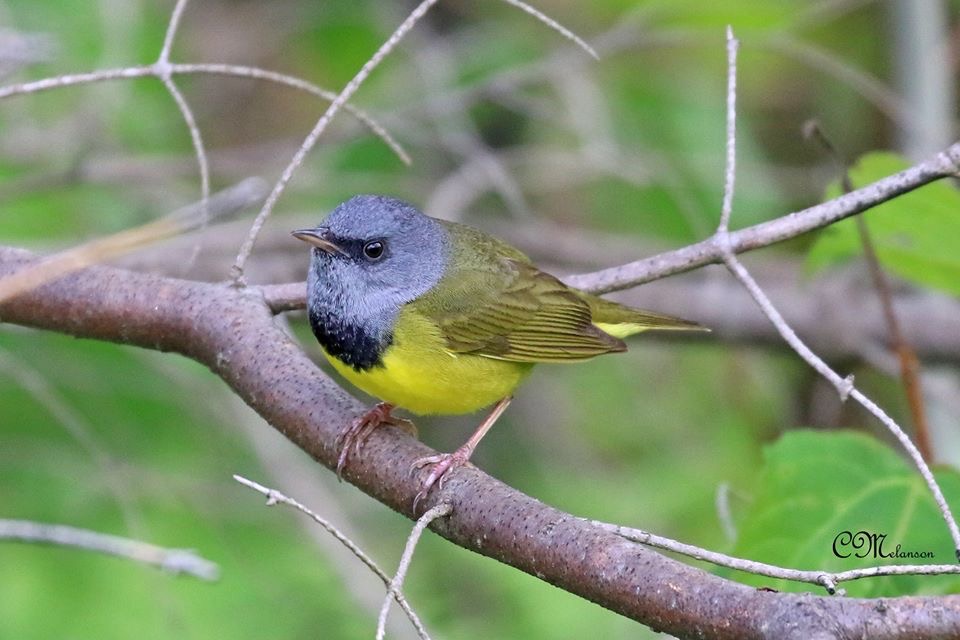
The Mourning Warbler, a member of the Parulidae family, is an intermediately sized warbler (13 cm long).  In breeding plumage the male has a bluish-gray hood and a variable dark patch on the breast.  The olive upperparts and yellow underparts make it outstanding in appearance.  There may be dark lores (patch in front of the eye) and the legs are pinkish.  Rarely there may be a thin white eyering.  The bill is pinkish with a dusky upper mandible.

The female in breeding plumage is similar to the male except she has a light gray hood and no or little black on the breast.  Her throat may be buffy or whitish and she may have a thin broken white eyering.  Like all warblers the plumage changes in the fall.  The males look similar to spring females except their heads and upperparts are all olive or brownish with a yellow or whitish throat.

                                     Mourning Warbler Female   [Marbeth Wilson Photo]

Other warbler species that one would need to differentiate this species from are MacGillivray's Warbler,  Connecticut Warbler and the Common Yellowthroat.  For us here in New Brunswick the Common Yellowthroat would be the most likely species one would have to watch out for.  But they have a longer tail, a smaller dark bill and they don't have the gray crown.  MacGillivray's are not seen here and Connecticut Warblers are very rare.  Connecticut Warblers have a distinctive complete white eyering and a shorter tail projection.   Connecticuts also walk and the Mourning Warbler hops to move itself along, a neat distinguishing feature.  

                       Mourning Warbler Male Showing Black Lores  [Carmella Melanson Photo]

The summer range of the Mourning Warbler includes Atlantic Canada, across the southern half of Quebec and Ontario and into the prairies north to touch a bit on northern British Columbia and the Northwest Territories.  It also is found south of the Great Lakes to about southern Ohio and Michigan and New England.  Their winter range is the southern part of Central America and the northwestern part of South America.  No wonder it takes them a long time to get here in the spring!

The song of the Mourning Warbler is not a mournful song as the name would suggest.  It is a happy, 'cheery' melody.  Their cheery cheery cheery chorry chorry is what led me to find my first ever member of this species.  It is an easy song to remember and describes this beautiful warbler.  So, why the name?  Well, the Mourning Warbler was named by Alexander Wilson, a famous American ornithologist, in 1810  because of the gray hood and the black markings on the male's breast.  He must have thought it looked like it was in mourning.  The 'philidelphia' part of the name came from the place where he first saw it.  Another ornithologist, Forbush, in 1929 took exception to the name given by Wilson and stated that the bird is active and happy and its song is a 'paean of joy'.  I agree with Forbush but unfortunately the name given by Wilson has stuck.  

The Mourning Warbler nests in dense undergrowth in forest clearings, usually near wet areas.  This is a vegetation type we don't often wander in so no wonder we don't often find their nests.  The nest, a well concealed open cup,  is on or near the ground and is made of fibres and leaves and lined with grass and hair.  Three to five creamy white eggs spotted with brown are laid and incubated by the female for 12 days.  Both adults will use the broken wing display to try to detract intruders from the nest.  After the young birds hatch, the female eats the egg shells.  Mourning Warblers feed on insects and spiders which they glean from tree and bush foliage. 

The Mourning Warbler population numbers are listed as stable.  This is one species that has benefitted from humankind's disruption of the forest.  It likes the bushy tangles that often are found where the trees have been cleared.  It also benefits from the broken continuity of the forest that often follows forest operations.  We have so much of that I am surprised we don't see more of this species in New Brunswick.