Friday, July 30, 2021

Fork-tailed Flycatcher

                                            Fork-tailed Flycatcher   [Louise Nichols Photo]

Around the middle of July a Fork-tailed Flycatcher appeared in Memramcook and stayed for a couple of days.  This is a rare species for New Brunswick and was seen by a few birders.  

The Fork-tailed Flycatcher (Tyrannus savana) is a Tyrant Flycatcher which is a large family group. The Fork-tailed Flycatcher is more closely related to the kingbirds and the Scissor-tailed Flycatcher, which are all of the Tyrannus species.  Fork-tailed Flycatchers are named for their very long, forked tails and were first described in 1760 by  Mathurin Jacques Brisson and were variously named until 1802 when Francois Marie Daudin gave the species its present name, Tyrranus savana.  This species is not mentioned in the literature by Austin Squires so presumably was not officially recorded here until the 1970s when the first record came from Grand Bay in October, 1977.  Various other individuals have been reported from Kent Island (June, 1991), New Horton (October, 1992), North Head (October, 2000), Miscou (October, 2011), and Grand Barachois (September, 2002).  So, not totally rare here, it certainly is an exciting find both in its appearance and in its scarcity.

Where is this bird normally found?  Well, a long way away.  Its normal range is southern Mexico and most of South America, ranging well down almost to the southern part of Argentina.  In most of that range it is usually found year-round but in the southern part it moves north during the southern winter.  Vagrants from this species do occur so that explains why a few reach the coasts of the US and up the eastern seaboard to Maine and New Brunswick.  During migration these birds gather in large flocks, sometimes up to 10,000 birds.  They are sometimes accompanied by their close relatives such as Eastern Kingbirds.  

                                        Fork-tailed Flycatcher  [Marbeth Wilson Photo]

The Fork-tailed Flycatcher is 30-35 cm long (11 to 15 inches).  That includes the long tail.  In adult males the tail is 2 to 3 times as long as the bird's body.  Males have slightly longer tails than females.  The Fork-tailed Flycatcher is white below, gray above and has a black cap.  There are no wing bars and the black cap extends down below the eye on the cheek.  Occasionally the males have a yellow crown stripe but his has not been described in any individuals seen here.  In the photo above it can been seen that the tail is relatively short (not 2 to 3 times the length of the body) and shows wear on its outer feathers.  That would indicate this is an adult female.  Note the photo below of a male.

                                                Fork-tailed Flycatcher Male  [Internet Photo]

Fork-tailed Flycatchers make a buzzy, chittery sound which is not musical at all.  Apparently their wings make a whistling sound in flight.  During mating displays the male's wings make a crackling sound.  During breeding males perform elaborate courtship displays.  They swirl, flip, twist and do somersaults while making buzzing sounds.  This must be impressive to watch with their very long forked tails!  Nests are built in their favourite habitat (riparian forests and grasslands).  Nests are cup-shaped and made of grasses, plant fibres, leaves and bark shreds and are lined with seed down.  Two to three white eggs with brown and lavender spots are incubated for 14 to 17 days by the female.  

                                            Fork-tailed Flycatcher    [Marbeth Wilson Photo]

Fork-tailed Flycatchers are insectivores.  They sit on conspicuous perches from which they fly out to catch their prey which they eat before returning to the perch.  They will also eat berries and fruits.  

An interesting fact is that Fork-tailed Flycatchers have longer tails than Scissor-tailed Flycatchers.  According to an ornithological source a group of flycatchers can be called an 'outfield', a 'swatting', a 'zapper' and a 'zipper'.  I don't know about you but I would like to see a 'zipper' of Fork-tailed Flycatchers.

Monday, July 12, 2021

Steller's Sea Eagle - A Mega Rarity

                                                    Steller's Sea Eagle Adult   [Andrew Olive Photo]

A Steller's Sea Eagle (Haliaeetus pelagicus) was seen recently on the Restigouche River near Tide Head.  Not only is this a 'mega rarity' for New Brunswick, it is a 'mega rarity' for North America!  This bird is supposed to be in Russia or Japan.  What is it doing here?

On June 28, 2021 a Listuguj ranger, Gerry Isaac, was out on the Restigouche River.  Among the 50-plus eagles present in that part of the river he spotted one that looked decidedly different.  He alerted a fisheries warden, Forest Condo, and local official and bird 'expert', Andrew Olive, and they confirmed that what they were seeing was a Steller's Sea Eagle.  Photos were difficult to capture but the ones you see in this blog were taken by Andrew Olive.  (Thank you, Andrew).  Word spread rapidly to astounded birders in both New Brunswick and Quebec.  Most of us, no, all of us had hardly heard of this species and certainly didn't know much about it.  

Unfortunately the bird was difficult to see and only a few birders got to see it.  I was one of the many disappointed.  On the morning of June 30, the bird was visible from the north shore of the Restigouche River at the Broadlands Camp Ground and a few got to see and photograph it.  Unfortunately the owner of the campground expelled the birders from his property so it made it difficult for others later.  With many hours of continuous observation the bird was not located for the rest of that day.  With diligent observation from many people from the high banks of the river on both the NB and the PQ sides and scoping the treed islands for perched eagles, the Steller's Sea Eagle was relocated from a good vantage point at Morissey Rock Park on the New Brunswick side about 3:00 pm the next day.  The eagle was perched on one of the tall hardwoods on the islands and was seen through a telescope by a few birders.  Later that day it was relocated perched on a high dead tree on an island upriver from Gillis Island where it remained until dark.  The bird was gone the next morning and was not seen again.  

The Restigouche is a beautiful river with lots of fish to feed eagles.  There is a population of at least 50 Bald Eagles in that general area.  There is a series of many islands upriver from Tide Head which are treed and uninhabited.  The river moves swiftly over gravel beds among the islands making good fish habitat.  That is where the Steller's Sea Eagle was hanging out.  

The Steller's Sea Eagle is one of the world's largest avian predators.  The Andean Condor, the Lappet Faced Vulture and the Californian Condor are larger (measured in weight and wingspan).  The Steller's Sea Eagle is larger than our Bald Eagle.  It is the heaviest eagle in the world, with females weighing 6,195 to 9,500 grams (13.66 to 20.94 lbs) and males weighing 4,900 to 6,800 grams (10.8 to 15.0 lbs).  Contrast this to the Bald Eagle which weighs 4,325 grams (9.5 lbs).  The wingspan of the Steller's Sea Eagle is 1.95 to 2.5 metres (6 ft 5 inches to 8 ft 2 inches).  The wingspan of the Bald Eagle is 2.03 metres (6 ft 8 inches).  Seen at the long distance we were viewing from, the difference was not that apparent.  

The Steller's Sea Eagle is a very large diurnal bird of prey.  It is the heaviest eagle in the world but may fall short in size of the Philippine Eagle or the Harpy Eagle depending on how measurements are taken.  It is certainly visually striking.  The Steller's Sea Eagle's normal range is northeastern Asia where it breeds in the Kamchatka Peninsula of Russia.  This far eastern area of Russia around the Sea of Okhotsk and lower Amur River and islands is known for its large populations of Steller's Sea Eagles.  About 4,000 of this rare species live there.  This species is listed as vulnerable on the International Union of Conservation of Nature Red List of threatened species.  The birds spend their winters in the southern Kuril Islands of Russia and in Hokkaido in northern Japan.  So, they do not inhabit a very large area of the world, not flying very far south in winter and restricting their range to a relatively small area.  The species is not known for vagrants but a few have been in North America, and inland in Asia as far as Beijing, China and Taiwan.  

As reported by Jim Wilson, a recent issue of the American Birding Association North American Birds (Vol 71, No 2) describes a Steller's Sea Eagle seen and photographed 150 miles inland in Alaska on the Denali Highway last August.  That was the first North American record away from the west coast.  It remained in the area from August 26 to September 14, 2020.  There have been only 14 coastal Alaskan records and one from British Columbia in the last 100 years of record keeping!  Mega rarity indeed! But, there was an adult Steller's Sea Eagle seen in Texas (of all places) in March, 2021.  The bird was well-documented but vanished.  Could our bird be the same bird?  Interesting to speculate!  Our record is the first east coast Canadian record.  

In layman's terms, the Steller's Sea Eagle is a very large eagle with a 'honking big orange bill'.  It is black and white (or dark brown and white) like our Bald Eagle but the placement of the colours is different.  The Steller's Sea Eagle has a dark head, breast and lower back with white across the forewings which turns under the forward edge of the wings and can be seen in flight.  This makes a white 'V' on the back of the perched bird.  The tail is white and diamond-shaped but shorter than the white tail of the Bald Eagle.  The legs and under-tail coverts are clothed in white feathers on the Steller's Sea Eagle and the legs are shorter than the legs of the Bald Eagle.  Some specimens show a tiny spot of white just above the dorsal aspect of the beak.  The head in some is lightly streaked with fine silver but this is not noticeable at a distance.  The eyes are a light lemon yellow.  The feet are the same yellow-orange as the beak and the feet have very large talons and spiculated soles for holding prey.  These feet are very powerful and the bird is capable of embedding its talons deeply into human flesh (like the Bald Eagle).  The beak may be the largest of any eagle and measures 117 mm (4.6 inches) from the gape to the tip.  The vocals of this eagle have been described as a deep barking sound like 'ra-ra-ra-raurau'.

      Steller's Sea Eagle Showing White Upper Wing Coverts, Diamond-Shaped Tail, White Under-tail Coverts         [Andrew Olive Photo]

Eagles are members of the Accipitridae family along with hawks.  The Steller's Sea Eagle's generic name is Haliaeetus which is shared also by the Bald Eagle.  The specific name, pelagicus, is from the Greek word, pelagos, which means 'open ocean'.  Its name has changed variously since 1811 when it was first described by Prussian naturalist Peter Simon Pallas.  It was given its present name by the International Ornithologists' Union and was named after the German naturalist, Georg Wilhelm Steller.  In 1996 a DNA analysis showed the Steller's Sea Eagle diverged from the lineage that gave rise to the Bald Eagle and the White-tailed Eagle about 3 to 4 million years ago.  

Steller's Sea Eagles feed mainly on fish but they will also eat gulls and kittiwakes and other water birds.  They hunt food by perching and diving down from heights of 30 metres to grab prey from the water or air.  In winter they gather around the ice-free areas of northern Japan where they feed on fish, fish offal from the fishing fleet, and gulls.  They sometimes gather in large flocks in the 100s.  They will also eat crustaceans and mammals.   Being such large predators they mostly have their pick of whatever other birds are feeding upon.  

Steller's Sea Eagles nest on rocky cliffs on sea islands or in large trees at a height up to 50 metres (150 ft).  The nests are built of sticks and twigs.  Courtship occurs in February and March and consists of soaring flights.  One to three greenish-white eggs are laid and incubated for 39-45 days.  Both adults help raise the eaglets.  The eaglets fledge in 2 months.  With egg predation, nest collapse and nestling predation only about 50% of the eggs are successfully raised.  Usually only one chick makes it to adulthood.  Adult plumage is attained by year 4.  In the wild the life expectancy is 20 years.  

What is the status of this species?  As mentioned above, it is listed as vulnerable.  320 pairs have been recorded in Kamchatka.  There is an additional 89 nesting areas which are not monitored.  In the Bay of Penshina over 1,200 pairs breed and 1,400 juveniles occur.  A few hundred other pairs in other areas are being monitored.  The food base and habitat in the wintering area are secure so far.  So the outlook for this species for now is 'favourable'.  In Japan this species is protected.  

So where now is the Steller's Sea Eagle found on the Restigouche River and is it the bird seen in Texas in March?  We have no way of knowing if it is the same bird.  As seen in the photos above, 'our' bird did not have a leg band.  Is the bird seen here a vagrant or is it a zoo or falconer's escapee?  We don't know. Given the fact that vagrants are rare in this species, one cannot predict where this bird came from and where it will go.  But it is definitely on the move.  On 9 July, 2021, a Steller's Sea Eagle was seen in the GaspĂ© on the York River.  This is many kilometres northeast of where it was found on the Restigouche but it is surely the same bird.  We cannot predict whether it will stay there or whether it will keep moving.  It will be interesting to hear of future sightings.  

Monday, June 28, 2021

Common Grackle

                                                                    Common Grackle
 The Common Grackle (Quiscalus quiscula) is just that, 'common'.  However, it wasn't always common.  It was quite scarce in the early 1800s. By the late 1800s it became more common.  Jeffries reported it was 'not uncommon' at Grand Falls in 1879.  By 1920 it became very common and perhaps was more common then than today.  Numbers have decreased significantly in the last 30 years.

The range of the Common Grackle is wide spread.  It breeds from western Newfoundland across the Prairie Provinces to inland British Columbia southward to New Mexico and eastward to Florida, a large part of North America.  Flocks arrive here in New Brunswick in late March or early April and leave in October prior to gathering into large flocks.  Some of the flocks have been epic in size.  A flock of 10,000 was reported from Sackville in 1968.  

The Common Grackle is one of three grackles which inhabit North America.  The Great-tailed Grackle and the Boat-tailed Grackle are much larger than the Common Grackle; 46 cm/18 inches, 42 cm/16.5 inches respectively compared to 32 cm/12.6 inches of the Common Grackle.  The Great-tailed Grackle inhabits the southwestern US and Mexico and the Boat-tailed Grackle inhabits the coastal US from Massachusetts to Texas including all of Florida.  With the differences in size and geographical location one is not likely to mistake the Common Grackle for its 'cousins'. 

The Common Grackle is one of our three common 'blackbirds' which spend their summers here.  It is easily differentiated from the Red-winged Blackbird and the Brown-headed Cowbird.  It is larger and has no wingbars and is black throughout.  On seeing a flock of blackbirds, the Grackles appear larger and heavier in body with a longer tail and a thicker, larger bill.  The tail is long and keel-shaped.  The tail shape is easily seen in the birds in flight.  Grackles are beautiful when the sun shines on them.  They show blue, green and bronze iridescence.  In a flock this is very beautiful.  Grackles have a pale yellow iris.  They are noisy birds and can make their presence known.  They readily enjoy seed scattered on the ground under your feeders and are not afraid to hop on the feeder or try to get suet from your wire baskets.  

                                Common Grackles Showing Bronze, Blue and Green Iridescence

Common Grackles prefer open and edge habitats, urban and agricultural areas, marshes, swamps, golf courses, etc.  You can see why they are common.  They have been able to adapt to many different habitats.  The nest is built in a tree, often a conifer, 1 to 3 metres above ground.  It is bulky and made of twigs, grass, mud, feathers and sometimes items of human garbage.  The 4 to 7 eggs are green to light brown with purple markings and are incubated for 12 to 14 days by the female.  The diet of this species includes insects, eggs and nestlings of other bird species, lizards, fish, fruit and seeds.  At your feeder they readily eat cracked corn, suet, millet, nuts and sunflower seeds.  Indeed, they are a versatile species.  

This species is very vocal.  Their call is a 'chuck' and their song is a squeaky 'reedle-eak'.  This spring we had large flocks of grackles visit our yard.  We often saw groups of 10 to 40 or 50.  The other birds get upset when the Grackles are around.  This is probably due to their preying on the other birds' young or eggs.  They also dominate the feeding area and sometimes leave little for the other birds.  

                                            Common Grackle Feeding from Seed Container

In the fall here it is fun to see the Common Grackles gathering in large flocks prior to migration.  Birders often check these flocks carefully for other species, especially Rusty Blackbirds.  This much less common species shows rusty markings at that time of year and can be easily identified.  

Common Grackles are interesting in their being so adaptable.  As many of us have seen, some inhabit coastal areas and they have learned to forage along the tide line where they find invertebrates.  They will even wade into the water to catch fish.  Another interesting behaviour is 'anting'.  They will spread out their wings while lying breast-down on the ground and allow ants to crawl through their feathers.  It is thought that the formic acid secreted by the ants is used by the Grackle to kill parasites.  It has also been observed that single Grackles (who for some reason do not have mates that season) will become helpers to other couples with their offspring.  

The Common Grackle, a common species here which flocks with other blackbirds, is an interesting and unique species when one takes a closer look!

Thursday, June 17, 2021

Black-bellied Whistling-Ducks --- Ultra-Rare in New Brunswick

                                        Black-bellied Whistling-Ducks  [Andrew Olive Photo]

The Black-bellied Whistling-Duck is definitely an ultra-rare species for New Brunswick.  It has never been recorded as being present in the province before now.  It has been seen very occasionally in Nova Scotia and Maine but none has been seen or photographed here.  The species has, however, been experiencing a northeasterly flow of vagrants over the years and it was an expected species sometime for NB.  Given that, the few birders, who were lucky enough, did not expect to be able to see and photograph this rare duck this year.  

There was one prior possible sighting of this species in NB a number of years ago.  A person allegedly saw one on the Miramichi River near Boiestown, took a distant photo and reported it.  Unfortunately the photo was not clear enough to prove it was a Black-bellied Whistling-Duck so the record was not accepted.  However, on 11 June 2021 that all changed!  On that day Steve Ouellette found 6 Black-bellied Whistling-Ducks behind the Atholville lagoon along some of the rubber berms.  He reported them through Andrew Olive who saw and photographed them (see above).  A few birders were able to make their way north to see them.  Unfortunately they must have left during the night because they were gone early the next morning.  Apparently a few days earlier a small group of Black-bellied Whistling-Ducks was reported from Connecticut and then New Hampshire.  These might have been the same ducks that arrived in Atholville.  Bird movement is interesting!

All ducks are members of the Anatidae family.  The family Anatidae includes 3 subfamilies found in North America; Dendrocygninae (Whistling-Ducks),  Anserinae (true geese and swans) and Anatinae (ducks).  The Dendrocygninae subfamily is by far the smallest group including 8 species which are all found mainly in tropical regions.  Anatomically they are distinctive.  They are slim, long necked, and they have long bills.  They stand noticeably upright.  They have whistling calls and some perch in trees.  They were formerly known as 'tree ducks'.  Notice the long necks, long legs and long bills in the photo above.  

The Black-bellied Whistling-Duck's normal range is the coastline of south-eastern US mainly Louisiana and Texas and Mexico.  It ranges through Central America and into South America.  It prefers quiet shallow freshwater ponds, estuaries, wetlands and marshes.  I have been fortunate to see them in Georgia where they were feeding on roots and seeds of marsh plants.  When I first saw them I immediately recognized the long pink legs and upright stance as being different.  See the photo below.  

                                        Black-bellied Whistling-Duck  [Bev Schneider Photo]

The Black-bellied Whistling-Duck is a large duck (53 cm [21 inches long]),  just a bit smaller than the Mallard.  Besides the features mentioned above, its red bill and bubblegum pink legs and feet are very noticeable.  It has a gray face, rufous brown breast and back, white wings and a black belly.  The white eyering is easily seen.  It appears tall and slim when it stands.  Imagine how amazed and excited the birders were who got to  see it.  

Black-bellied Whistling-Ducks nest mainly in tree cavities.  They also nest on the ground in a poorly-formed nest.  Twelve to sixteen white eggs are laid and incubated by both adults for about 28 days.  The ducklings fledge at about 56 days and remain with the adults for the rest of the year.  This species feeds mainly at night on seeds, roots and grasses.

Black-bellied Whistling-Ducks are named for their whistling vocals.  That is described by some as a multi-syllabic nasal whistle, a pe-che or a pe-che-che-ne.  

Another close relative of the Black-bellied Whistling-Duck, the Fulvous Whistling-Duck has been seen in NB.  A flock of 21 of them arrived on Grand Manan in the autumn of 1961.  This flock broke up and smaller groups were seen on Grand Manan and at Evandale, Kings County.  Five were shot by hunters and are preserved in both the Grand Manan and the NB Museums.  

I think we can agree the Black-bellied Whistling-Duck is an unusual duck.  One early American ornithologist described it as 'most un-duck-like'.  Being a tree duck, it readily uses duck boxes.  This has undoubtedly helped its range expansion.  You never know, we just might witness a 'brace' of Black-bellied Whistling-Ducks soon in one of our Ducks Unlimited areas.  Wouldn't that be nice!

Tuesday, June 8, 2021

Luna Moth

                                                                Luna Moth Adult  [Internet Photo]

The Luna Moth is a spectacular moth, for me our most beautiful moth.  It is very large with a wingspan of 8 to 11.5 cm (3 to 4.5 inches).  Rarely it can get as large as 17 cm (7 inches).  I saw one this past weekend (June 6) in a hardwood forest at Scotch Settlement, York County.  Believe me, it is a mouth-dropping experience.  It flew past me from behind and quickly made its way among the deciduous leaves just above eye level.  Its awesome light lime colour was remarkable and the trailing tails on its hind wings were waving back and forth as it flew past.  It looked to be about 15 cm (6 inches) across.  Unfortunately it did not give a photographic opportunity.  As shown in the photo above, the Luna Moth  has simulated eye spots on both the fore- and hind wings.  The body is white.  The antennae are feathered, moreso in the males.

I have not seen many Luna Moths in my lifetime.  After reading about their life history I now know why.  The adults are very short lived.  In fact, they are only around for about a week.  So let's look at the life history.  The eggs are laid under leaves of deciduous trees.  In New Brunswick the favoured trees are maple, oak, willow and white birch.  (See how important it is to plant native trees).  In our part of North America Luna Moths go through only one life cycle per year.  Further south they can manage 2 or 3 cycles.  The eggs hatch into larvae which then go through five stages.  They feed, grow and then pupate repeatedly until they get large enough to metamorphisize into adults.  

                                                        Luna Moth Larva (Caterpillar)  [Internet Photo]

The larvae grow up to 70-90 cm in length (2.8-3.5 inches).  The larvae go through 5 cycles before becoming a cocoon.  Most stages look similar.  The black spots are sometimes burgundy in colour.  All cycles are carried out in the same deciduous tree.  After the fifth cycle (instar) the larva crawls to the ground and forms a cocoon in the leaf litter under the tree.  The adults then emerge in about 2 weeks from the cocoon.  It takes 2 to 3 hours for the adults to inflate their wings and harden their structure so they can fly.  The adult females fly to a preferred tree and then emit their pheromones to attract a male.  She usually accepts the first male that arrives.  The breeding process takes place around midnight and it takes about 2 hours.  The female usually dies after laying her eggs.  The male remains alive for a few more days in order to breed more females.  The adults are nocturnal and remain alive for only 7 to 10 days.  No wonder we rarely see them.  

Luna Moths have a few interesting defence mechanisms.  The larvae make a clicking noise when in danger.  These sounds extend into the ultrasound frequencies but are also audible to humans.  They also regurgitate intestinal contents as a deterrent.  Bats prey on Luna Moths and research has shown that their trailing long tails on their hind wings scramble echolocation helping to protect them from bats.  

Luna Moth populations are threatened by pesticides.  Another insult has come from well-meaning attempts to control the gypsy moth.  A fly was introduced from Europe to help control the gypsy moth and unfortunately adversely affected the Luna Moth as well.  

Luna Moths, Actias luna,  are members of the Saturniidae family, giant silk moths.  They have been mentioned in Greek mythology, modern pop music and literature. A Luna Moth was featured on a US postage stamp in June, 1987.  

Monday, May 31, 2021

House Wren

                                                                            House Wren

 I was visiting a friend's yard last week (May 27) to try to see the Orchard Oriole which had arrived there the day before.  I had no luck with the Oriole but I heard an unusual bird song which I immediately identified as a House Wren.  I invited my friend to come outside and listen and was able to show her the House Wren sitting on the top of the tallest spruce tree singing its heart out.  The photos in this blog are of that beautiful little songster.

The House Wren is not common here in New Brunswick.  It is officially listed as a very rare summer resident and migrant.  Reports are usually from along the St. John River and there are only a few breeding records.  So, most of our singing males do not find mates.  We are at the northeastern limit of its range so only a few make it here.  It is, however, a common inhabitant over much of the US and the most southern aspect of Canada which includes southern Ontario and Quebec but not the Maritimes.  It winters in the southern US and Mexico.  

Historically there were three reports of House Wrens in New Brunswick in the 19th century.  In the first half of the 20th century there were reports of only about 20 to 30 individuals (Austin Squires, The Birds of New Brunswick).  We have had many more reports in recent years including breeding records so the species appears to be moving slowly northward into our province.  Long-term population increases have been documented.  The species is tolerant of human activity which favours its survival success.

                                                                            House Wren

The House Wren is the ultimate 'little brown bird'.  It is a mere 12 cm (4.7 in) long.  It is brown on the upper parts and grayish beneath.  Its supercilium (line over the eye) is indistinct, a field mark which helps distinguish it from its relative, the Carolina Wren.  Its tail is long and the bill is medium in length.  The dull appearance of this little bird is overshadowed by its loud, effervescent song which it delivers with great gusto.  The song is described as a trilling, energetic flutelike melody which is often delivered in bursts with many repeats.  That is what this little ball of energy was treating us to the day we saw it.  

I have also seen a pair of House Wrens nesting in the Mactaquac area.  They were in the backyard of a house along the river and using a nest box.  They successfully raised their brood.

House Wrens prefer habitats such as  gardens, hedgerows, dense brushy patches, forest edges, shrubby areas and farmland.  They nest in tree cavities and readily accept nest boxes.  Five to nine white eggs with brown flecks are laid in a nest made of sticks and grasses.  The female incubates the eggs for 13 to 15 days.  House Wrens eat insects and they forage by gleaning insects, arachnids, millipedes and spiders from leaves and bushes.  

                                                                            House Wren

There are two wren species here which you would have to distinguish the House Wren from; the Carolina Wren and the Winter Wren.  The Winter Wren is far more common and is a common summer resident.  It is much smaller, shorter-tailed and more heavily barred.  It also has a very different song (but beautiful in its own right).  The Winter Wren is more secretive and hard to see.  The Carolina Wren is larger, and is a brighter, richer rufous brown with a bold white supercilium.  The Carolina Wren is not common here.

House Wrens are sometimes notorious for their strong territorial behaviour.  They will destroy other species nests to achieve that.  They have been known to destroy nests of Bluebirds no matter how far along the family is in its development.  That is remarkable for such a small bird.  They can indeed 'pack a punch'. 

Monday, May 24, 2021

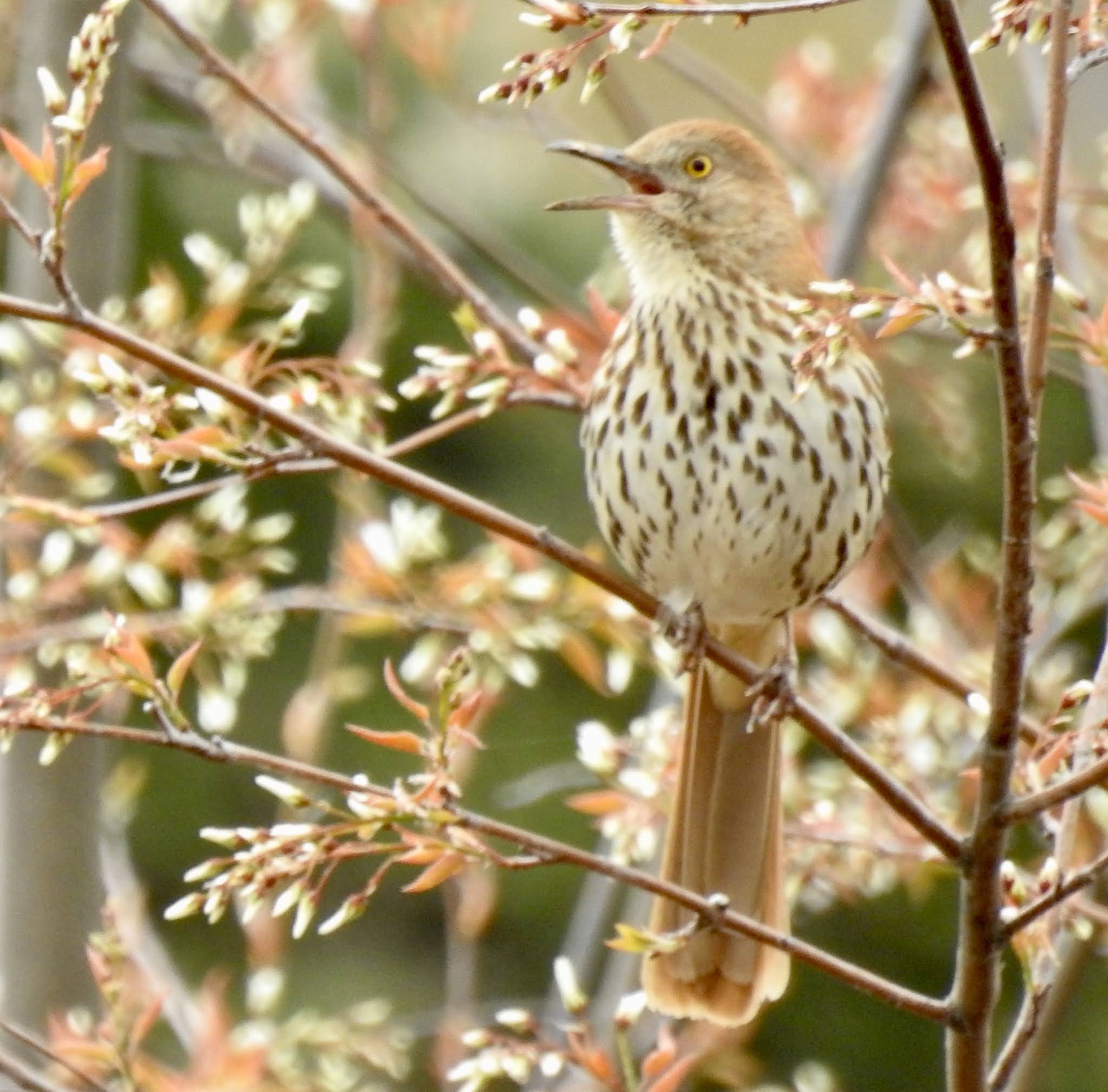
Brown Thrasher Spring Surprise

                                                                            Brown Thrasher

On May 2 we were walking our dogs on a vacant court near our home in Fredericton on a beautiful sunny day.  This has been an early spring and the Amelanchiers were already in bloom.  I became aware of loud, intense bird song on my left over a tangle of blackberry and raspberry canes with a hedgerow of bushes beyond.  I could tell it was a mimic, one of our 3 species which produce long, varied, repetitive bird songs.  I describe them as loud and boisterous.  

The Brown Thrasher, along with the Gray Catbird and the Northern Mockingbird are members of the Mimidae family.  There are 34 species in 11 genera worldwide in that family.  In North America there are 10 species and all live in the southwest except the Brown Thrasher, the Gray Catbird and the Northern Mockingbird.  We have the Gray Catbird as a common summer resident.  The Brown Thrasher and the Northern Mockingbird are listed as rare summer residents.  These three species prefer thickets, hedgerows and grown-over areas.  Brown Thrashers and Northern Mockingbirds like to sing from a high perch and they certainly make their presence known.  The Gray Catbird is boisterous and noisy but it usually hides in thick vegetation.  

Brown Thrashers have a long decurved bill with which to probe for food in leaf litter and holes in the ground.  They feed on insects, seeds and invertebrates.  They have the distinctive orange/yellow eye of the thrasher family.  The Brown Thrasher is a beautiful rufous brown and the long tail is very noteworthy.  It is a large bird, 29 cm (11.5 in) long.

                                          Brown Thrasher Singing from an Amelanchier Bush

Male and female Brown Thrashers are similar in appearance.  The rufous brown colour and the stripes on the breast and flanks are striking.  

The family Mimidae are noted for their boisterous, repetitive songs.  One can actually use the repetitive characteristics of the song to identify the species.  That is helpful in identifying species that like to spend their time in thick vegetation!  As I listened to the song of the bird mentioned in this post I was immediately aware it was a 'mocker' (member of Mimidae).  Here in NB that would make it either a Gray Catbird, a Northern Mockingbird or a Brown Thrasher.  I could tell right away it was not a catbird because I am most familiar with that song.  So the test then, since I could not see the bird at first, was was it a mockingbird or a thrasher.  One can tell, although it is not as easy as described in the literature, by the number of repetitive elements in each repetitive phrase.  These phrases are intermingled with many other warbles and twitters so one has to listen carefully.  I could eventually tell there were usually 2 repetitive elements in the phrases, so that would make the bird a Brown Thrasher.  The Northern Mockingbird usually has 3 repetitive elements in each repetitive phrase.  So the task then was to wade through the blackberry and raspberry canes and to try and see the singing bird.  I eventually found it sitting near the top of the high bushes blended in very well with the blossoms.  What a sight - what a beautiful bird.  It continued to sing.  I stayed well back and just enjoyed the concert.  It allowed the photos seen above.  

Brown Thrashers are amazing songsters.  They have the largest repertoire of songs of all North American songbirds.  They are able to vocalize 3000 distinct songs!  They sing for long periods at a time interspersed with rest periods.  

Brown Thrashers are the state bird of Georgia.  They have inspired the National Hockey League team, the Atlanta Thrashers, to use their name.

For more information on the life history of this species, search this blog for 'Brown Thrasher'.